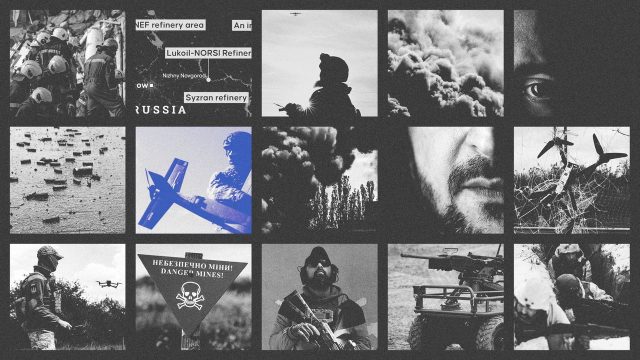
Russian forces last month lost more territory to Ukraine than they were able to capture. The first of such occurrences in nearly two years, this marks an ignominious milestone and potential turning point in Moscow’s years-long invasion effort. At the same time, Russia is losing soldiers faster than it can recruit and deploy them. While the Ukraine front remains an active war zone that has left deep scars on both nations, there is a growing sense among observers that momentum has shifted in Kyiv’s favor.
What did the commentators say?
Russia’s conspicuously “diminished” Victory Day parade this month “signaled its vulnerability,” said The Economist. That sentiment was an “accurate reflection of Russia’s battlefield setbacks,” as well as the country’s “fear of the growing effectiveness of Ukraine’s long-range strikes.”
Russia’s weakened position can be traced to a confluence of three factors, said The Economist, citing research from the Institute for the Study of War: Ukrainian “ground counter-attacks and mid-range strikes,” the end of Russia’s “illicit use of Starlink terminals in Ukraine,” and the Kremlin’s “paranoid throttling of the Telegram messaging app at home.” At the same time, Russia’s “exaggerated territorial ambitions and aggressive territorial demands” have run “completely counter to battlefield reality,” said the Institute.
May marks the fifth consecutive month in which Russia has lost “more soldiers than it can replace,” said National Security Journal. Ahead of an expected fifth summer of violence, Russia’s invasion “continues to falter” as the “fortunes of the war” seem to be “trending less and less in Russia’s favor.” Ukraine’s military technological advances have “not been the only key element” in Kyiv’s “recent battlefield gains.” Rather, they come amid Russia’s “growing command-and-control problems within its own military.”
Communications failures “contributed significantly to Russia’s problems” on the battlefield, said the Atlantic Council. After SpaceX “cut the Russian army’s illicit access to the satellite-based Starlink system” this spring, some Russian commanders were “forced to rely on inaccurate maps” showing “exaggerated gains.” In other cases, clusters of Russian troops were deployed “without adequate communication tools or coordination,” leaving them “highly vulnerable to Ukrainian counterattacks.”
All this comes as the public mood within Russia is “souring,” said Alexander Baunov at the Carnegie Russia Eurasia Center. The Putin government has “unceremoniously violated” the terms of its social trade-off offered to the public — that “you can live outside of the war, but you cannot be against it” — and now “society is angry.” Russian authorities have also banned the use of “popular foreign messaging apps” because they are “non-transparent” and boosted the “homegrown” Max app as an alternative. But the “implication” of Max’s transparency “has not gone unnoticed, and people feel their privacy has been rudely invaded.”
Russians “increasingly chafe” at the “restrictions on their liberties” imposed “in pursuit of a battlefield victory that now appears to be unattainable,” said Noah Rothman at the National Review. Moscow lacks “freedom of action” in the theater of battle and has “lost the ability to dictate the tempo of events,” while its economy contracts “following several years of war-driven growth.”
What next?
The Russian military’s “recent communications problems” are “unlikely to persist in their current form indefinitely,” said the Atlantic Council. Moscow has already explored a “range of alternatives, including relay drones and satellite links.” But it will probably take a “number of years for the Russian military to replicate the same level of efficiency previously provided by Starlink.”
Russia’s flagging battlefield progress is a problem for Putin, who has “insisted that Russia’s victory in the war is inevitable,” said CNN. That promise has “always been flawed,” given how “slow and incredibly costly the Russian advances have been.” Still, the momentum shift of late “feels like an inflection point in the war,” said Sir Lawrence Freedman, an emeritus professor of war studies at King’s College London, to The Economist. “If the Russians have nothing to show for their efforts, I would not be surprised if in some places things start crumbling.”
After years of conflict, Moscow is struggling to maintain troop levels and hold territory