Is Benjamin Netanyahu’s time finally up? Is Israel’s longest-serving prime minister, in power for almost 15 of the past 17 years, heading for a fall at the forthcoming October general election?
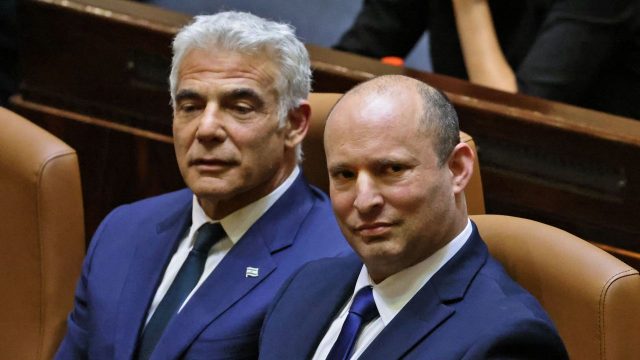
Following the decisive move made by Israel’s opposition parties last week, that is now a real possibility, said Ravit Hecht in Haaretz (Tel Aviv). The hardline right-winger Naftali Bennett and the centrist Yair Lapid have announced they will be merging their two parties to form a single party called Yachad (Together). Prior to their announcement, polls had Bennett’s party projected to win 21 seats and Lapid’s party seven. A total of 28 seats would make Yachad the biggest party in the 120-seat Knesset, ahead of Netanyahu’s Likud, on a projected 25.
‘Era of correction’
This pair have teamed up before, said Philissa Cramer on the Jewish Telegraphic Agency. After the 2021 election that briefly dislodged Netanyahu from office, before he stormed back in late 2022, they struck an unusual power-sharing deal, agreeing to take it in turns to serve as prime minister. And this time they are presenting their combined party as a more permanent antidote to the polarisation in Israeli society that has deepened under Netanyahu. “Our unity is a message to the entire people of Israel,” declared Bennett on announcing the merger. “The era of division is over. The era of correction has arrived.”
Don’t be so sure, said Ori Wertman in The Jerusalem Post. This merger may well backfire. True, the two men have agreed on some significant issues, including the need for an eight-year cap on a PM’s time in office and for a full army draft with sanctions on Haredi (ultra-Orthodox) draft evaders. But the fact remains that Bennett is an Orthodox Jew who has called for the annexation of parts of the West Bank: in teaming up with Lapid, a secular Jew who has previously endorsed the two-state solution, he may well prompt some of his supporters to defect to Likud.
Conversely, Lapid’s shift to the right – he has agreed to rule out the possibility of a coalition with any of Israel’s Arab parties – will alienate much of his moderate base. And indeed, the first post-merger poll projects the new party winning just 26 seats, not the 28 total forecast when the two parties were running separately.
‘Same troubled system’
Still, there is a clear political logic behind the merger, said Aaron T. Walter in The Times of Israel. Lapid’s support has crashed since his party won 24 seats in the last election, while Bennett – who is going to lead the new party – has gained in popularity. The trouble is, Yachad has a “core arithmetic problem”.
Without Arab parties, which it has ruled out as potential coalition partners, its only hope of securing the 61 seats needed for a majority is to lure Gadi Eisenkot, former chief of staff of the Israel Defence Forces, in to join the party. Eisenkot’s military credentials and his moving personal story of having lost a son to the war in Gaza have made him a leading contender of the Right. But for that very reason he’d probably only join if made leader, something Bennett has made plain he won’t countenance.
But what would a Yachad victory actually achieve, asked David Issacharoff in Haaretz. Lapid and Bennett are keen to highlight the corruption charges Netanyahu has managed to fend off by staying in power, and to blame him for the security failures that enabled Hamas’s October 2023 attack. But on the big questions – how to extricate Israel from the conflicts in Gaza and Lebanon; how to prevent settler violence in the West Bank – they’ve nothing new to say.
Yachad’s central weakness, said Hani Hazaimeh in Arab News (Riyadh), is that its focus is simply on removing Netanyahu from office. By refusing to address “the unresolved Palestinian issue” and “the normalisation of military-first policies”, they have missed the chance to redefine Israel’s future in any meaningful way. Even if his rivals do displace him, Netanyahu’s fall would be less a “political revolution” and more a “reshuffling of power within the same troubled system”.
An unlikely alliance has formed in the hopes of crowding out Israel’s longest-serving prime minister