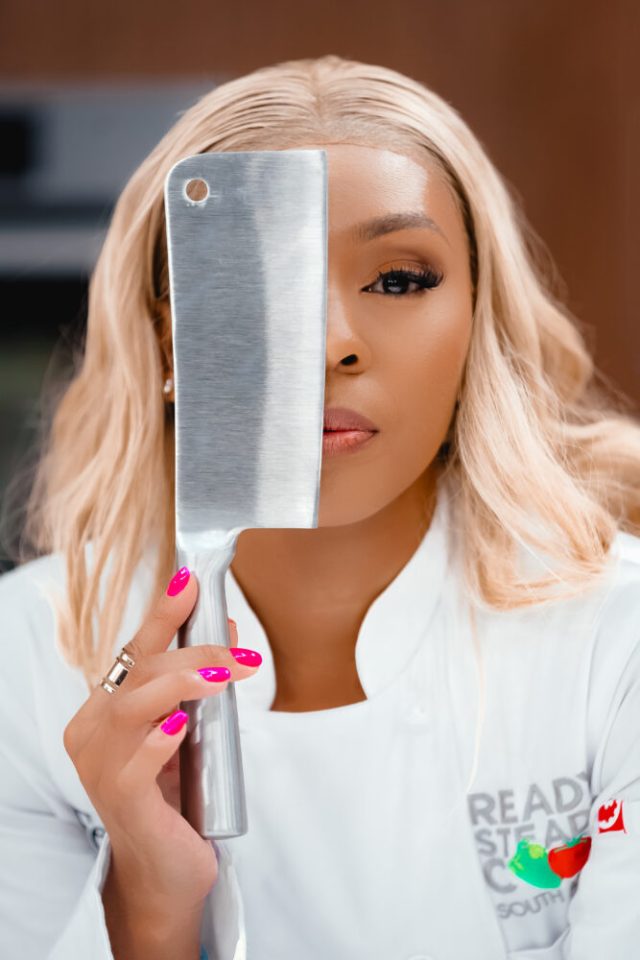
For Mmule Setati, the founder of Feed My Tribe, food has never been just about what sits on a plate. It is a language that moves between memory, emotion, culture and care. What she has built is not simply a culinary platform but a way for people to return to themselves through the act of eating.
At its core, Feed My Tribe is not about recipes. It is about relationships to the body, to memory, to others.
Setati did not begin her career in the kitchen. She studied PR and communications, moving through corporate spaces with the clarity of someone who had mapped out her future in conventional terms.
Food existed alongside this life but never as its centre. It showed up in the margins: in the clients she worked with, in the juice business she later built and scaled. And in the quiet act of cooking for friends.
“I always thought I would be a millionaire by 30. I’m going to be on the Forbes list as an executive. What I would be doing exactly, I had no clue but I knew that’s where I was going to end up. Food was never it,” she says. “But when I look back now, the one thread that has always been there in my life is food. Even when I didn’t choose it, it kept choosing me in different ways.”
Out of that return came Feed My Tribe. Initially it was a simple platform, a place to archive recipes and share meals with friends and followers. It was not built with scale in mind but with intimacy. A way of saying: this is what I’m cooking tonight; this is how you can do it too.
“When I started, it was just my friends asking me for recipes after they’d come over,” Setati says.
“People would say: ‘Please send me that thing you made’ and I thought let me just create a platform where I can put everything. So whenever I cook at night for my family, I post it there. It was never a business at first. It was just passion.”
Then the world changed. Lockdown confined people to their homes and suddenly, food was no longer optional. It became central to survival.
“People have a very strange relationship with food,” Setati says.
“We assume everyone loves cooking but they don’t. A lot of people don’t like it or they don’t know where to start. And during Covid, everyone was forced into the kitchen. You had executives living alone who had never cooked before. You had couples stuck together trying to figure out how to connect again. You had women who had just gotten married and suddenly had to cook every day.”
Her work began to meet that moment.
“They didn’t necessarily not have time,” she explains. “They just didn’t know what to do. And that’s where I came in, to show that it doesn’t have to be complicated. You can make something simple and still make it look and feel beautiful.”
The idea that food can be both simple and intentional sits at the centre of Setati’s storytelling. Through videos, recipes and classes, she breaks down the perceived complexity of cooking, offering meals that feel elevated but remain accessible.
But beneath the accessibility lies a deeper, more layered conversation.
“People’s relationship with food is very deep-rooted,” she says. “It’s emotional, it’s cultural, it’s psychological. The deeper I’ve gone into this work, the more I’ve realised that Feed My Tribe is not just about cooking. It’s about how we see ourselves, how we’ve been conditioned and how we take care of ourselves.”
She speaks candidly about how food is entangled with identity, particularly for women. The expectations placed on women’s bodies, the contradictions of diet culture and the inherited ways of eating all shape how people engage with food.
“There’s too much information,” she says. “We’re told don’t eat carbs, then eat carbs. Don’t eat fat, then eat fat. Eat butter, don’t eat butter. People don’t know what to do anymore. So food becomes this scary thing, instead of something that nourishes you.”
In response, she advocates for a shift in mindset, one that begins with awareness and intention.

“A simple thing I always tell people, even in my cooking classes, is to ground yourself before you eat,” she explains.
“Put your phone down. Take a deep breath. Look at the food in front of you. And then eat according to how you feel. Because everything is psychological. If you’re sitting there saying: ‘Oh my gosh, I’m eating this and it’s going to make me fat,’ your body is going to respond to that. But if you say: ‘Thank you for this meal that is about to nourish me,’ it changes your relationship with it.”
The philosophy extends into her cookbook, Feed My Tribe, published in 2023. Written over two years, the book reflects not only her culinary approach but her understanding of the modern woman.
“I wanted to reinvent what the modern-day woman looks like in the kitchen,” she says. “Not just traditional food because we already know how to cook those meals. I wanted to speak to the woman who is busy, who is working, who doesn’t have time or thinks she doesn’t have time. The woman who is trying to balance everything — family, career, herself.
“It’s the mother who is trying to look after her kids but also look after her body. It’s someone trying to lose weight, go to gym, feel good about themselves. It’s someone trying to recreate the meals their grandmother used to make but in a way that fits their life now. That’s who I wrote the book for.”
The result is a body of work that feels both practical and reflective. Recipes are paired with context, offering not just instructions but entry points into a different way of thinking about food.
Beyond the page, Feed My Tribe has taken on a physical form through cooking classes and curated gatherings. The spaces, often centred on long tables have become sites of connection, where food is the starting point but not the end.
“It’s not just recipes,” Setati says. “It’s about building a community. When people come to these spaces, they’re not just there to eat. They’re there to connect, to feel seen, to share. And I’ve seen how powerful that can be.”
She recalls the impact the gatherings have had on attendees.
“A lot of women have healed through the conversations that happen at these tables,” she says.
“They’ve made friends, they’ve built connections. You get mothers, executives, people from all walks of life in one room and the common denominator is that we’re all just trying to navigate life. And it’s comforting to know you’re not alone.”
The sense of shared experience is what sustains the platform. It is not transactional but relational, a continuous exchange between Setati and her audience. To hold that space, Setati is intentional about how she cares for herself.
“You can’t give of yourself if you’re not giving to yourself,” she says.
“For me, gym is a non-negotiable. Therapy is non-negotiable. Journalling, prayer — those are things that ground me. Because the work that I do is very emotional.
“You’re dealing with people, you’re holding space for them and you need to be okay within yourself to be able to do that.”
Looking ahead, her vision for Feed My Tribe continues to expand. A second book is in development, one that will explore the connection between food, the gut and emotional well-being in greater depth.
“The gut is the biggest teller of our emotions,” she says. “What we eat and how we eat shows up in how we feel. So I want to go deeper into that, into how we can use food to heal ourselves.”
There are also plans for a cooking studio, a physical home for the community she has built as well as further ventures into storytelling through media.
“The ultimate dream is to keep connecting with people,” she says. “Whether it’s through books, through classes, through shows, I just want to keep sharing this love for food and helping people reconnect with it in a way that feels good for them.”
Setati’s work resists rigidity. It does not demand perfection or prescribe strict rules. Instead, it invites a return to the body, to the table, to the small rituals that sustain everyday life.
In a world of conflicting food narratives, Mmule Setati offers clarity through ‘Feed My Tribe’, centering simplicity, intention and emotional connection in every meal