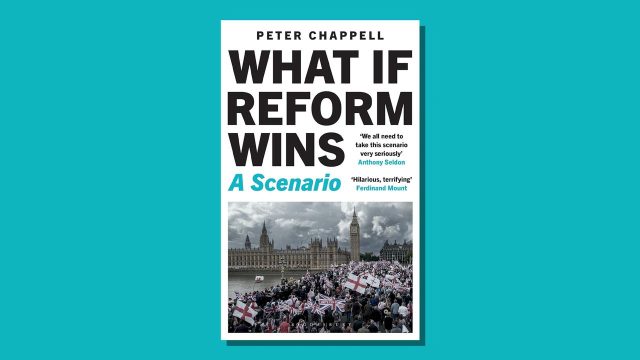
It’s the morning of 29 June 2029. Whitehall is packed and there’s a huge police presence. Outside 10 Downing Street, the outgoing Labour PM gives a short speech; and not long afterwards, to thunderous applause and equally loud boos, his successor, Nigel Farage, takes his place behind the same lectern. “Is this your dream or your nightmare?” asked Lucy Denyer in The Telegraph. Either way, it’s a plausible scenario.
Reform UK currently has the most members of any party, the support of many of Britain’s most generous political donors, and a consistent lead in the polls. In this “by turns entertaining and downright terrifying” book, the journalist Peter Chappell offers a “speculative account” of what might happen if Farage were to come to power.
Chappell doesn’t “mask his dislike of Reform”, and the future he envisages – marked by rioting, parliamentary chaos and a full-blown constitutional crisis – is “definitely a worst-case scenario”. But nor do his predictions seem wholly far-fetched, as they’re based on a careful analysis of “what Farage and Reform have promised should they be elected”.
Chappell’s “semi-fictional Farage” wastes no time in withdrawing from the various human rights and refugee conventions, said Gaby Hinsliff in The Guardian. That clears the path for mass deportations and sending Navy gunboats into the Channel to turn back small boats. He then goes to war with the BBC, falls out with J.D. Vance (who by now has replaced Donald Trump as US president) and comes close to starting a war in the Falklands. “Events unfold at a zippy pace”, and within just two years Farage is desperately clinging onto power. “My only worry is that Chappell may be too optimistic about the speed with which things fall apart.”
There’s much that is convincing in his account, particularly when it comes to how the protagonists behave, said Ethan Croft in The Times. “On his first day in Downing Street, Farage lights up the first cigarette smoked in No. 10 in decades.” Dominic Cummings returns to Downing Street, then “flounces out again”. Robert Jenrick gets demoted when he’s “caught plotting to replace Farage”.
But the book’s lack of partiality is a weakness: in Chappell’s “premonition, there is no scenario in which Reform succeeds on its own terms”, achieving a new political settlement, as in 1945 or 1979. Nor does he “extend his predictive powers” to what happens if Reform fails. “Don’t assume it will be a sudden return to the soothing centrist balms of the established parties. There could be something much worse waiting.”
Journalist Peter Chappell offers a speculative account of what might happen if Nigel Farage becomes PM