One of the world’s biggest and most prestigious art events has opened mired in political controversy, resignations and boycotts over the ongoing wars in Europe and the Middle East.
The 61st edition of the Venice Biennale, it takes place every two years, began on Tuesday “under grey clouds and rain showers”, reflecting an atmosphere dominated by “political tension, parties and protest”, said Lanre Bakare in The Guardian.
What’s the cause?
The festival had been thrown into turmoil even before it formally opened. Last week, the entire five-person biennale jury resigned over the decision to allow Russia to participate – they previously stated they would not give awards to artists from countries whose leaders were facing charges of crimes against humanity by the International Criminal Court (ICC).
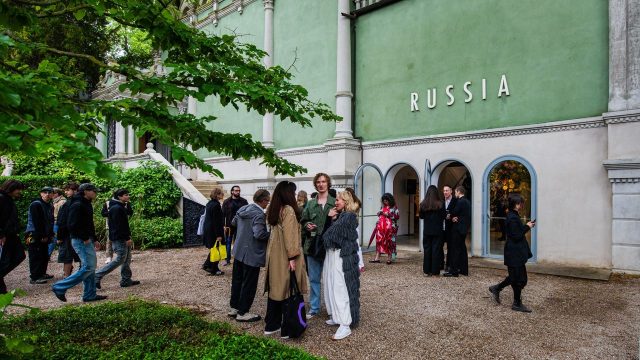
Russia did not show in the past two editions because of the outcry over its war in Ukraine, but was allowed to reopen its pavilion this year in what the New York Times called a “soft-power opportunity” for the Kremlin.
The Biennale argued it is “an open institution” that “rejects any form of exclusion or censorship of art”, but its decision sparked outrage from the Italian government – with Culture Minister Alessandro Giuli boycotting the opening – and the European Commission, which has threatened to terminate or suspend its €2 million (£1.73 million) grant for the exhibition.
Why the change in stance?
In letters seen by the Financial Times, the commission warned Russia’s participation would violate a ban on “providing services” to the Kremlin, as the pavilion is owned by Vladimir Putin’s government.
“By not respecting EU sanctions, Biennale has called into question its obligation to ensure respect of EU values,” the Commission’s agency for culture wrote.
With the threat of further protests and boycotts ahead of the public opening on Saturday, organisers finally bowed to pressure and agreed to close the Russian pavilion to the public.
Tetyana Berezhna, a Ukrainian culture minister, told The Guardian that not opening Russia’s pavilion to the public was a “meaningful step” but that the country’s “symbolic presence” was still powerful.
“Cultural platforms shape global perception,” she said. “They define what is considered acceptable and whose voices are amplified. In this context, every form of representation matters.”
What about Israel?
There have also been protests aimed at Israel’s entry. It shuttered its pavilion in 2024 amid growing condemnation of its occupation of Gaza, with the building guarded by military personnel.
This year it is back, but “if anything, Israel’s presence has proved even more divisive” than Russia’s, said The Telegraph’s chief art critic Alastair Sooke.
Last autumn, an activist collective, Art Not Genocide Alliance (ANGA), organised a letter demanding the exclusion of Israel that was signed by almost 220 artists, curators and “art workers” involved in this year’s show. It has invited people to stand “in solidarity” against what it calls a “genocidal state” perpetrating “Zionist atrocities” in Palestine and plans to protest the participation of Israel this Friday.
Although it did not name specific names, the jury’s decision not to award artists from countries whose leaders are facing charges by the ICC includes Israel’s Benjamin Netanyahu, as well as Vladimir Putin.
The Israeli foreign ministry responded to the statement, saying: “The political jury has transformed the Biennale from an open artistic space of free, boundless ideas into a spectacle of false, anti-Israeli political indoctrination.”
“For some, the jury’s resignation was predictable”, said Sooke, yet “for those on the other side of the debate, excluding any country from the Biennale smacks of censorship”.
“Their decision discriminated against me on a racial basis,” said the Romanian-born Israeli sculptor Belu-Simion Fainaru, who’s representing Israel. “I’m an artist and have equal rights, and I can’t be judged by belonging to a country or a race. I should just be judged on the quality and message of my art.”
Sooke said arguments over whether or not artists should be accountable for the actions of their state or country have highlighted “the creakiness of the Biennale’s national pavilion system”, one that seems outdated and “stymied by geopolitics, given the cosmopolitan nature of contemporary art”.
Protests, resignations and boycotts dominate opening of the ‘Art Olympics’