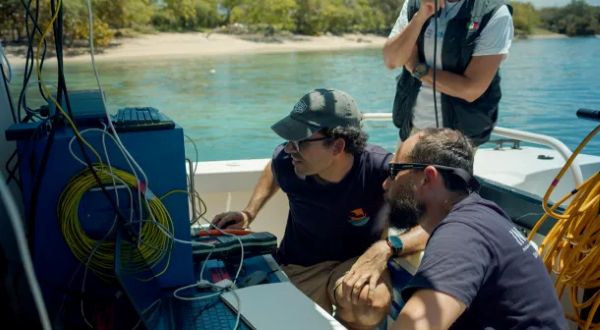
The full title of this article by UNESCO news is “UNESCO and the Dominican Republic protect and research the underwater cultural heritage of the La Isabela Villa Archaeological Site.” The article follows an international scientific mission that has conducted “geophysical surveys and sediment sampling in La Isabela Bay in search of submerged remains dating to the late fifteenth century, including possible shipwrecks associated with the expeditions of Christopher Columbus.”
UNESCO and the Dominican Republic, with the support of the Spanish Agency for International Development Cooperation (AECID) and Spain’s Ministry of Culture, carried out a scientific mission at the Historic and Archaeological Site of Villa La Isabela between 5 and 10 April 2026. The mission’s overall objective is to identify, record, inventory, and produce a diagnostic assessment of the Underwater Cultural Heritage of La Isabela and its bay, with special attention to shipwrecks associated with the expeditions of Christopher Columbus, and to incorporate an evaluation of risks and the effects of climate change.
On that basis, recommendations are proposed and actions are suggested to enhance its value, including legal and technical protection; in situ preservation measures and adaptive management in response to climate-related risks; research and conservation plans that integrate climate monitoring and response protocols for extreme events; and outreach and community participation strategies to strengthen the resilience of the heritage and its surrounding environment.
The mission was carried out by specialists from the Scientific and Technical Advisory Body (STAB) of the 2001 UNESCO Convention, as well as experts from other recognized organizations, building on a first phase implemented in 2024. In this second stage, the specific objectives focused on collecting data and samples through different techniques: geophysical prospecting and seafloor profiling using remote-sensing devices, as well as sediment cores for reconstruction.
The initiative is being implemented within the framework of the Dominican Republic’s commitment to the 2001 UNESCO Convention on the Protection of the Underwater Cultural Heritage, ratified in June 2021, which promotes the protection and preservation of underwater cultural heritage as a source of archaeological knowledge. At the national level, the mission was supported by the Ministry of Culture of the Dominican Republic and the National Authority for Maritime Affairs (ANAMAR). [. . .]
The mission was led by Helena Barba-Meinecke, an underwater archaeologist at Mexico’s National Institute of Anthropology and History (INAH). [. . .]
In addition, the second phase of the mission included the collection of sediment cores along the coastline and in the area linked to the hypothesis of the historical shipyard, with a view to radiocarbon dating and the reconstruction of the paleolandscape.
“If we want to know where the ships might be, we first have to reconstruct where the coastline was. Over time, rivers have deposited sediments that may have buried those remains; that is why they will not necessarily be visible on the surface of the seabed,” explained Dr. Isabel Rivera-Collazo, Director of the Scripps Center for Marine Archaeology at the Scripps Institution of Oceanography, University of California, San Diego (UCSD), an institution that is a member of the UNESCO UNITWIN Network.
Community engagement occupies a central place in the mission’s methodology. Fishers and local informants took part in the fieldwork, helping to identify points of interest and strengthening the sense of belonging to the heritage. [. . .]
“La Isabela has shaped my life since I was a child. Coming back now as an archaeologist and seeing the community involved and rebuilding trust reaffirms for me that protecting this site is not only about investigating the past: it is about safeguarding identity and memory for the next generations,” said Diana Peña Bastalla, a Dominican archaeologist and UCSD doctoral candidate. [. . .]
La Isabela is a site of exceptional heritage value. It preserves the remains of the first foundational European settlement in the Americas, established by Christopher Columbus in January 1493 during his second voyage. The bay was the setting for the first European naval operations on the continent, and shipwrecks from that period have been documented, making its seabed an invaluable historical archive. In its nomination to the World Heritage Tentative List, the ruins of key structures are highlighted, such as the church, the house of Christopher Columbus, the tower, the royal storehouse, and the treasury, as well as areas associated with the pier and the shipyard, now buried, and a quarry linked to the construction of the settlement.
For full article, see https://www.unesco.org/en/articles/unesco-and-dominican-republic-protect-and-research-underwater-cultural-heritage-la-isabela-villa
[Photo above by UNESCO/ R. Macía.]
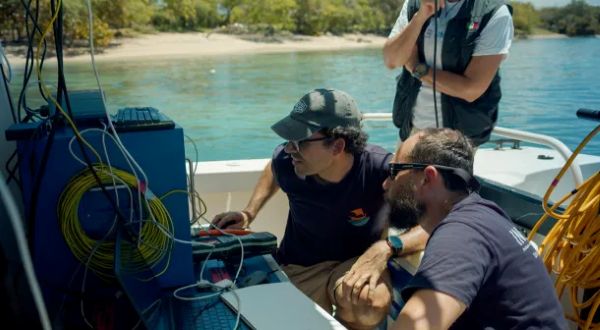
The full title of this article by UNESCO news is “UNESCO and the Dominican Republic protect and research the underwater cultural heritage of the La Isabela Villa Archaeological Site.” The article follows an international scientific mission that has conducted “geophysical surveys and sediment sampling in La Isabela Bay in search of submerged remains dating to