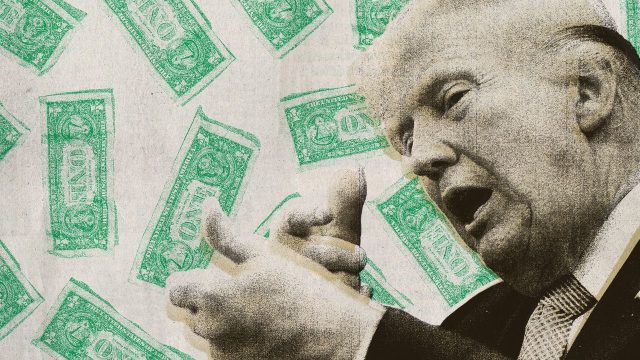
For weeks, the Trump administration has waged a brutal war on Iran. But now that Iran has successfully shifted the conflict’s nexus to the oil-shipping bottleneck in the Strait of Hormuz, the White House has a new plan to inflict maximum pressure: economic warfare, the “financial equivalent” of a bombing campaign, said Treasury Secretary Scott Bessent during a White House briefing last week.
What did the commentators say?
Blocking Iranian ports and shipping lanes and pivoting from “kinetic to economic warfare” is an attempt to “end the conflict without a new U.S.-Israeli onslaught,” said CNN. Per the White House’s “rationale,” the “ruinous financial and humanitarian consequences” of being unable to ship and sell oil leave Tehran with “no choice but to accept U.S. terms” to end the conflict.
Although focused on Iran specifically, the administration’s threats stretch beyond the Islamic Republic to those who would do business with it. Countries that are “buying Iranian oil” or hold Iranian funds in their banks now risk “secondary sanctions, which is a very stern measure,” Bessent said on PBS News. Iranians themselves will feel the “financial equivalent of what we saw in the kinetic activities.”
Bessent’s threat came one day after his Treasury Department notified “financial institutions in China, Hong Kong, the UAE and Oman” that they are at risk of secondary sanctions for “allowing Iranian illicit activities to flow through their financial institutions,” said The Associated Press. The “argument being made to Trump” is that no matter if the Iranians think they can “weather the storm,” any inability to pay their “loyalists” could “pressure Iran to the table.”
Approximately one-third of the oil Iran exports through the Strait of Hormuz “directly funds the Islamic Revolutionary Guard Corps,” said The Foundation for Defense of Democracies Senior Fellow Miad Maleki on Fox News. Bessent’s threats will “shut down a lifeline that the regime desperately needs right now to keep its economy on some life support.”
Trump himself has been a “heavy user of financial sanctions” targeting “countries, individuals and companies,” The Washington Post said. At the same time, his administration seems to have been “caught unawares” when rivals like China and Iran “weaponized their economic advantages.”
While sanctions have long been the “instrument of choice for applying pressure on Iran,” the White House’s pivot toward “more kinetic forms of economic coercion” blurs the line between “financial restriction and military intervention,” said Harsh Pant, an international relations professor with King’s India Institute at King’s College London, at The Economic Times. “By physically interdicting maritime traffic” with its naval blockade, Trump is showing a willingness to enforce America’s “economic objectives through direct control of global commons.”
What next?
In many ways, the “damage” caused by economic weapons is already “sparking a response,” with nations that depend on the Strait of Hormuz “making plans to reduce their vulnerability to a future closure,” the Post said. But critics warn that attempts to impose other financial consequences on Iran could ultimately backfire on the United States and its allies. Much of the previous phase of war has “helped Iran’s economy,” said Sen. Elizabeth Warren (D-Mass.), per the AP. Imposing further economic conditions is simply an attempt by Bessent to “mop up the mess that Donald Trump has created by initiating this war.”
The administration could still be making a “sound bet,” said CNN. Iran’s economy has been “shattered by sanctions” and could “quickly suffer critical food shortages, hyperinflation and a banking crisis” that would push Tehran to settle with the Trump administration. But this hope shared by “U.S. officials, conservative editorial pages and analysts” may ultimately “rest on an assumption” that has “led the U.S. astray in the Middle East” many times in the past.
The Trump administration considers adding monetary munitions to its martial tool chest