The full title of this article by Kenneth Mohammed (The Guardian) is “Cuba’s doctors were a lifeline for the world. Now the Caribbean is shamefully complicit in the US drive to expel them.” Mohammed writes, “For decades, Cuban doctors have served the Caribbean’s most marginalised. Now, as Cuba faces its own crisis, the region looks away, waiting on Trump’s approval.” Here are excerpts; read this thorough and incisive article at The Guardian. [Many thanks to Peter Jordens for bringing this item to our attention.]
There is a line, often quoted, seldom practised, from the Christian gospels: “Love thy neighbour as thyself.” It is recited from the Americas to Africa, invoked in speeches, embroidered into national mottoes.
But like many moral injunctions, it has proven easier to proclaim than to live by. Across the Caribbean and Latin America, something extraordinary and shameful is unfolding.
Cuban doctors, emissaries of one of the world’s most besieged nations, are being expelled from host nations, contracts terminated, health programmes dismantled. And, in their absence, the poorest will pay – in untreated illnesses, unattended births, undiagnosed cancers. The region is, in effect, amputating its own lifeline – under pressure from the US.
On Friday the Cuban foreign minister Bruno Rodríguez accused the US of “extorting” countries by forcing them to cancel decades-old deals with Havana for the supply of doctors.
The tone was set in Donald Trump’s first term. In 2018, 8,300 Cuban doctors left Brazil after the country’s then president-elect, Jair Bolsonaro, closely aligned with Washington, threatened the programme and its payment structure, questioning the qualifications of the Cubans – issues that had never been raised when their services were indispensable.
Since then, the US has pushed countries across the region to terminate these agreements, branding them “forced labour” and even “human trafficking” because the Cuban state retains a share of salaries. Conveniently ignoring that these doctors were trained free of charge by the Cuban government, unlike their heavily indebted counterparts in countries such as the UK where medical graduates have the onerous burden of student debt for decades.
The consequences have been enormous. Guatemala, Honduras, Jamaica, the Bahamas, Antigua and Barbuda, Guyana and St Vincent and the Grenadines have all capitulated. Across the Caribbean and Latin America, programmes, some as old as 50 years, are being dismantled, doctors withdrawn and already fragile systems strained, all under the threat of US visa and diplomatic sanctions. Only St Kitts and Nevis and Trinidad and Tobago have yet to follow. Millions could lose basic healthcare, with Indigenous communities particularly exposed.
Cuba is the island that chose “doctors, not bombs”. For more than six decades, Cuba has practised something profoundly unfashionable in modern geopolitics: solidarity. When Ebola tore through west Africa in 2014, Cuban medical brigades arrived first. When hurricanes flattened Caribbean states, Cuban teams showed up. When Haiti collapsed, again, under the weight of history, debt and disaster, Cuban doctors were there. When Nepal was devastated in 2015, Cuba dispatched a medical brigade within days.
Cuba has built a global medical network of more than 50,000 professionals working across dozens of countries, generating billions in foreign revenue and sustaining its economy under embargo. In places such as Venezuela, where tens of thousands of Cubans once staffed community health programmes, these missions became central to public health. But that model is now under strain. As US pressure intensifies – disrupting oil, tightening sanctions and targeting allied governments – Cuban medical personnel are being withdrawn, cutting off one of the island’s few reliable sources of income while weakening healthcare systems abroad.
Cuba has also trained tens of thousands of foreign students, including from the Caribbean, at its Latin American School of Medicine. All free of charge. Yet this same island, 90 miles from Florida, under embargo since 1962, is being economically strangled into submission.
What is being brought down on Cuba is not “pressure”. It is economic warfare and the Caribbean and Latin America are complicit. [. . .]
For full article, see https://www.theguardian.com/global-development/2026/apr/11/cuba-doctors-lifeline-world-caribbean-complicit-us-expel
Also see previous posts https://repeatingislands.com/2026/03/21/cubas-medical-diplomacy-begins-to-unravel-as-jamaica-and-guyana-end-doctor-agreements and https://repeatingislands.com/2026/03/21/concerns-grow-as-jamaica-ends-cuban-medical-programme
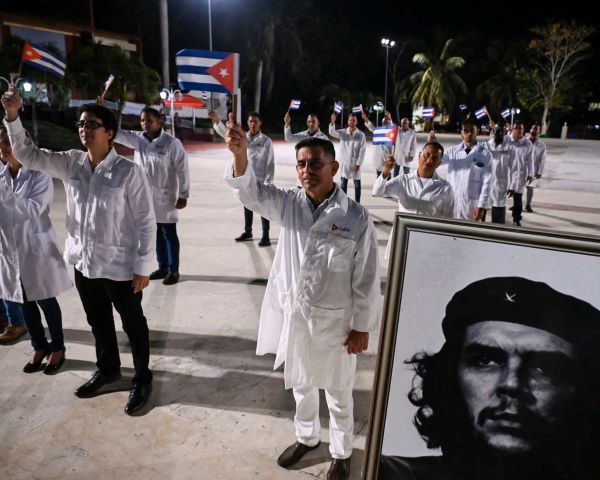
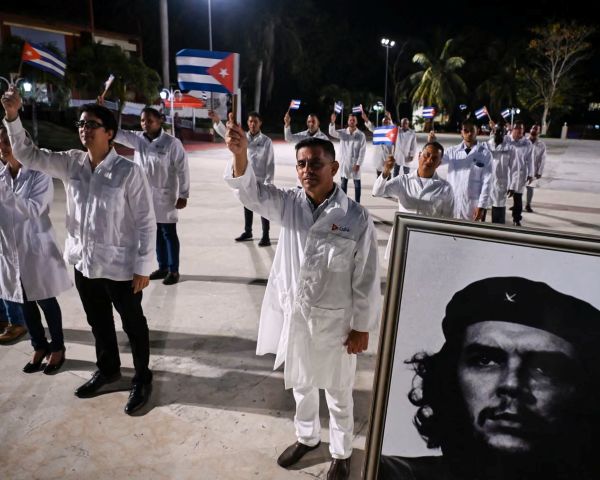
[Photograph above by Yamil Lage/AFP/Getty Images: Cuban doctors and nurses bid farewell in Havana as they leave for Turkey to treat victims of the 2023 earthquake.]
The full title of this article by Kenneth Mohammed (The Guardian) is “Cuba’s doctors were a lifeline for the world. Now the Caribbean is shamefully complicit in the US drive to expel them.” Mohammed writes, “For decades, Cuban doctors have served the Caribbean’s most marginalised. Now, as Cuba faces its own crisis, the region looks away, waiting