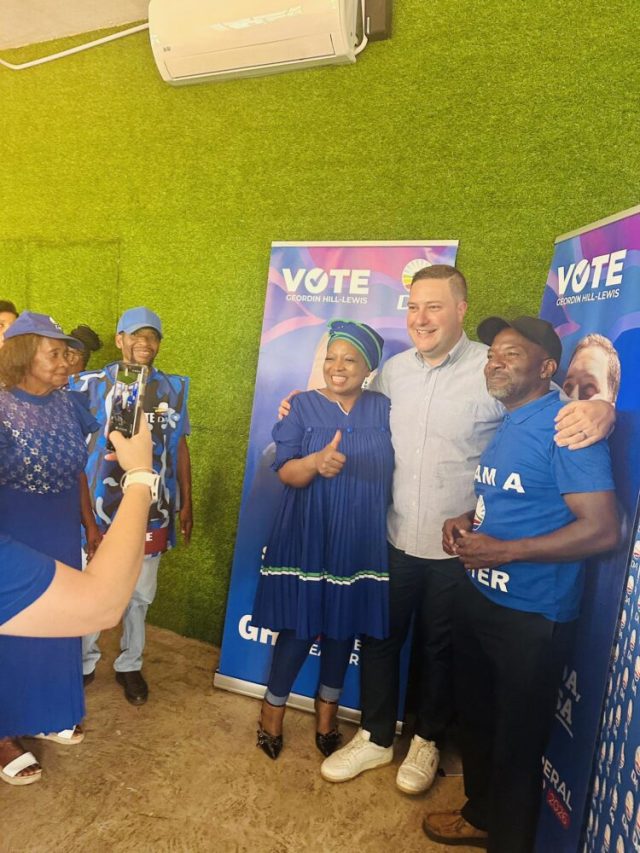
Democratic Alliance (DA) federal leader hopeful Sbusiso Dyanase is set to disrupt what was expected to be a smooth path to victory for, reframing the DA leadership race as a test of internal democracy.
This is despite the consolidation of support around his opponent ahead of the party’s federal congress this weekend.
Dyanase, a caucus leader in Sedibeng, spoke to the Mail & Guardian this week as delegates prepare to elect a new leader at this weekend’s gathering.
“I’m confident about this because I believe in the democratic processes of the DA,” he said. “I have been receiving strong support from people all over South Africa. I’ve received calls from KwaZulu-Natal, Limpopo and the Northern Cape – people I don’t even know personally but they believe in me.”

His entry into the race followed reports that Hill-Lewis would run without opposition. “I’m not here on an ‘if I die, I die’ basis. I’m here because I believe contestation strengthens the party and gives delegates a real choice,” said Dyanase.
Party insiders described his decision to enter the race as unexpected, given the level of support already consolidated behind Hill-Lewis. “It’s a brave move,” one senior party figure said. “But realistically, this is a race that was settled before it began.”
Another party source said Dyanase’s entry had sparked internal discussion about timing and political positioning.
“Some people feel he should have built his name more before going for the top job,” the source said. “You don’t jump straight into a leadership contest at this level without a national base.”
The late entry has not shifted the balance of support within the party.
Hill-Lewis goes into the congress as the only candidate with backing from provincial structures and senior leadership, following a nomination process that aligned behind him early and did not produce a rival campaign of comparable scale.
At his campaign launch, Hill-Lewis set out his pitch in detail, focusing on party growth, electoral strategy and the separation between party leadership and executive office.
“We must build a party that can win nationally, that can govern effectively and that can bring real change to the lives of South Africans. Our mission is to grow the DA so that we can rescue South Africa and deliver a government that works for all.”
At the same launch, he placed emphasis on the party’s role in the government of national unity (GNU) and how that would intersect with his leadership.
“The DA will remain in the government of national unity because South Africa needs stability and reform but that does not mean the leader of the party must serve in Cabinet.
“I will not be going to the Union Buildings. The responsibility of the federal leader is to build the party into a national majority, not to take up an executive post.”
He said the arrangement required a separation between party leadership and government participation. “We can participate in government where it advances reforms but we must also grow independently so that we can win power in our own right.
“The task ahead is to grow the DA so that we are not permanently in coalitions but in a position to lead a government ourselves.”
Dyanase has been a member of the DA for more than 15 years. He began his political career at 19, leading his branch in 2011 and has since held positions across local and provincial structures.
In 2021, he became a public representative and was elected deputy chairperson of the caucus in the Sedibeng district municipality. He became caucus leader in 2023 and has served in both regional and provincial executive structures in Gauteng. He currently sits on the regional executive and is also a member of the provincial executive in Gauteng.
He said he had spoken with Hill-Lewis earlier this week in Cape Town ahead of the congress. “He came to me and said he respects that I am upholding the democratic processes of the party.
“He assured me that this is a democratic party and that contestation is necessary. So we had a good, healthy and productive conversation and we even exchanged numbers.”
Dyanase said he would remain active in the party, regardless of the outcome. “Whatever the outcome of the congress on Sunday, it will determine the leadership that will take us forward in pursuing the vision, values and principles of the DA.”
Hill-Lewis is expected to be elected leader at the weekend congress after John Steenhuisen announced in February that he would not seek re-election after leading the party since 2019.
Steenhuisen’s decision followed internal discussions within party structures. While senior leaders publicly described the move as voluntary, internal accounts indicated he was under pressure not to campaign for another term.
Following that announcement, nomination processes at branch and provincial level consolidated around Hill-Lewis, with party sources describing a process in which support aligned early and alternative candidacies did not emerge.
Federal council chair Helen Zille publicly backed him as the best person for the job, the M&G previously reported. Her endorsement was followed by the absence of additional senior contenders entering the race.
Gauteng leader Solly Msimanga, who had been identified internally as a potential leadership contender, was later discouraged from entering the race, sources told the M&G. Party sources said his decision followed internal engagements during the nomination process. “There were discussions and it became clear where the support was going,” one source said, adding that “he was encouraged to consider other positions rather than contest the leadership.”
Msimanga subsequently entered the race for federal chairperson, shifting the competition into that position.
Hill-Lewis has served as Cape Town mayor since 2021 and previously held roles in parliament and within the party’s national structures. Lewis said under his leadership, the DA would deliver on all promises made.
“We are building a party that is ready to govern South Africa, not just to oppose. That requires growth, discipline and a clear vision that South Africans can trust. The DA must be able to demonstrate where it governs that it can deliver, while also preparing to take that record to the national stage.”
He reiterated his position on leadership and executive roles. “The leader of the Democratic Alliance must focus on growing the party, building support and preparing for national government, not on holding a position in Cabinet.”
Hill-Lewis indicated in internal communication that if elected leader, he intends to remain mayor of Cape Town. “I will continue to serve the people of Cape Town while leading the party nationally,” he said.
This would leave the parliamentary leader position vacant, sparking interest among senior members of parliament. Party insiders said that the contest has drawn attention from senior leaders within the caucus.
“That’s another race to watch,” one source said. “There are senior MPs positioning themselves for that role because it becomes important if the leader is not in parliament.”
While the leadership race itself has not developed into a competitive contest, attention within the party has shifted to deputy federal chairperson positions, where internal competition has been concentrated.
Internal processes recorded at least 13 candidates for one deputy federal chairperson position and seven for another. Party insiders described these contests as among the most competitive at the congress.
“These deputy positions are where the real contest is,” one party source said. “Different groupings within the party are backing different candidates and that is where you are seeing real lobbying.”
Another party insider said the outcome of these races would shape the balance of power within the party’s federal executive.
“Whoever comes in as deputies will matter for how the leadership team functions and how decisions are taken going forward. These are not ceremonial roles. They influence how the party is run on a day-to-day basis.”
These contests come amid internal shifts, including developments affecting leaders such as Karabo Khakhau. Her removal from her role forms part of broader changes within party structures ahead of the congress.
Internal discussions have also included positions held by DA members in government, particularly those serving as ministers and deputy ministers within the GNU.
“There is competition not just in the party but also around who stays in government roles,” another party source said.
In previous DA congresses, candidates who challenged eventual leaders have often left the party or moved into less prominent roles. This includes leaders such as Mbali Ntuli and Mpho Phalatse, who both contested Steenhuisen, as well as Khume Ramulifho, who challenged Msimanga in Gauteng.
Asked whether this trend concerned him, Dyanase said he was not worried about being sidelined. “My main aim for the DA is that, even if I don’t win, we remain a united party that can lead South Africa into the upcoming local government elections. I believe those who left the party did so of their own accord, and for me that’s not a decision I will be making anytime soon.”
Delegates at the federal congress will elect the party leader, federal chairperson, deputy federal chairpersons and other members of the federal executive and council.
Hill-Lewis remains the overwhelming favourite to replace John Steenhuisen as DA federal leader but Dyanase’s candidacy has turned the race into a debate over internal democracy