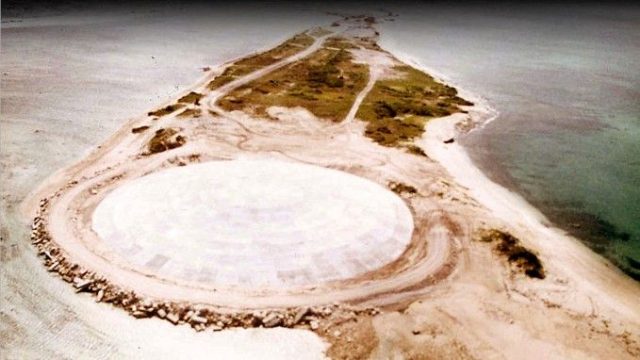
The concrete cap of a tomb encasing radioactive fallout now has cracks, and what’s beneath can rise from the dead. The U.S. military, in 1958, conducted a nuclear test on Runit Island in the Marshall Islands with an 18-kiloton bomb called Cactus. The resulting blast left behind an almost 33-foot deep crater, which later became a dumping ground for the debris from a myriad of nuclear tests between the 1940s and 50s. In 1977, the Runit Dome was created to contain that radioactive waste. The dome’s deterioration could contaminate the ocean and displace hundreds of people.
Nuclear consequences
The Runit Dome contains more than 120,000 tons of contaminated material from nuclear testing, including lethal quantities of plutonium. The isotope plutonium-239 is a “radioactive element used in nuclear weapons that remains dangerous for more than 24,000 years,” said the Australian Broadcasting Corporation (ABC).
Merely coming into contact with the radioactive element can kill you. Concrete, unfortunately, does not endure that long. “There are already cracks in it in less than 50 years,” Arjun Makhijani, a nuclear engineer and president of the Institute for Energy and Environmental Research, said to the ABC.
Since the concrete tomb was built, “groundwater has penetrated the otherwise-unlined crater, beneath which there lies a bed of porous coral sediment,” said Science Alert. The leaked water in the dome is “soaking the radioactive waste with the daily rise and fall of the tide,” said ZME Science. The tomb’s outer shell also contains cracks, “allowing contaminated waste to wash into the surrounding lagoon,” said the ABC. Runit Dome is approximately 20 miles from a human population that regularly uses the lagoon. Continued radioactive waste would lead to its displacement.
While these are the current problems, there are also “concerns that layers of the dome intended to sit above sea level are not going to stay above water much longer,” said Science Alert. “Sea levels are rising and there’s indications that storms are intensifying,” Ivana Nikolic Hughes, a senior lecturer in chemistry at Columbia University and president of the Nuclear Age Peace Foundation, said to the ABC. “We worry the integrity of the dome could be in jeopardy.” Higher water levels could bring radioactive contaminants further into the Pacific Ocean.
Radioactive risks
Despite experts’ concerns about the Runit Dome, the U.S. Department of Energy has claimed that the “dome was not in imminent danger of collapse,” and the “cracks were consistent with aging concrete and that the lagoon already contained large amounts of radioactive material from past tests,” said the ABC. The U.S. conducted 67 nuclear tests across the Marshall Islands between 1946 and 1958, some of which were bigger than Hiroshima and Nagasaki. Over 300 Marshallese people were removed from the area in 1946 before the U.S. began nuclear testing.
The ocean has been “steadily encroaching on the dome over the years,” and “residents fear nuclear contamination if the site were to collapse,” said The Cool Down. The problem is expected to worsen over time without climate change mitigation. “Legacies of nuclear testing and military land requisitions by a foreign power have displaced hundreds of Marshallese for generations,” Paula Gaviria Betancur, the UN Special Rapporteur, said in 2024, and the “adverse effects of climate change threaten to displace thousands more.”
The nuclear waste problem may explode once again