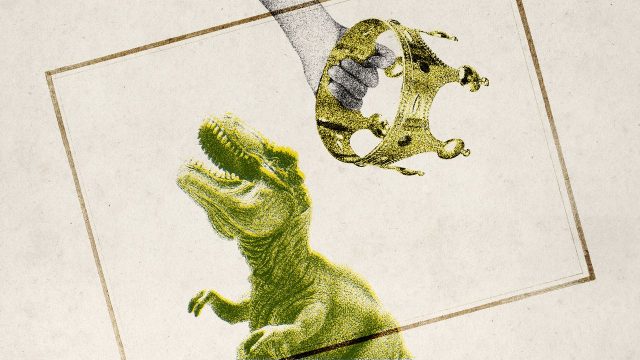
“When you come for the king, you best not miss,” said New Scientist – “particularly if the king in question” is Tyrannosaurus rex, a nine-tonne dinosaur with “the biggest teeth of any known land predator in history”.
Researchers have found that far from being a “one-species monopoly” under T. rex, the dinosaur “landscape” may have “hosted a tiered guild of hunters”, said Scientific American, including one of the most hotly contested dinosaur species: the Nanotyrannus.
‘Tyrant lizard king’
Tyrannosaurus rex has quite a fan base. It was the “tyrant lizard king” and it has “developed tremendous loyalty,” said Greg Paul, a dinosaur researcher. “There’s even a rock band named for the animal.”
For decades, palaeontologists have argued whether the single skull used to define the Nanotyrannus represented a true species in its own right or whether it was merely a young T. rex.
Now, a study in the journal Science argues that this thorny question has finally been resolved: Nanotyrannus was nearly fully grown and not a juvenile T. rex.
The researchers, who set out to “cut T. rex down to size”, investigated the microscopic details of a bone and compared it with those of modern birds, crocodilians and other dinosaurs. They concluded that Nanotyrannus was a mature and distinct predator.
Complete rethink
But Team Tyrannosaurus “aren’t yet ready to rewrite the family tree of T. rex and its kin”, said Scientific American. They insist that “skeletal maturity alone doesn’t define a species”. There is a need for “more small T. rex fossils” to be studied and, without those, “distinguishing growth from evolution remains difficult”. And “if every small skeleton is Nanotyrannus, where are the juvenile T. rexes?” said Stephen Brusatte, an evolutionary biologist at the University of Edinburgh.
Now that the researchers behind the new study have “corrected the record on Nanotyrannus”, said co-author James G. Napoli, a palaeontologist at Stony Brook University in New York, they think it’s “possible that other smaller tyrannosaur fossils are misidentified”, so there may be “many more species awaiting recognition”.
It is not often that “opinions on a high-profile dinosaur change so rapidly and so dramatically”, said New Scientist. This latest shift has “profound implications” because it means we “may need to completely rethink the way that dinosaur ecosystems were organised” and “how and why the dinosaur-dominated world came crashing down”.
And, “most exciting of all”, the reassessment of T. rex itself is “only just getting started”. This research “raises new questions”, such as how did the various tyrannosaurs “carve up the ancient landscape between themselves?”
New findings about the Nanotyrannus have upended what we thought we knew about dinosaur hierarchy