[Many thanks to Peter Jordens for bringing this item to our attention.] In National Geographic Traveller (UK), Sarah Gillespie writes “Fifty years since Tobago — together with its island neighbour, Trinidad — became a republic, it’s embraced independence while grappling with the complexities of its past. Festivals honour local heritage while looking to the future and communities celebrate their roots against a backdrop of steel drums.” This travel article offers an in-depth view of the rich and diverse social and natural environment of Tobago, with attention to its flora, fauna, cuisine, cultural highlights, and the complex historical developments behind it all. Here are excerpts; visit National Geographic for the full article, illustrated with an outstanding series of photographs by Irjaliina Paavonpera.
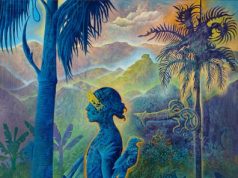
The grave of Jane Lovell, one of the last former enslaved people of Tobago, is marked with a bronze carving of the Sankofa: a mythical bird of West Africa. Its body faces forward, but its head looks back. “The Sankofa symbolises the belief that in order to move forward you must first return to the past,” says my guide, Phill Williams, as we stand before Jane’s final resting place at St Patrick’s Anglican Church. Phill’s voice, like that of many of the locals, has a lilt that sings the Caribbean island’s stories as much as saying them.
Along with other enslaved people, Jane Lovell carried bricks from British ships two miles into the island’s centre to build this church, explains Phill. When they achieved full emancipation in 1838, she would have been just 18 years old. She lived out her days on Tobago and died at the age of 103. As we take a moment to remember her life, the ochre-coloured building casts a shadow that stops just short of her grave.
Since independence, Tobagonians have built an identity that looks in two directions, like the Sankofa; one that reconciles their West African origins and the scars of colonialism with their post-independence history and a future yet unwritten. Exactly how they’ve done this is what I’m here to find out. The visit to St Patrick’s Church is a harrowing reminder of what they’ve had to overcome. [. . .]
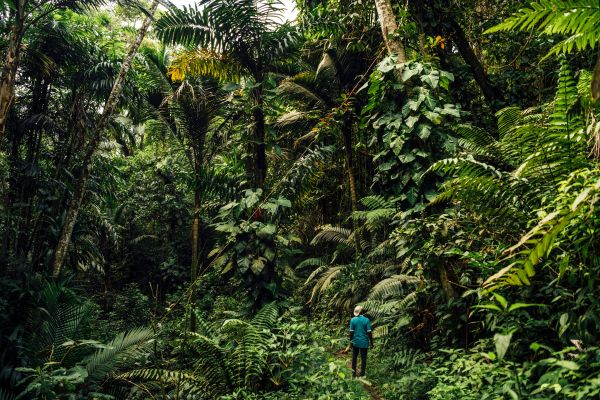
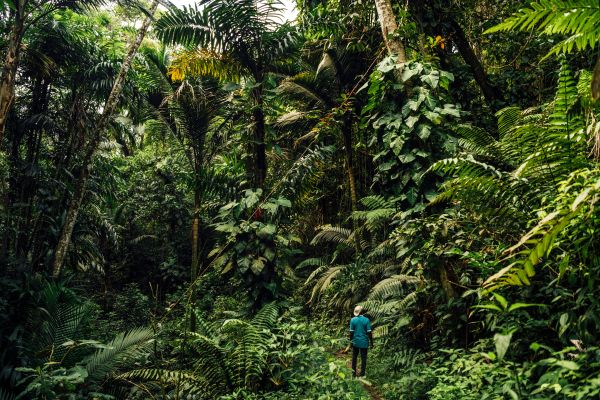
We drive up to Mount Irvine Bay, from where Jane Lovell carried the church bricks almost two centuries ago, and along Tobago’s north coast. Today, resorts and restaurants line the golden crescent of sand, behind which the ocean turns from cerulean to indigo. People are hanging out — ‘liming’, as the locals say — with Carib beers. But development on Tobago has been gentle over the past few decades. Around half of the island makes up the North-East Tobago Unesco Biosphere Reserve; even further south, where we are now, the landscape is covered in trees, some of which stretch their long limbs out to create a green canopy over the road. These include the mango, the cacao and the taro, but also the kapok — sacred to the West African Yoruba people, from whom many Tobagonians are descended. “It’s believed the spirits of our ancestors, both good and bad, are released from the tree in the evening,” says Phill, adjusting his glasses and flashing me a smile as he drives.
At this time of year, the trees are lush and full. It’s the rainy season, but also when the island’s biggest annual party — the month-long Tobago Heritage Festival — takes place. My plan is to explore the island and check out festival events that delve into the island’s history, folklore and legends. I already feel I can sense the trees whispering the island’s stories. [. . .]
The parade culminates with a demonstration of a barefoot ‘coco dance’ around a heap of cacao, symbolising Tobago’s affection for a crop that overtook sugar between 1880 and 1980 to become the island’s biggest export. It’s a colonial-era ritual that originated as a way for island labourers to dry and polish the beans, making them more attractive for sale. I watch the dancers, mesmerised by the twisting feet, the pulse of drums, the shine of the beans and the vanilla notes of cacao that swell to fill the shimmering air.
Moving forward
Once, chocolate production made colonial landowners fantastically rich. In today’s Tobago the profits are shared by small local businesses. On the western side of the island, a 30-mile drive from Charlotteville in the palm-ringed northern-coast village of Plymouth, I find local cult favourite, Tonči Chocolates & Coffee, owned and run by Carlina Jules-Taylor and her husband Randy. Carlina greets me on the porch of her home — surrounded by fragrant cinnamon trees and oregano bushes — dressed in a magenta kaftan and a headscarf that runs the gamut of jewel tones. She and Randy offer visitors a chocolate- and coffee-making experience, as well as tastings of their popular ‘coco tea’ blend.
Coco tea — a combination of cacao, spices and milk — is drunk across the Caribbean, but each family has its own version. [. . .]
For full article, see https://www.nationalgeographic.com/travel/article/how-tobagos-festival-season-celebrates-its-futureand-its-past
[Photo above by Irjaliina Paavonpera for National Geographic (posted here with permission from the photographer) “For the Tobago Heritage Festival, locals set up dance and percussion bands across the island.”]
[Many thanks to Peter Jordens for bringing this item to our attention.] In National Geographic Traveller (UK), Sarah Gillespie writes “Fifty years since Tobago — together with its island neighbour, Trinidad — became a republic, it’s embraced independence while grappling with the complexities of its past. Festivals honour local heritage while looking to the future