One of the most powerful and feared organisations in Iran, the Islamic Revolutionary Guard Corps plays central roles in the country’s internal security, economy and foreign policy; it runs Iran’s ballistic missile programme; and directs support to its network of allies.
The IRGC was founded soon after the Iranian Revolution of 1979, as Islamists, nationalists and Leftists competed to set the course of the new republic. Initially, it was a street militia, designed to protect Ayatollah Ruhollah Khomeini’s leadership from the army and the police, which he did not trust. After a referendum, Iran became a constitutional republic, with universal suffrage, a president and a parliament, but one wrapped in a theocracy; ultimate authority rests with the supreme leader. The IRGC began to operate as a sort of parallel state, bypassing the government and answering directly to the leader.
How did it evolve?
The Iran-Iraq War (1980-1988) transformed the IRGC into a conventional fighting force, with a structure similar to that of a Western military. Its soldiers fought alongside the regular army, the Artesh, supported by units from the Basij, the youth volunteer militia set up by the IRGC in 1980. The Guard and the Basij became known for their “human wave” attacks, in which waves of religiously inspired Iranian teenagers overran better-equipped Iraqi positions, incurring massive casualties (in some units, more than 40% of troops were “martyred”).
By the end of the war, the IRGC had built up great engineering and construction capabilities, for military logistics. To prevent a postwar collapse and to keep the IRGC funded, the government tasked it with rebuilding the nation. The result was Khatam-al Anbiya (“Seal of the Prophets”), today one of Iran’s largest construction and industrial contractors.
How is the IRGC structured?
There are five main branches. It has about 200,000 troops in the three wings of its military service: ground forces, navy – which has a special responsibility for patrolling the Strait of Hormuz – and the aerospace force, which runs Iran’s ballistic missile programme. In addition, there’s the Basij paramilitary force, which claims it can mobilise some 600,000 volunteers, and the Quds Force, an elite unit tasked with spreading the influence of Iran and the Islamic Revolution abroad.
What does the Basij do?
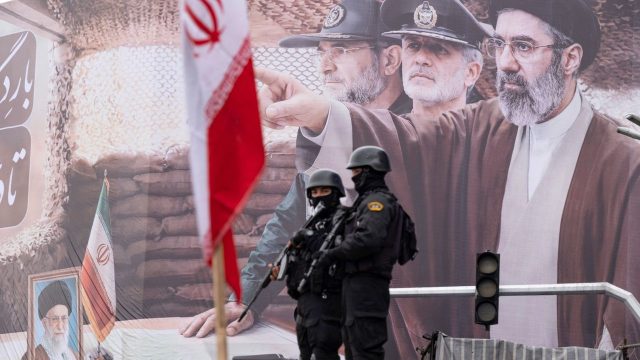
It is best known in the West for enforcing Islamic codes and suppressing dissent: masked Basij gunmen on motorbikes patrol streets during periods of unrest. They were accused of beating, shooting, sexually assaulting and torturing Iranians during the 2009 election protests and the “Woman, Life, Freedom” protest movement in 2022. There are about 100,000 employees of the Basij, and a much larger number of volunteers. These are mostly young working-class men, who are paid cash bonuses for going on patrols, and also receive benefits comparable to those of party members in Communist states: access to welfare schemes, jobs, and university places for their children, for instance.
And the Quds Force?
The Islamic Republic has a constitutional commitment to “export the revolution”, and the Quds (Jerusalem) Force is the section of the IRGC tasked with that. It began sponsoring armed groups in the region in the 1980s: first, the Shia militias that would become Hezbollah during the Lebanese Civil War; in the 1990s, the Palestinian groups Hamas and Islamic Jihad, as well as Shia groups in Bahrain and Afghanistan. After the invasion of Iraq in 2003, the Quds Force played a vital role in organising and aiding Shia militias fighting there against the US and its allies. Following the Arab Spring in 2011, the force was deployed to Syria, to prop up the rule of Bashar al-Assad; more recently, it has supported the Houthis in Yemen.
How about the IRGC’s economic role?
It controls great swathes of Iran’s economy, particularly in construction, energy and telecoms. Many of its interests are run via religious foundations, known as bonyads. US-led sanctions, since the 2000s, have actually bolstered the IRGC’s position: it has developed sophisticated black-market and smuggling networks, orchestrating the sale of oil to China and drones to Russia, as well as, reportedly, smuggling drugs and alcohol. It is estimated that upwards of a third of Iran’s GDP is controlled by the IRGC. “A lot of Revolutionary Guard commanders have become billionaire generals, more businessmen than military leaders,” opposition spokesman Shahin Gobadi told The Times.
What about its role in politics?
The IRGC is highly influential. Many former members have moved on to senior government roles – often appointed by the late supreme leader, Ali Khamenei, who was closely involved with the IRGC. At least 16% of seats in the Majlis, the parliament, are held by veterans or active commanders. Former Guards tend to advocate a hardline foreign policy, and to support Iran’s nuclear programme. Senior former IRGC officers include Ali Larijani, the head of the National Security Council, who was killed week. The IRGC’s new commander in chief, Ahmad Vahidi, is the former minister of the interior.
What is happening to it now?
At least 30 IRGC generals were assassinated in the 12-day war with Israel last year; during the current war, the Israel Defence Forces claim to have killed 6,000 Guards, including the commander-in-chief – and the Basjij chief. Basij check points have been attacked by drones. Even so, the IRGC has played a leading role in launching missile and drone attacks. And its influence is arguably growing: Mojtaba Khamenei is said to have been the IRGC’s choice as leader. Some analysts now describe Iran as a militarised “IRGC republic”.
The Islamic Revolutionary Guard Corps (IRGC) is both the backbone of the theocratic regime, and a state within the Iranian state