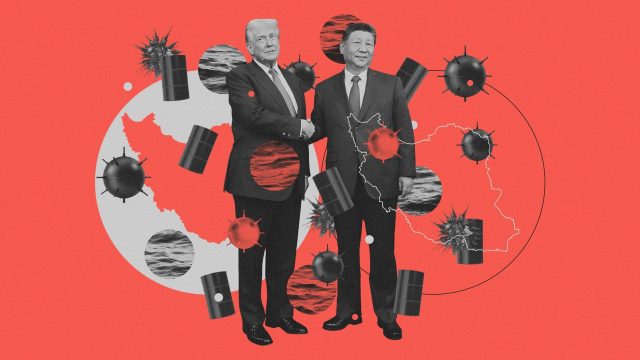
President Donald Trump wants to delay his upcoming summit with Chinese leader Xi Jinping, citing the demands of the Iran war. It’s a sign that the Middle East conflict could upend delicate relations with the United States’ most powerful rival.
The Iran war is “threatening a fragile détente” between the two superpowers, said The New York Times. Trump demanded China send ships to the region to help reopen the Strait of Hormuz, but Beijing has “reacted coolly.” Meeting Trump’s request would be “tantamount to entering the war,” said Ding Long of Shanghai International Studies University’s Middle East Studies Institute. But China’s reluctance to come to America’s aid “may jeopardize a trade truce” with the U.S., said the Times.
Trump’s call to delay the summit “casts a shadow” over what had been a stable relationship following last year’s trade war, said Reuters. The Iran war “makes U.S.-China interactions this year more difficult,” said Fudan University’s Zhao Minghao. Both sides are prioritizing “keeping relations on an even keel,” however, and China has signaled that it wants to reschedule the summit soon. Face-to-face diplomacy “plays an irreplaceable role in providing strategic guidance to China-U.S. relations,” said a Chinese government spokesperson.
What did the commentators say?
Beijing is “not going to bail Trump out” in Iran, Edward Luce said at Financial Times. His request that China send ships to the Strait of Hormuz is a “black swan moment,” when the world’s leading superpower is “inviting its main challenger to help extract it from the world’s most combustible region.” China gets half its imported oil through the strait, but helping the U.S. is a non-starter. “Why interrupt your enemy while he is making a mistake?”
The Iran war “really is about China,” Doug Stokes said at The Spectator. Teheran and Beijing have developed a partnership in recent years, with the bulk of Iranian oil exports flowing to Chinese refineries “operating beyond the reach of American sanctions enforcement.” China also supplied Iran with weapons “specifically designed to kill American sailors and constrain American freedom of maneuver” in a future conflict. Making war on Iran weakens the “infrastructure of Chinese power projection.”
Trump’s war “could play into China’s hands,” Lyle Goldstein said at The Chicago Tribune. Beijing will benefit from the U.S. shifting forces to the Middle East. China’s strategists will also “get yet another chance to closely study U.S. military technologies and doctrines” and adjust their war plans accordingly. Going forward, China may get to present itself as a defender of the global status quo, contrasting itself against a U.S. government “increasingly viewed as having gone rogue.”
What next?
China sees the summit delay as “less a setback than an opportunity to regroup” and meet when the U.S. president isn’t distracted by Iran, said Bloomberg. But the delay does “underscore the fragility” of both countries’ efforts to maintain trade peace, said Wendy Cutler, the senior vice president at the Asia Society Policy Institute.
Trump asks to delay planned summit with Xi