When I had the VW Tiguan on test last year, I found it profoundly verified VW’s vision of incorporating technology with a composed drive while maximising style, comfort and fuel economy.
The VW Tiguan ended up winning Family Car of the Year at the 2025 South African Car of the Year (Coty) awards.
In late 2025, VW launched the big sibling to the new Tiguan — the Tayron. It replaced the old Tiguan Allspace and also stands as a finalist for the 2026 Coty awards.
While it might seem like a simple name change from “Tiguan Allspace” to “Tayron”, it’s clear that VW wanted to give the seven-seater SUV in its line-up its own identity. But the Tayron has similar design elements to the Tiguan, both inside and outside.
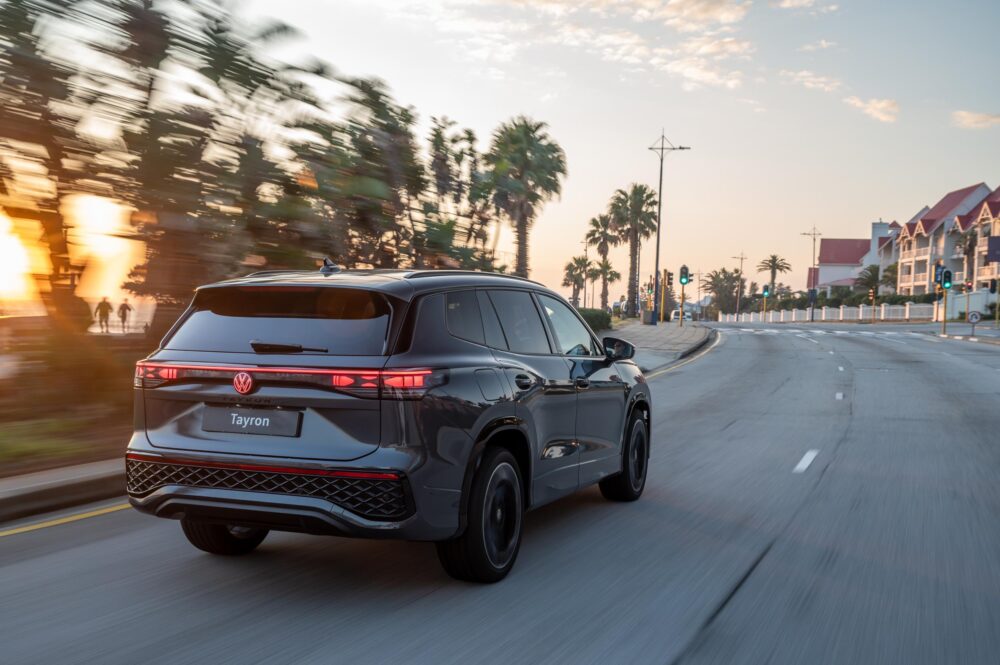
Starting with the exterior, the LED headlights and illuminated VW badge, along with the LED strip that goes across the front, give the vehicle that modern VW identity you notice a mile away. The same goes for the rear, with its full-length horizontal LED bar and illuminated Volkswagen logo. It delivers the kind of symmetrical styling I loved on the Tiguan, though, to be fair, the similarities between the two models could make it hard to tell them apart if you didn’t know the Tayron existed.
That said, it aligns perfectly with VW’s design language, looking sharp and stylish from the outside without feeling forced.
The interior
This is where things get interesting for me.
I had the Life model, which is the mid-range variant just below the R-Line.
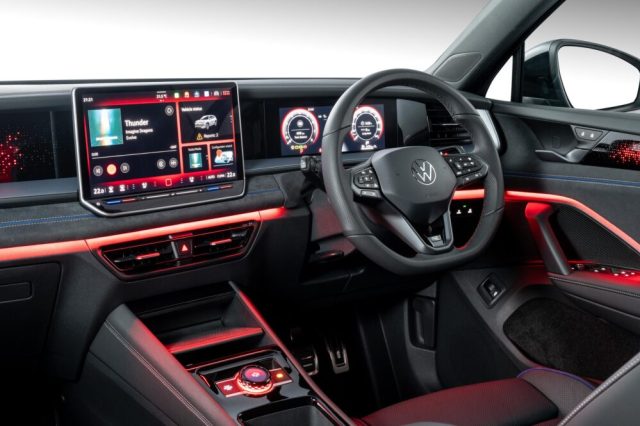
You get some standard features like a three-zone automatic air conditioner, 10-colour background lighting, nine airbags, driving experience control (which adjusts driving profiles) and an infotainment system with App-Connect Wireless (for Apple CarPlay and Android Auto).
It looks stylish and follows the same minimalist format that is mapped out in the Tiguan, with the gear selector now placed on the right stalk of the steering to free up space in the centre.
The driving experience dial is also present in the Tayron Life. It looks like a volume dial on the surface and it is. If you press it though, it allows you to select your driving mode or change the atmosphere in the cabin to fit your mood.
Those things are all cool but I do have two issues with this interior.
One is that this might not be the R-Line package but for a vehicle that costs more than R800 000 — and one that’s being touted as a comfortable family SUV — I would think standard leather seats would be a no-brainer.
The other issue is that the driver’s seat was not electrically adjustable. Again, for the price, those things should be standard.
Other than that, the Tayron offers a stylish and minimalist interior that has ample space and easy comfort for the whole family.
The interior of the R-Line does look a thing of beauty.

The drive
The Tayron is available in VW’s tried-and-tested 1.4 litre turbocharged engine that is mated to a seven-speed DSG transmission.
It delivers 110kW of power and 250Nm of torque.
The Tayron is 4.79m long — rather a large car – so at first I thought that the 1.4 litre might be slightly small to carry the vehicle without stretching itself.
I was also worried that for the first time in my life, my fuel consumption while driving a VW might be ridiculous.
I was right, to a certain extent, on both counts. While not underpowered by any means, the vehicle could do with a little extra to make it slightly more comfortable without feeling like it’s screaming at times.
However, once the vehicle is on its way, the drive is fantastic. The handling is phenomenal and in true VW fashion, you can just sit back, relax and enjoy the drive.
On fuel consumption, the in-town figures made me stress because for the first few days while I had the vehicle, I drove around town only and my fuel consumption sat close to 14 litres/100km.
Remember, I wasn’t driving an SUV with a 3 litre V6 engine that’s expected to guzzle fuel.
Once I got moving on the highways, my fuel consumption dropped to 8.1 litres/100km by the time my test period was over. That was a big win for me, considering the size of the vehicle.
I do feel that a 2-litre turbo would do the car way more justice though.
Safety
The Life variant comes standard with adaptive cruise control, lane-change system, lane-keeping system, an automatic emergency braking system with pedestrian and cyclist monitoring (Front Assist) and Park Assist Plus and a rear-view camera system.
Additionally, the Tayron features a new exit-warning system, which can prevent a door from being opened if a vehicle approaches from behind, offering both acoustic and visual warnings.
The Tayron has achieved a five-star safety rating from Euro NCAP, demonstrating high levels of safety performance. It achieved strong scores, including 87% for adult occupant protection and 85% for child occupant protection.
Verdict
For me, the Tayron gives off the same vibe the Tiguan gave me last year. It’s a family SUV that offers extreme comfort for a family while emphasising style and quality.
However, features such as leather seats and electronically adjustable seats in a vehicle that starts at more than R800 000 should be standard. VW would benefit if it brought a 2-litre Tayron into the market.
The extra space is not needed. The Tiguan is more than enough for the consumer but it’s also nice to have the extra space.
The Tayron is available in three variants: Base, priced at R811 800, Life, R853 800 and R-Line, R899 900.
If you are considering a Tayron, straight to the R-Line spec to make sure you get your money’s worth.
The Tayron replaces the Tiguan Allspace and sits as VW’s seven-seater vehicle. A 2-litre variant would’ve done it more justice