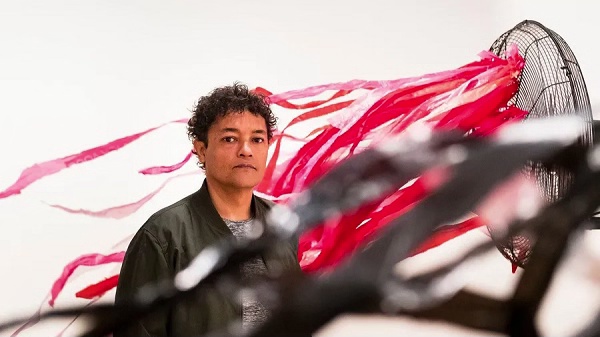
Figures from the Francophone art world have been sharing the news of Jean-François Boclé’s untimely death at age 55 [see, for example, AICA SC’s “In Memoriam: Jean-François Boclé (1971-2026)”]. The full title of this obituary article by Manon Palassy (La 1ièreFrance Info-Outremer) is « Décès de Jean-François Boclé : l’artiste martiniquais décolonial et engagé contre le chlordécone disparaît à 55 ans » [Death of Jean-François Boclé : Martinican artist, a champion of de-colonialism and activism against chlordecone pollution, dies at 55]. Here are excerpts.
A major figure in contemporary art, Martinican visual artist Jean-François Boclé died Wednesday following a heart attack in his studio. He was deeply committed to the fight against chlordecone pollution. His internationally acclaimed work is distinguished by its ability to decipher the legacy of colonial violence. In his lifetime, he enjoyed a level of recognition rarely seen for a contemporary artist.
He was a native of Martinique, deeply proud of his roots. Jean-François Boclé left the island at 17 to pursue his studies, but throughout his life, it remained a constant presence, along with its strengths and its wounds.
After initially studying modern literature at the Sorbonne, he turned to visual arts, first at the École Nationale Supérieure des Beaux-Arts in Bourges in 1992, then at the École Nationale Supérieure des Beaux-Arts in Paris from 1995 to 1998. This prestigious training quickly opened doors for him in the international contemporary art world. A painter, sculptor, video artist, and photographer, Boclé exhibited his work in Europe, Asia, Africa, North America, Latin America, and the Caribbean, asserting his identity as a Martinican artist on the global stage.
In 2001, Boclé created the work that would leave a lasting mark on his career: an “ocean” made of blue plastic bags. Presented for the first time at the Espace Niemeyer, the installation “Tout doit disparaître” (Everything Must Go) has since been exhibited worldwide. Often interpreted as a metaphor for the Atlantic Ocean, the triangular trade, and consumer society, this powerful piece illustrates the artist’s commitment to fighting pollution, particularly the type caused by chlordecone in the French Antilles. He tirelessly produced a wide range of works, performances, and series, solidifying his place among the most influential contemporary artists from France’s overseas territories.
In 2024, he celebrated the work and struggle of Martinican psychiatrist and thinker Frantz Fanon with “I can(’t) breathe,” a 40-minute performance featuring six dancers, presented in Paris, France. The title directly echoes police violence, but also Fanon’s seminal text, The Wretched of the Earth [Les damnés de la terre] in which the author invites the readers to free themselves from the oppression that stifles them.
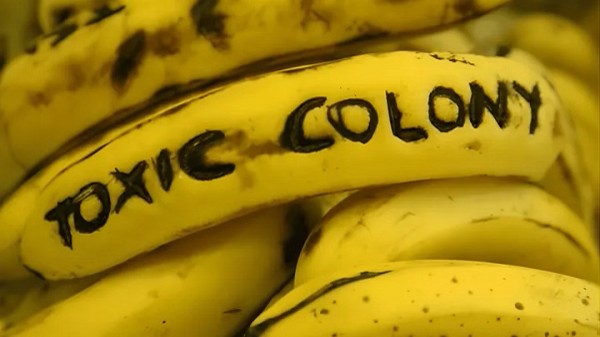
Latest performances: between cooking, memory, and sharing
His latest exhibition took place at Cloud Seven in Brussels, where he presented a culinary performance with the flavors of Martinique. Entitled “Cuisiner un colombo à Colombo” [Cooking a Colombo in Colombo], this piece was first presented in 2016 at the Colombo Art Biennale in Sri Lanka. Boclé thus leaves behind a final memory imbued with gentleness and love, true to his ambition to bring people together around the “We” that was so dear to his heart. [. . .]
A multifaceted artist, Jean-François Boclé also expressed himself through writing. A poet from age 15, he turned to prose in 2021 with the publication of Les Chroniques de Mamoudzou, Les Chroniques dakaroises, and Les Chroniques de la possession. In these texts, he recounted his daily life, his encounters, and his work in marginalized spaces: prisons, slums, and schools. His writing extended his visual work by documenting often-invisible social realities. [. . .]
Translated by Ivette Romero. For complete text (in French) and more photos of his work, see https://la1ere.franceinfo.fr/deces-de-jean-francois-bocle-l-artiste-martiniquais-decolonial-et-engage-contre-le-chlordecone-disparait-a-55-ans-1680810.html
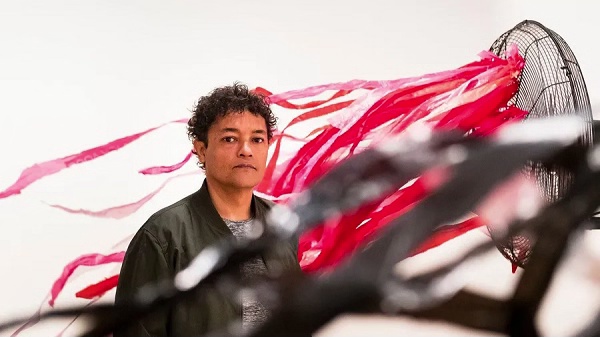
[Photo of Jean-François Boclé by Jan-Kees Steenman.]
Figures from the Francophone art world have been sharing the news of Jean-François Boclé’s untimely death at age 55 [see, for example, AICA SC’s “In Memoriam: Jean-François Boclé (1971-2026)”]. The full title of this obituary article by Manon Palassy (La 1ièreFrance Info-Outremer) is « Décès de Jean-François Boclé : l’artiste martiniquais décolonial et engagé contre le