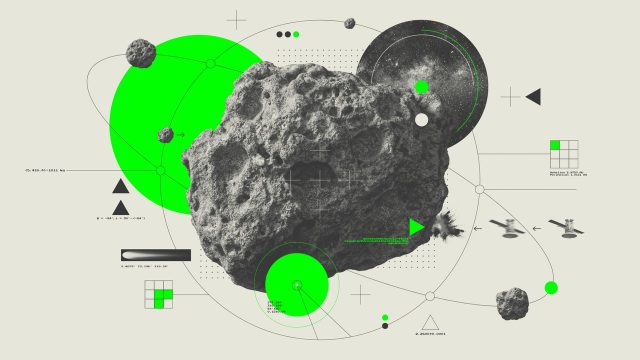
NASA crashed a spacecraft into an asteroid as an attempt to change the asteroid’s trajectory in 2022. Now, scientific observations have shown that the mission had more far-reaching effects than previously thought, affecting both the struck asteroid and the larger one it orbits. This could be a promising answer to protect the planet from cosmic threats in the future.
No crash dummy
NASA’s DART (Double Asteroid Redirection Test) spacecraft intentionally crashed into a small asteroid called Dimorphos in September 2022. The goal of the mission was to “prove that if a killer space rock ever threatened Earth in the future, humans could deflect it,” said The New York Times. The hit was quite the success, altering not only the orbit of Dimorphos around a larger asteroid, Didymos, but also the orbit of the pair around the sun, according to a study published in the journal Science Advances.
Dimorphos and Didymos are a binary pair, which means they circle each other while also orbiting the sun. The crash changed Dimorphos’s orbit around Didymos to be 33 minutes faster than it was before the strike. Scientists also found that DART made a bigger impact than expected. Observations of the asteroid pair’s motion “revealed that the 770-day orbital period around the sun changed by a fraction of a second after the DART spacecraft’s impact on Dimorphos,” said a NASA release. That change “marks the first time a human-made object has measurably altered the path of a celestial body around the Sun.”
While shifting the orbit by just 150 milliseconds per circle around the sun seems insignificant, “given enough time, even a tiny change can grow to a significant deflection,” Thomas Statler, the lead scientist for solar system small bodies at NASA, said in the release. The study “validates kinetic impact as a technique for defending Earth against asteroid hazards and shows how a binary asteroid might be deflected by impacting just one member of the pair.”
The space between
When DART hit Dimorphos, the “impact blasted a huge cloud of rocky debris into space, altering the shape of the asteroid,” said the NASA statement. The debris “carried its own momentum away from the asteroid,” giving the asteroid an “explosive thrust.” The study found that the “debris loss doubled the punch created by the spacecraft alone.” And because Dimorphos is part of a binary pair, a “measurable change for one will affect the other,” said CNN.
Didymos “was never on a path toward Earth, and the DART experiment could not have placed it on one,” said a press release about the study. However, the “small shift in orbital speed demonstrates how spacecraft could be used to redirect a threatening asteroid if scientists detect it early enough.” In that case, a “spacecraft would strike the object and slightly alter its velocity,” and that “tiny change could accumulate into a large enough deviation to prevent a collision with Earth.”
NASA, in a similar guardian vein, is also developing its Near-Earth Object Surveyor mission, which “could spot dark, risky asteroids that have remained nearly invisible from Earth-based observatories,” said CNN. Being able to identify potential threats in space along with knowing how to change their orbit goes “hand in hand with how space agencies envision protecting Earth.”
A rock and a hard place