The fog of war has settled thick over the United States and Israel’s ongoing assault on Iranian military targets and an expanding terrain of associated sites. With Washington’s strategic aims unclear and the disorder of the Trump regime confounding attempts to justify this latest bout of bellicosity, Iran’s strategy to end these attacks is coming into sharper relief.
Faced with superior military might and forced to scramble after last week’s surprise attack, Iran has turned to — and on — its Gulf State neighbors. Those countries are now a leverage point to reshape the contours of a war that thus far has had the Islamic Republic in a defensive crouch.
What did the commentators say?
Iran’s government has “for years” threatened to “blanket the Middle East with missile and drone fire” if it felt its existence was “threatened,” said PBS News. Now “the Islamic Republic is doing just that.”
Iran’s “basic strategy,” said PBS News, is to “instill fear about the dangers of a widening war,” prompting American allies to “apply enough pressure to halt their campaign.” Persian Gulf nations have long been a “bastion of calm in a deeply unstable region,” with “oil wealth and careful diplomacy” to keep “turmoil at arm’s length.” But with cities such as Dubai and Qatar’s Doha under bombardment, investors are recalibrating their “perception of the region’s stability,” said The Wall Street Journal.
The question facing Gulf leaders is essentially “how long do we keep sitting on our hands and absorb these relentless Iranian strikes?” said Middle East policy expert Hasan Alhasan to The New York Times. Do places like Qatar and Dubai “join a war that they did not start, whose goals are entirely unclear, and whose tempo and cadence they do not necessarily control?”
Gulf states may have hoped that the war would “remain confined to Israel and Iran,” leaving them and their oil shipping “relatively unaffected,” said Foreign Policy. But Iran “rejected that script,” bombarding the region in a way that suggests a “clear strategy.” The goal, in part, is to “quickly cause global economic pain” to build pressure for a cease-fire, evidenced by Iran’s closing of the Strait of Hormuz. Meanwhile, Saudi oil and Qatari liquified natural gas production remains effectively “shut down even without direct Iranian attacks.”
Iranian assaults have “increasingly targeted energy infrastructure,” leading to a “jump in gas prices” and raising alarm around the world, said Al Jazeera. Much of the Gulf’s oil production might have to be temporarily shut down, causing “long-term, knock-on effects,” said Thijs Van de Graaf, an energy fellow at the Brussels Institute for Geopolitics, to the outlet. “You do not turn on and off an oil well like flipping the switch of a light.”
Nor is Iran limiting its focus to energy production. Iranian drone strikes on Amazon Web Service facilities in the United Arab Emirates and Bahrain signal a “new front for Iran’s retaliation against the U.S.” by “complicating Gulf ambitions to build multibillion-dollar AI facilities in the region,” said Financial Times. Data centers have emerged as “attractive targets to anyone seeking to disrupt a country,” said technology professor Vili Lehdonvirta to the BBC. Given the degree to which cloud and commercial AI software has become integrated into U.S. military operations, it’s “not entirely unexpected” that those “infrastructures” would be specifically targeted as “‘dual-use’ facilities.”
What next?
Although Iranian attacks may draw Gulf states into the widening regional conflagration, it “isn’t obvious” that those countries have much to add militarily compared to what Iran “already faces,” said Foreign Policy. Moreover, Iran sees pushing Gulf states into an “open alliance with a deeply unpopular Israel” — compared to “veiled tacit cooperation” — as a move with “significant regional and political benefits.”
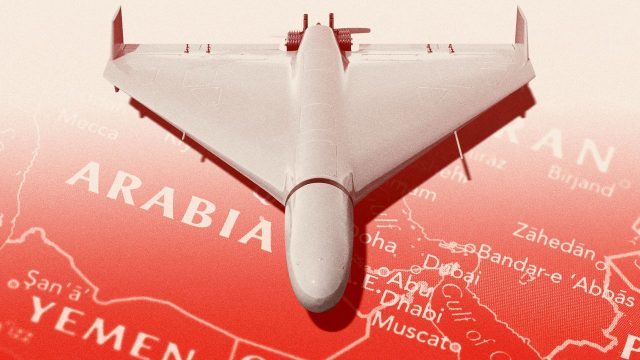
Iran’s shift from missile-based assaults in the region to a combination of traditional munitions and drone bombardments suggests a “more lasting threat” than missiles alone, said the Times. Tehran has “proved it can produce drones quickly and cheaply,” suggesting a “healthy supply to target the Gulf for the foreseeable future.” The result, said PBS News, is a “grim math equation,” in which Iran has a “finite number of missiles and drones.” And American, Israeli and Gulf states have, in turn, a “limited number of interceptor missiles capable of downing the incoming fire.” As such, Gulf states are looking to both “acquire more weapons to intercept incoming fire,” plus “find ways to broker an end to the war.”
While the thrust of the combat has been between American, Israeli and Iranian forces, Tehran has sought to leverage threats against its oil-producing neighbors to force the West’s hand.