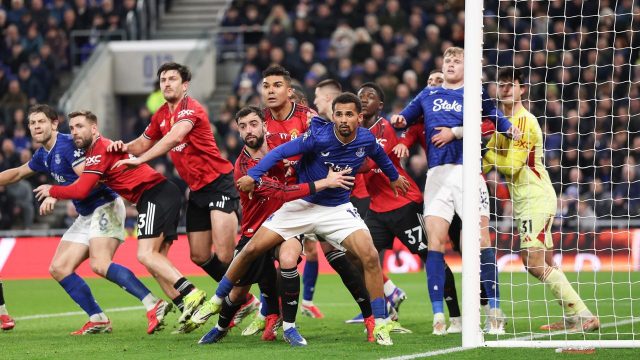
The Premier League has turned a “tactical corner”, said Jonathan Wilson in The Guardian. Corners and set-pieces generally are back in fashion, much to the annoyance of some fans who claim they are the antithesis of the beautiful game.
Clubs are employing specialist set-piece coaches, and players are celebrating winning corners, allowing them to perform their well-rehearsed routines in front of goal. After years of “strategy and technique”, and the dominance of patient, possession-based football, fans are concerned that packed penalty areas and the all-in wrestling between opposing players is ruining the spectacle of the English game.
‘It doesn’t feel right’
Most of what goes on from dead-ball situations “is not strictly against the rules per se”, but it’s a question of optics, said Football 365. Players can stand where they want, and have no obligation to move to allow others to challenge for the ball. The issue is that when “12-14 players” are all doing the same thing in such an enclosed space, it “jars with what the game is supposed to be. It doesn’t feel right.”
Tony Pulis, who managed Stoke City and Crystal Palace in the Premier League in the late 2000s and 2010s, was known for his “pragmatic” approach, he said on the BBC. “I was seen as a dinosaur for my focus on dead-ball situations and long throws”, but “I knew back then how important they were”.
Premier League leaders Arsenal have led the way in the resurgence of set-pieces. Their 37 league goals from corners since the start of the 2023-24 season far eclipsing the next-best 26 by German side Borussia Monchengladbach out of all teams in Europe’s top five leagues.
Some people are “snobbish” about the role of set-pieces in the game, said Pulis, but “the expectation, and the pressure they put on the opposition, is amazing”. Ignore the inevitable criticism, “what matters is winning”.
The “suddenness” of the change in approach from English teams has been “remarkable” but this “present trend will fade away”, said Wilson in The Guardian. The obsession with possession-based tactics, as well as widening financial inequality, has led to opposition teams defending in a compact “low block”, feeling unable to compete skill-wise. A “reversion to something more physical” in the game certainly poses a threat, but in a game of tactical cycles “this too will pass”.
‘Action is needed’
Some scenes in the recent game between Everton and Manchester United were an “absolute disgrace”, said Martin Samuel in The Times. We have grown used to a “melee of grabbing, holding, pushing, pulling, grappling, backing in” penalty areas. The game has become dominated by a “supposedly unsolvable wrestling issue” and fans are not happy about it.
Nothing is being done to safeguard the “beautiful game”. Governing bodies “obsess over trivia and the trivial”, exemplified by the International Football Association Board prioritising things like five-second countdowns for goal-kicks. “No group is less qualified to decide on football’s rules than Ifab”, and it has already made a “mess” of video replays, offside and handball rulings.
“Enough already,” said Graham Scott, a former Premier League referee, in The Telegraph. Corners are “ruining the spectacle” of football with all the “wrestling, grappling and holding”, but referees have a “nearly impossible job to decide who is truly to blame”. Occasionally, a clear pull or obstruction in the fracas around the six-yard box is “black and white, but there are more than 50 shades of grey in between”. With fans having little “appetite” for lengthy VAR delays, officials must “walk a tightrope” to decide what is “fair and foul”.
So “action is needed”. To try to fix the issue, “I would imitate hockey by forcing teams to place a certain number of players in the other half” to reduce congestion. In a “more radical move”, defenders could be inside the six-yard box and attackers outside it when a corner is taken, separating them entirely.
After an era of possession-based tactics, a more ‘physical’ approach has emerged, but many fans believe it is ‘ruining the spectacle’