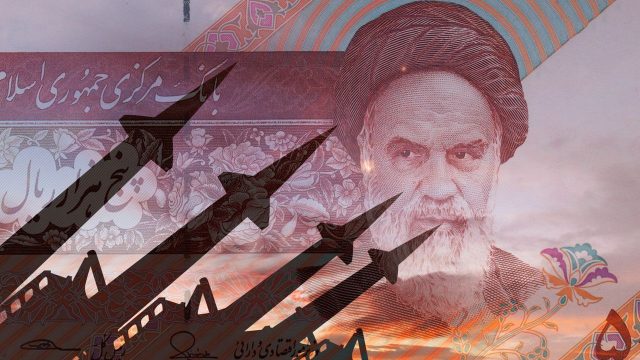
President Donald Trump appears to be on the cusp of ordering an attack on Iran, but some Pentagon insiders are warning of potential risks of a new war in the Middle East. Any escalation could bring significant long-term conflict.
The possible downsides of attacking Iran include “U.S. and allied casualties, depleted air defenses and an overtaxed force,” said The Wall Street Journal. Trump is considering a range of options from a quick-hit strike to a longer aerial bombing campaign. While all the scenarios “carry risks,” an extended attack lasting multiple days “could incur significant costs to U.S. forces and munitions stockpiles” and has the “potential to pull the U.S. into a broader war in the Middle East.” Depleting American weaponry against Iran could also “impact preparations for a possible future conflict with China.”
What did the commentators say?
There is “no low-cost, easy, clean military option available in the case of Iran,” said Ali Vaez of the International Crisis Group to The New York Times. Iran’s government has command of “extensive military abilities” as well as a “network of regional proxy forces” that could attack U.S. forces in the region, said the Times. An Iranian counterattack could strike Israel, as well as American allies like Saudi Arabia and the United Arab Emirates. Iran’s goal would be to “quickly escalate and export instability” to spread the pain of a conflict, said Sanam Vakil, the director of the Middle East and North Africa program at Chatham House.
“The risks of escalation are grave,” said Rosemary Kelanic, the director of the Middle East Program at Defense Priorities, at The Hill. Iran is weak compared to the United States, but history offers numerous examples of “weak countries prevailing over stronger ones.” Weak countries “just need to not lose, to outlast their opponent” until the stronger country decides the costs are not worth it anymore. Iran’s leaders have incentives to take the retaliatory gloves off this time around. Trump’s “regime-toppling rhetoric” about Iran’s government makes this an “existential” crisis for Tehran. That gives the U.S. a “clear imperative” to avoid a “pointless war.”
Americans can “reasonably hope” for the downfall of the Iranian regime, said Thomas Wright at The Atlantic. And the United States could “defeat Iran quickly and decisively.” But an “open-ended regional conflict” is also possible. A “cornered” Iranian regime “could prove more resilient than expected,” leading to a drawn-out war that leaves Americans to “deal with the consequences for years to come.” The June 2025 attacks on Iran’s nuclear facilities “bought time” for the U.S. to consider its options. Trump should use that time instead of attacking now.
What next?
The president is “increasingly frustrated” with his military options, said CBS News. Trump wants a “singular, decisive blow” that would force Iran’s leaders to make nuclear concessions at the bargaining table, but Pentagon planners have told him “such an outcome cannot be guaranteed.” What happens next will depend on “how much risk Washington is prepared to bear.”
Once again, fears of a wider Middle East war