“Vladimir Putin has not achieved his goals,” said a defiant Volodymyr Zelenskyy in a televised address marking the fourth anniversary of Russia’s full-scale invasion of Ukraine.
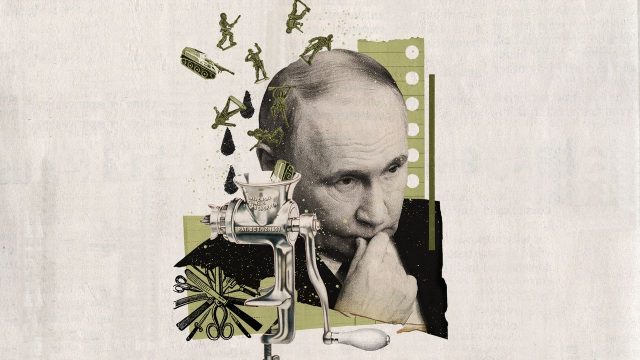
The February 2022 invasion was meant to be a “short and successful military operation” that would “force Kyiv back into Moscow’s orbit” and “overturn the entire post-Cold War security architecture in Europe”, said the BBC’s Russia editor, Steve Rosenberg. “It didn’t go to plan”, leaving Russia with an ever-mounting cost.
What did the commentators say?
As the conflict enters its fifth year, Russian victory seems as far away as ever and it has little to show for its estimated 1.2 million casualties, according to Seth G. Jones and Riley McCabe at the Center for Strategic & International Studies. The average pace of Russia’s progress has sometimes been as little as 15 metres per day, “slower than almost any major offensive campaign in any war in the last century”.
Russia’s economy is finally starting to teeter. It faces a huge shortfall in oil revenues and has been forced to sell gold reserves to cover its budget deficit.
The West has always believed that domestic discontent as a result of the ongoing sanctions would “persuade Putin to abandon the war”, said Peter Rutland and Elizaveta Gaufman on The Conversation. This, in turn, was “based on the assumption that the legitimacy of Putinism rests on a social contract” that offers Russians stability and income in exchange for loyalty.
But this approach “tends to downplay the role of ideology”, which has been successfully exploited by the Kremlin to spin the war as an existential threat and maintain support for the president, according to data from Statista.
This narrative has also been deployed externally, towards Russia’s opponents. The idea emanating from the Kremlin that Ukraine’s front line faces “imminent collapse” is “an effort to coerce the West and Ukraine into capitulating to Russian demands that Russia cannot secure itself militarily”, said the Washington-based Institute for the Study of War. This is a “false narrative”.
The West should “stop buying into Moscow’s bluff that Russia is invincible” and “use the Kremlin’s weaknesses and double down on its support for Ukraine to bring about real negotiations to end the war”, said Jana Kobzova and Leo Litra for the European Council on Foreign Relations.
“The notion that ‘time is on the Russian side’ betrays a lack of strategic patience and, even more importantly, squandered opportunities to exploit Moscow’s growing structural vulnerabilities.”
What next?
“Standard economic theory suggests that deteriorating conditions should push the Kremlin towards negotiations on ending the war,” said The Economist. “A rational actor facing mounting costs seeks an exit.”
Yet there is little sign that Putin has any intention of yielding on his push for the “capitulation” of Ukraine, Russian political scientist Tatiana Stanovaya told The I Paper. If no peace deal can be struck, the war could even “escalate further”, with the possible involvement of China a “growing factor”, as well as fears of a “new nuclear race”, said The i Paper.
Russia can “probably continue waging war for the foreseeable future”, said The Economist, but every additional year “raises systemic risk: of fiscal crisis, of institutional breakdown, of damage so severe that no post-war policy can repair it”.
So the question for Western allies is “what kind of Russia will emerge” when its appetite for war finally fades, “and whether anyone has a plan for what comes next”.
Four years on from the full-scale invasion, Vladimir Putin faces battlefield fatigue, economic unease and a fraying social contract at home