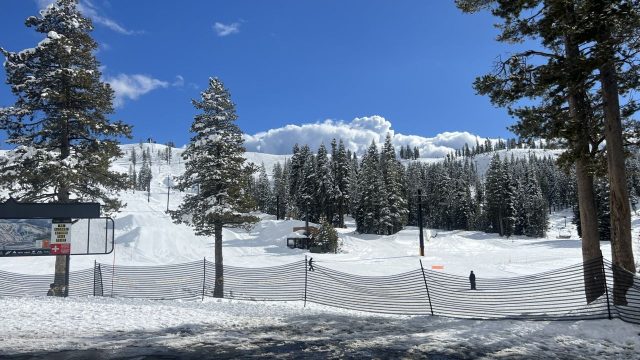
While 2026 is less than three months old, this year has already seen its fair share of avalanches. This includes one that slammed into a train in the Swiss Alps, injuring five people, and a recent occurrence near Lake Tahoe that left nine skiers dead. The latter was the deadliest in the history of California, and scientists say there may be a major factor contributing to these events becoming more dangerous: climate change.
Why are avalanches becoming more hazardous?
Scientists say that a decrease in snow caused by a warmer planet may be making avalanches worse. People “might assume that increasing global temperatures would lead to fewer avalanches,” said The Independent. But rising temperatures can “increase the risk of avalanches,” especially at altitudes of 6,500 feet or higher.
At these higher elevations that see more snowfall, climate change can “increase the risk of ‘wet’ avalanches, which contain more liquid from rain or melted snow,” said The Independent. These are avalanches that “travel less far and more slowly than dry snow avalanches,” but they are also “denser, so they can exert greater pressure and impact,” Nicolas Eckert, a mountain risk specialist at the French National Research Institute for Agriculture, Food and Environment (INRAE), told Le Monde.
Scientists investigating the Lake Tahoe disaster are “pointing to a combination of heavy snow on top of an unstable snow pack as conditions that led to the avalanche,” said The New York Times. Some have also pointed to atmospheric ‘rivers’ that “occur when a high-altitude current of moisture flows from the tropical ocean regions.” These rivers over the Pacific Ocean are “becoming wetter and warmer,” and when they pass over the Western U.S. they could “lead to heavy snowfall in higher mountain elevations even as the number of snowy days decreases.”
In some areas of Europe, the lack of snow could be problematic. When it “does not snow for some time, the surface snow is exposed to warming during the day and colder temperatures at night,” said The Sydney Morning Herald. The snow’s unstable crystals function like “standing up a deck of cards on their end all the way across the snow pack,” Craig Sheppard, the program manager for the Mountain Safety Collective, said to the Herald. When the next snowfall arrives, it creates a “recipe for avalanches because you have snow sitting on a really weak grain.”
What can be done?
Many experts say the best solution is proper avalanche safety. About “90% of slides that cause an injury or death are triggered by the victim or a companion,” said The Associated Press. Avalanches travel fast and can’t be outrun, so the best “plan is to make sure you’re not in a place where one is at risk of occurring.” The National Avalanche Center allows outdoor enthusiasts to track avalanche threats and warnings across the U.S.
Despite avalanches occurring less often these days, when they do happen, they are increasingly likely to be deadly. Over the “last 10 winters, an average of 27 people died in avalanches each winter in the United States,” according to the Colorado Avalanche Information Center. Still, there is no way to determine the exact number of people in such avalanches, as “most non-fatal avalanche incidents are not reported.”
Several major ones have recently occurred