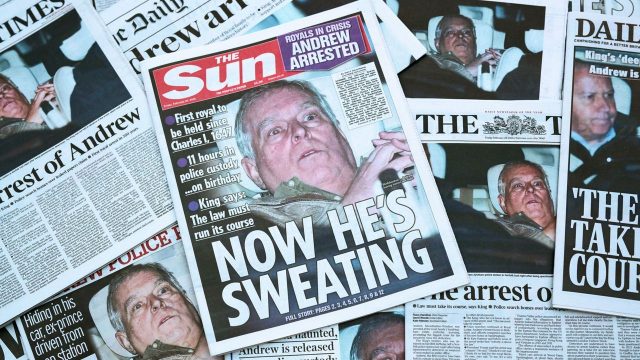
The arrest on Thursday of Andrew Mountbatten-Windsor, “the fool formerly known as a prince, marks the definite end of public reverence toward the British monarchy”.
“I write that as an Englishman who is rather fond of it,” said Tim Stanley in The Washington Post.
The King has said that the authorities “have our full and wholehearted support and cooperation”, in their investigation into his brother, who has consistently denied any wrongdoing. But the latest twist in the sorry tale has raised questions as to whether the royals have the full and wholehearted support and cooperation of the nation.
What did the commentators say?
While the arrest has prompted a “sliver of misty-eyed, ‘good on us Brits for actually clearing out the rot’ commentary” said Harry Cole in The Sun, “that’s far eclipsed by discussions about the very future of the Crown not heard since those dark days following the death of Princess Diana”.
Indeed, “how does this work out any way other than badly for the Palace, the Royal Family, and the monarchy?” asked the BBC’s royal correspondent Jonny Dymond. Some believe the royals have done enough to distance themselves from Andrew’s actions but while he “may not have been on the Buckingham Palace balcony for a while”, any distinction between him and the royals, “is entirely lost on most people” as “the Palace, the Royal Family, the monarchy, all seem as one”.
But where there might be a distinction is between the actions of the family and the future of the monarchy, said Jonathan Dimbleby, the King’s biographer and friend. “I don’t think that it damages the monarchy,” he said of the arrest to the BBC. “I think we have to separate the notion of a family from the institution of the monarchy.”
Republicans “hope that the scandal will lead to the collapse of the crown itself”, said The Economist. Graham Smith, chief executive of the campaign group Republic, said Andrew’s arrest “threatens the whole monarchy”. It’s a sentiment that is “ambitious, even if it is a chance to erode support for the institution”, said the magazine. But Andrew does embody a “monarchy that is reduced in stature in a country that is itself getting poorer and crasser”, said Stanley in The Washington Post. The Crown is just one of a number of institutions that the country has inherited, “the purpose of which it can’t recall”.
“If we’re not careful, if their reputation sinks any lower, we might finally join the US and wipe them away in a fit of revolutionary disgust.”
What next?
While it may not result in the end of the monarchy, a “change in culture is long overdue”, said The Times in an editorial. “Under cover of royal deference and secrecy, far too little was done for far too long to rein in Mountbatten-Windsor’s behaviour.” Transparency is the only way to change public opinion and “records should now be released, and staff encouraged to speak honestly about what they saw.”
The royals “will be holding crisis talks today with a mixture of sorrow and panic”, said The Spectator’s Alexander Larman. They had hoped that, when it came to this particular scandal, “the worst was past”. But “it is now clear that far worse is almost certainly yet to come, and the question is what anyone can do about it”.
The King has distanced the Royal Family from his disgraced brother but a ‘fit of revolutionary disgust’ could still wipe them out