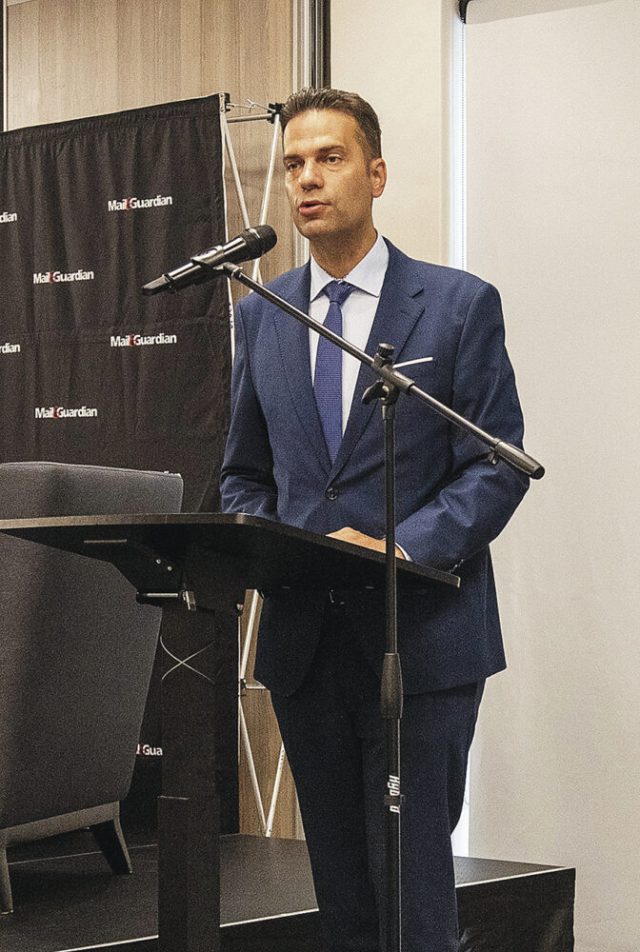
At a Mail & Guardian post-Sona breakfast held in partnership with the Konrad-Adenauer-Stiftung and the Embassy of Ireland, analysts turned from the president’s reform agenda to the harder question of execution. Structural unemployment, municipal dysfunction, coalition politics and institutional rebuilding dominated a discussion that placed delivery, not rhetoric, at the centre of South Africa’s political moment.
If Sona sought to project stability, the question the following morning was credibility. At a post-address breakfast discussion hosted by the Mail & Guardian in partnership with the Konrad-Adenauer-Stiftung and supported by the Embassy of Ireland, analysts interrogated not the president’s themes but the state’s capacity to execute them.

Opening the event, Gregor Jaecke, Resident Representative of the Konrad-Adenauer-Stiftung in South Africa, described the platform as evidence of “a vibrant and strong democracy”. In a global environment where democratic norms are under pressure, he said, such spaces for open debate should not be taken for granted. Ireland’s ambassador to South Africa, Austin Gormley, said Sona remains “a great opportunity for debate and exchange”, reflecting the vitality of engagement between government, media and civil society.
The panel turned quickly to the substance of President Cyril Ramaphosa’s address.

Sanusha Naidu, senior research associate at the Institute for Global Dialogue, framed the discussion within the context of local government elections and deepening service delivery crises. The president, she said, “could not shield government from the level of crises that exists” in municipalities, particularly in relation to water provision and infrastructure management.
While the address touched on the water crisis, gangsterism, organised crime and collaboration between the South African Police Service and the South African National Defence Force, Naidu questioned how these commitments would translate into measurable change. “How does it become actionable?” she asked. The announcement of new agencies and oversight mechanisms, including water infrastructure interventions, must be matched by capacity and accountability.
She cautioned against the routine creation of commissions and task teams in response to structural problems. “Let’s have another commission,” she said, capturing what she described as a pattern of institutional layering without sufficient reform. Urbanisation pressures, demographic shifts and infrastructure strain require long-term planning and technical competence. Without that foundation, interventions risk addressing symptoms rather than causes.
Naidu also reflected on the political economy of local governance. Municipal structures, she argued, have in some instances become sites of patronage. The challenge is not confined to one political party. “It’s not just an ANC problem,” she said, noting that governance failures cut across the political spectrum. In an election year, performance at local level will shape public trust in national commitments.
Prof Christi van der Westhuizen, professor of sociology at the University of the Western Cape, shifted the focus to poverty, social protection and structural unemployment. South Africa’s labour market crisis, she said, is not cyclical. “There’s a structural problem in our economy that people can’t actually find jobs,” she said. Growth rates remain too low to absorb those excluded from formal employment.
In that context, the social relief of distress grant assumes heightened importance. “If you don’t make sure that the social relief grant reaches everybody that it needs to reach, you are not helping,” she said. Ongoing debates about eligibility and administrative tightening, she argued, risk undermining the grant’s stabilising function.
The child support grant, she added, remains insufficient to address food poverty in many households. Fiscal discipline must be balanced against the social realities confronting vulnerable communities.
Van der Westhuizen also addressed the legacy of state capture. Administrative capacity was “actively destroyed”, particularly within state-owned enterprises and logistics infrastructure. The need to involve private operators in port management and freight systems reflects the scale of institutional erosion. Rebuilding capacity requires sustained structural reform.
She noted that the Government of National Unity represents a significant political development in a fragmented electoral landscape. Cooperation across parties with divergent ideological positions is not guaranteed. The challenge lies in translating that cooperation into effective implementation.
Asanda Ngoasheng, political analyst and academic, focused on coalition dynamics and accountability. “Once you are part of government, its failures and successes are yours,” she said. Political parties within the GNU, she argued, cannot continue to operate as if they are in opposition while occupying executive office.
Coalition instability has direct economic implications. “Every time they threaten to collapse, the rand drops and everybody holds their breath,” she said. Political uncertainty feeds market volatility and shapes investor confidence.
Ngoasheng also raised concerns about leadership decisiveness. The president’s articulation of policy is not in dispute, she said. The question is whether executive authority is exercised consistently in matters of accountability. Public confidence is shaped not only by announcements but by visible consequences for governance failures.
Angelo Fick broadened the analysis to the global environment. South Africa, he argued, is attempting to address centuries of dispossession and decades of apartheid engineering while navigating a volatile international order. Multilateral institutions are under strain, and growth projections remain modest.
Governance under such conditions becomes a process of prioritisation. Yet Fick cautioned against reducing political discourse to fiscal arithmetic. “We are reducing life itself to cost rather than value,” he said. Speeches that focus heavily on expenditure and targets risk framing citizens primarily in economic terms.
He emphasised the generational dimension of policy choices. With a majority youth population, the country must consider not only immediate stabilisation but long-term opportunity.
Fick also addressed institutional integrity. “We keep asking who is corrupt. We don’t ask what makes corruptibility possible,” he said. Corruption, he argued, is sustained by systems that allow procedural shortcuts. “If there are rules, and you want people not to be unlawful, you have to stick by the rules,” he said. Consistent adherence to established processes is foundational to rebuilding trust.
Throughout the discussion, the panel returned to the intersection of structural economic constraints, weakened institutional capacity and coalition politics. The president’s address covered pressing national priorities, including crime, infrastructure reform, economic growth and social protection. The debate centred on whether the state can deliver on those commitments in a context shaped by fiscal limits, administrative rebuilding and political fragmentation.
The breakfast discussion, supported by partners committed to democratic engagement, reflected the resilience of South Africa’s public sphere. It also underscored the complexity of the tasks outlined in the State of the Nation Address.
As policy commitments move from announcement to implementation, the issues raised at the forum remain central. Municipal governance, structural unemployment, social protection, institutional reform and coalition stability will continue to shape the national agenda in the months ahead.
At a Mail & Guardian post-Sona breakfast held in partnership with the Konrad-Adenauer-Stiftung and the Embassy of Ireland, analysts turned from the president’s reform agenda to the harder question of execution. Structural unemployment, municipal dysfunction, coalition politics and institutional rebuilding dominated a discussion that placed delivery, not rhetoric, at the centre of South Africa’s political