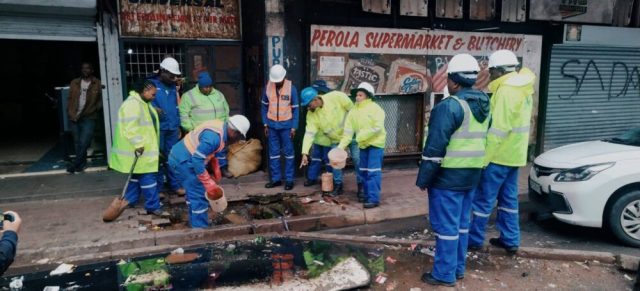
To eradicate the City of Johannesburg’s water crisis, an investment of about R7 billion is needed to fix roughly 2 600km of infrastructure, mayor Dada Morero said this week.
Morero has faced mounting criticism as the months-long crisis pushes residents to the edge.
In his State of the Nation address (Sona) last week, President Cyril Ramaphosa said water, along with crime, had become the single most important issue for many South Africans.
In an interview with the Mail & Guardian, Morero laid most of the blame for the Johannesburg water problems on old infrastructure.
“The key issue is the pipes. The pipes underground are asbestos pipes that can no longer be repaired — they are finished.
“In the CBD, it is the steel pipes which have also rusted and need to be replaced,” he said, noting that the city has about 12 600km of water network infrastructure and almost the same length for the sewer network.
Johannesburg loses vast amounts of water through leaks and revenue through meter bypassing.
Officials have also said heavy migration to the city from other parts of South Africa have added strain to supply.
Heatwaves that tended to hit the city, particularly in summer, also fuelled overconsumption, they said.
Asked how the city would raise the money for water infrastructure, Morero said it would look to refinance some of the revenue generated from the resource, adding: “There are grants from the national treasury and entity reforms to secure additional funding.”
The city was focused on reducing water losses through leaks, with about 2 600km of pipes requiring urgent attention, he said.
“What we require is about R7bn, and around R6bn for sewer infrastructure. With a R13bn investment, once we reduce our losses — even by 10% — we will save about R300 million annually, which is a good saving that can be reinvested into infrastructure,” he said.
With its current financial resources, Johannesburg is able to replace about 84km of pipes, Morero said, adding that in the next financial year, it was looking at replacing about 100km.
The second part of fixing the water issues involved refurbishing water reservoirs, the mayor said.
The city was fixing 19 reservoirs and would refurbish another 19 in the next financial year.
“That means as we refurbish, we also need to build new ones so that we keep up with developments taking place.
“That is why in Midrand we are building four more reservoirs and three towers,” he said.
“One tower is almost complete because we are aware that Midrand has experienced significant residential and commercial growth.”
Morero assured residents that the city would not implement water-shedding in the same manner that South Africans had endured years of electricity load-shedding by Eskom.
Last week, the South African Human Rights Commission called for the water crisis engulfing not just Johannesburg but numerous other parts of the country to be declared a national disaster, saying communities across the country were battling to access the critical resource.
“Water is a fundamental human right entrenched in section 27 of the Constitution,” the commission said.
“It is the lifeblood of human existence and plays a critical role in the achievement of several rights, including healthcare, children’s rights and education.”
Asked whether the city was ready to defend itself after the Democratic Alliance (DA) threatened to take it to court for failing to provide residents with water, Morero said the court would ask the necessary questions and Johannesburg would respond accordingly.
He accused the DA of using the issue as a political campaign tool before the local government elections planned for later this year.

revenue through meter bypassing.
In a media briefing last week, DA federal council chair and the party’s Johannesburg mayoral candidate in this year’s local government elections, Helen Zille, said it had taken a decision to take the City of Johannesburg to court.
They said Johannesburg’s infrastructure had not been properly maintained for 30 years, leading to continued water challenges.
“We are now going to take steps to ensure that Johannesburg Water, Rand Water and the national government treat this as the priority that it is,” Zille said.
“We are going to make sure that the infrastructure budget and maintenance budget are properly allocated, that we fix the four critical systems that are on the verge of collapse, ensure backup systems in case of emergency and eliminate illegal connections through stricter management.”
Zille said the city could not afford to lose the amount of water it was losing daily, estimating that about 46% of the precious resource was lost.
The DA would be going to court to enforce residents’ constitutional rights and had a clear
plan on how to solve the water problem, she said.
“Cape Town, in the past year, replaced 167km of water and sewage pipes.
“That was more than three times the number replaced by Johannesburg, Tshwane and Ekurhuleni combined,” she said, adding that this was the level of infrastructure investment needed to prevent Johannesburg’s water crisis.
This week, ANC Gauteng provincial task team co-convenor Amos Masondo said the party was confident that the water crisis would be effectively addressed in the same way load-shedding had been resolved.
“What I’m saying is that the water problem is real. It is an issue that needs to be sorted out.
“I have confidence that the government has the capacity and the necessary skills to resolve it,” Masondo told the M&G.
In the Sona, Ramaphosa said he would take charge of the water crisis and deal with the matter urgently.
“We are now elevating our response to the water crisis to a national water crisis committee, which I will chair.
“This structure will bring together all existing efforts into a single coordinating body,” he told MPs.
“The deputy president has been working with a number of water authorities in the country and we will coordinate all those efforts to ensure that we address this problem.”
At the closing of an ANC provincial task team lekgotla earlier this week, co-convener and Gauteng Premier Panyaza Lesufi apologised for the lack of water and electricity in parts of the province.
“We have urged our deployees to leave no stone unturned in taking advantage of the decision taken by our president to have the water intervention team permanently stationed in our province,” Lesufi said.
He said all involved had embraced the president’s decision to establish a water task team and that all ministers had accepted deployment to resolve the water challenges, with the exception of the deputy minister of water and sanitation, the DA’s Sello Seitlholo.
“This is nothing but an attempt to undermine our president and to play cheap politics — that if the problem is resolved, it is credited to the GNU [government of national unity] but if it is not resolved, it is blamed on the ANC,” Lesufi said.
“This goes beyond cheap politics. We supported all forms of government nationally, including in George when they were facing Day Zero. Our government was not selective — it provided national support.”
He said he was encouraged by reports that water was starting to flow in areas where there had previously been none and that the city of Ekurhuleni remained a shining star in tackling the crisis.
Joburg’s Dada Morero assured residents that the city would not implement water-shedding in the same way South Africans endured load-shedding