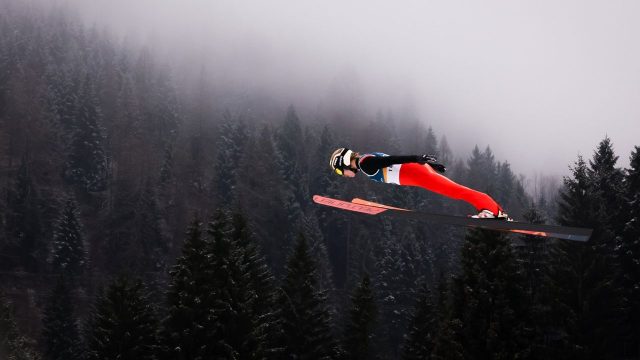
The International Olympic Committee has boasted that Milano-Cortina 2026 is “the most gender-balanced Olympic Winter Games in history”. But there’s actually one sport women don’t even get to try.
For all the claims about “the highest level of female participation in Winter Games history”, the door is “slammed shut” for women in Nordic combined, said The Independent. The three Olympic events where athletes compete in both ski jumping and cross-country skiing are strictly men-only, despite there being equivalent women’s World Cup and World Championship events.
‘Misogynistic mindset’
Nordic combined has been part of the Winter Olympics since its beginnings in 1924. It requires precision, courage, strength and endurance to follow the “daredevil thrill” of ski jumping with a “physically exhausting cross-country ski race”, said The Associated Press. It makes for a “two-day event unlike any other”.
Cross-country skiing has centuries-old origins in Scandinavian military training, which could be a partial explanation for the “misogynistic mindset” towards Nordic combined, said ABC News. But it’s the combination with ski jumping that seems to be the decisive factor. While women had to wait until 1952 to compete in single-discipline cross-country events at the Winter Olympics, they were barred from ski jumping until the early 2000s. For decades, they were “deemed too fragile to stand up to the rigours of repeatedly hurtling themselves off the side of a mountain”. And it’s only at these 2026 Games that women ski-jumpers will be allowed to jump off the same large hill as the men.
To complicate matters for those campaigning against Nordic combined’s Olympic gender imbalance, the sport as a whole is “in jeopardy” – because it “doesn’t have a big following” and only “a small number of countries dominate the podium”, said AP. The IOC has “put the entire sport on notice”, said The New York Times, telling it to boost the number of participating athletes, “the size of the audience” and “the diversity” of competing countries or “risk falling off the Olympic programme altogether”.
The women of Nordic combined are not just “stuck sitting on the sidelines” while the men compete, they are “relying on the men’s performance to keep the sport’s future in the Games alive”.
‘Glacial pace’ of change
Women have had a long fight for fair inclusion in the Olympics. They were excluded entirely from the first modern summer Olympics in 1896 and, when they were allowed to compete in Paris four years later, their participation was limited to a handful of sports, such as tennis, archery and croquet. Slowly, the exclusions for women have been mostly eliminated but the Winter Olympics, in particular, has changed “at a glacial pace”, said The Independent.
Female athletes staged a protest a fortnight ago at the Nordic combined World Cup, in Seefeld, Austria. They held up their ski poles at the starting line in the shape of an X, symbolising “no exceptions” for women’s inclusion at the Winter Games.
“I do what every single other athlete does,” US Nordic combined skier Annika Malacinski told The Washington Post. “I work my ass off to be where I am. And yet there’s one group of people telling me I’m not doing it hard enough.” I cried for eight hours when I found out the IOC wouldn’t open Nordic skiing up to us at Milano-Cortina but I will continue to campaign for inclusion at the French Alps 2030 Winter Olympic Games.
Female athletes excluded from participation in demanding double-discipline events at Milano-Cortina