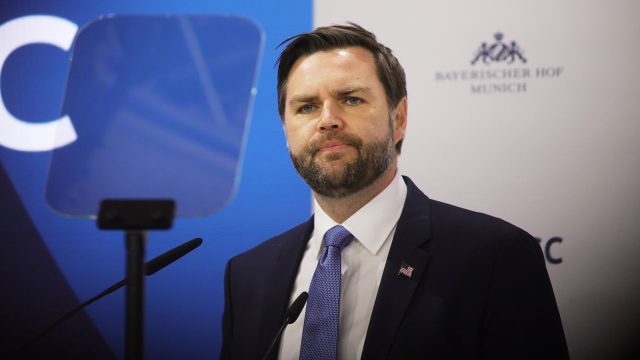
J.D. Vance opened last year’s Munich Security Conference (MSC) with an attack on the US’ European allies, stunning the world’s biggest defence summit.
In the year since, Donald Trump has published the new US national security strategy, which outlined the desire for “strategic stability” with Russia and accused European leaders of “civilisational erasure” – a document praised by the Kremlin. The president shook the foundations of the Nato alliance with his threats to seize Greenland, imposed tariffs on friend and foe alike, and undermined Europe’s defence of Ukraine.
Ahead of this year’s conference, which begins today, a report prepared by the MSC warns that the era of depending on the US is nearing the end. “Europe has come to the painful realisation that it needs to be more assertive and more militarily independent from an authoritarian US administration that no longer shares a commitment to liberal democratic norms and values,” it said.
What did the commentators say?
The MSC report “sets the scene for an all-out ideological confrontation with the Trump White House”, said The Guardian’s diplomatic editor Patrick Wintour. The president’s remarks disparaging European Nato soldiers who fought alongside the US in Afghanistan caused “deep offence” among Europe’s military leaders. The MSC report also accuses Trump of having “a lust for destruction and of siding with Vladimir Putin”.
There are also “strong suspicions” that Germany’s hard-right Alternative for Germany was only invited to the MSC following “pressure from the Trump administration”, said The Telegraph’s Berlin correspondent James Rothwell. The AfD was banned from the conference for two years for its “pro-Kremlin views”. Its attendance has “caused a furore” and there are fears the party will “use the summit as an opportunity to spy” – possibly for Russia.
Sergej Sumlenny, co-founder of the European Resilience Initiative Centre, a security think tank, has urged guests to “keep quiet about state secrets in the presence of AfD members” because whatever “sensitive topics” you’re talking about “stands a chance of making it back to Moscow”.
This year, Marco Rubio will be leading the US delegation. The “generally more restrained and tad more diplomatic” secretary of state is unlikely to emulate Vance’s “daylight throttling” of last year, said Politico’s Jamie Dettmer. But even if he does, Europeans are “becoming almost inured to Trumpian jolts”.
The focus in Munich will therefore be on “the practical steps necessary to de-risk” from the US, reduce reliance on its technology and military, and “forge a much more independent” path with the Canadians, who are “now honorary Europeans”. Basically, this MSC will be about how Europeans “can stand on their own two feet”.
But Nato Secretary General Mark Rutte spoke for many in the highly divided, deeply gloomy bloc: if EU lawmakers think they can do without the US, “keep on dreaming”, he said. “You can’t.”
The “unquestioned assumption of transatlantic cooperation” that always underpinned the MSC has been “upended”, but Europe’s dependence on US military support “will take years to undo”, said Reuters. It will also leave the continent “vulnerable”.
Plus Europe–US security ties have been damaged, but “they have not disintegrated”, said the BBC’s security correspondent Frank Gardner. “We still benefit enormously from our security and military and intelligence relationship with America,” said Alex Younger, former chief of MI6.
Ultimately, this MSC should “provide some answers on where the transatlantic alliance is heading”, said Gardner. “They just may not necessarily be what Europe wants to hear.”
What next?
On arriving in Munich, Rubio struck a “warmer tone” than Vance managed last year, said Reuters. But the Trump administration’s direction remains clear: Rubio’s next stops in Europe are Hungary and Slovakia. Washington has “hinted”, said Politico, “that it could assist ideologically allied European parties”, such as the nationalist regimes of Viktor Orbán’s Fidesz in Hungary or Slovak Prime Minister Robert Fico’s Smer.
“In an era of wrecking-ball politics, those who simply stand by are at constant risk of entombment,” the MSC report argues. Relying on “sterile communiqués, predictable conferences, and cautious diplomacy” is doomed to failure. “Effectively pushing back against the demolition men requires much more political courage and innovative thought. The actors defending international rules and institutions need to be just as bold as the actors who seek to destroy them.”
Those who “oppose the politics of destruction” have to “become bold builders themselves”. “Too much is at stake. In fact, everything is at stake.”
Report suggests European leaders believe they can no longer rely on the US for military support – but decoupling is easier said than done