The last time I spoke to Gregory Maqoma, he was retiring.
Or at least that was the language we reached for then, retirement, an ending, the quiet folding away of a body that had carried the emotional and political weight of South African contemporary dance for over two decades.
He was stepping off the stage, he said, hanging up his dancing boots, loosening his grip on the centre of the frame. It felt final, like the closing chapter of a long incandescent book.
And yet here we are speaking again, not about an ending but about Genesis.
“I never said I was stopping work,” Maqoma corrects gently, when I bring this up. “The break is me not being on stage.”
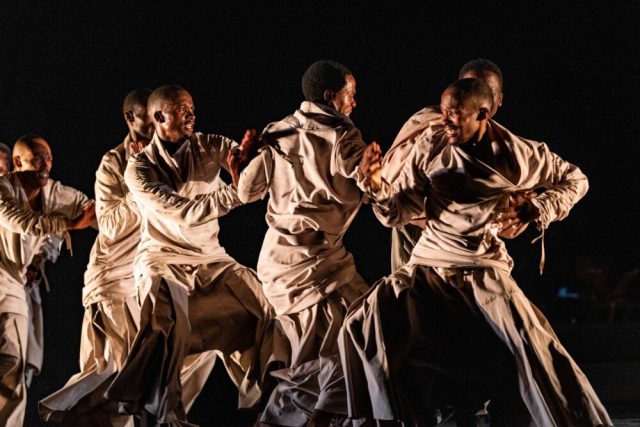
That distinction sits at the core of Genesis, Maqoma’s latest work and his return to the Baxter Theatre for its world premiere from 18 to 21 February 2026. Framed as a groundbreaking dance opera fusing dance, music and poetry, Genesis is not a comeback to the stage but a reconfiguration of power, labour and vision. Maqoma is no longer the body through which the work speaks. He is the architect.
Renowned choreographer Maqoma is the founder and creative director of Vuyani Dance Theatre, established in 1999.
“For the last 25 years, I have been on stage,” he says. “I now step out of that so I can really be involved in the choreography and the making of work and not the literal form.”
What emerges from that stepping back is a work of formidable ambition. Genesis, subtitled The Beginning and End of Time is a poetic and visceral meditation on creation, collapse and the possibility of beginning again. It follows Maqoma’s critically acclaimed Exit/Exist (2023) and Cion: Requiem of Ravel’s Bolero (2024), both of which enjoyed triumphant seasons at the Baxter and together form a loose philosophical continuum. But where those works were anchored by Maqoma’s own body as protagonist, Genesis disperses authorship across an ensemble, a score, a libretto, a stage picture that feels at once expansive and intimate.
At its conceptual centre is a desire to return, not nostalgically but radically.
“Genesis is a desire to return to the beginning of time,” Maqoma explains, “but also to allow ourselves to immerse in the revolutionary ideas of those people who have spoken quite extensively about Black consciousness and how we need to tune into our humanity — the sense of consciousness of who we are and culture being the datum that should lead in on spirit.”
This is not abstract theorising. Maqoma situates Genesis firmly within the present moment, shaped by contemporary leadership, global instability and the repeated failure of systems that continue to produce inequality and violence.
“I’m looking at the world leaders currently and the decisions that they are making that are affecting humanity,” he says. “And this word Genesis is saying we must begin again. Maybe we need to pause and restart. And perhaps through that, we can be able to eradicate all that has failed, including those who are leading us into tragedy.”
It is a sobering proposition but one that resonates deeply within Black intellectual and artistic traditions. The work leans heavily into Black Consciousness philosophy, not as a historical reference point but as an unfinished demand.
“We see history itself but we haven’t really got it,” Maqoma says. “We haven’t listened. We haven’t acted in a way that the sense of consciousness of who we are can really prevail and really lead in the operations of how we conduct ourselves as Black people.”
He speaks about borders, land, redistribution concepts that are widely discussed and endlessly debated but rarely embodied in lived practice.
“We know about it,” he continues. “But we have not really put it into our conduct.”

Everything, Maqoma says, is architectural. Photo: Arthur Dlamini
For Maqoma, dance is the space where that embodiment becomes possible. Asked how such dense philosophical material translates into movement, he returns again to the body, not as metaphor but as structure.
“The body is an architecture,” he says. “That’s how I’ve been treating it. We carry all these insurmountable world phenomena in our bodies, in our minds and in our thinking. We are aware of them and they have taken a toll on us. They weigh on our bodies.”
Creation then becomes an act of release.
“When we create work, it’s for me to unleash that weight, to offload that weight,” he explains. “And to allow others who work with me, through music, through design to build on that architecture as well.”
This is why Genesis is described as a dance opera. Not as a borrowing from European forms but as a reclamation of something that has always existed within African performance traditions.
“We cannot separate music from the dance, or the dance from the music, as well as storytelling,” Maqoma says. “Our ancestors used to tell stories under the tree, with a dancer and singing being part of that. That whole experience was put apart by Eurocentric ideas of making theatre, of making dance separate. With this work, we are saying as part of this Genesis, we reclaim what has been lost.”
The creative team assembled for this work embodies its holistic vision. A live musical landscape is performed by Mthwakazi Chosi, Annalyzer, Yogin Sulaphin and Xolilisle Bongwana, under the musical direction and with additional composition by Nhlanhla Mahangu. Poetry is delivered by Anelisa Phewa, while a libretto by acclaimed writer Karthika Nair grounds the work in lyricism and imagination.
Visually, Genesis is approached with equal rigor. Costumes by Jacques van der Watt of Black Coffee Fashion frame the body without overwhelming it, while lighting by Oliver Hauser and set design by Willy Cesar foreground space, line and form. Everything, Maqoma says, is architectural.
“The setting itself, the music itself, the questions, everything is architectural in its movement,” he explains. “The costume does not take over the conversation around the body. It becomes the bone.”
“By removing myself from performing, that in itself is something of a different degree for me,” he reflects. “But more importantly, Genesis takes on a very different approach to movement.”
It is, by his own admission, his most daring work to date.
“It is expansive. It is immersive. It is brave,” laughing softly. “I thought Exit/Exist was brave. But this has really pushed me onto the edge of making theatre and I like it. I like to push myself. I like to challenge other artists that I work with.”
And yet, for all its scale and ambition, Genesis is also deeply intimate. It asks audiences not simply to watch but to sit with discomfort and memory and the unsettling possibility that what we need most is not progress but return.
Returning to the Baxter Theatre, Maqoma says, feels profoundly significant.
“The Baxter has long been more than a venue in my journey,” he notes. “It has been a partner in my becoming a dancer and choreographer. Their support allows me to confront time itself in Genesis, its violence, its grace and its invitation to begin again.”
After Cape Town, Genesis will transfer to the Joburg Theatre from 19 to 22 March 2026, before embarking on an international tour. Maqoma’s calendar is full, he has work in the UK, multiple productions running back to back but there is no sense of burnout in his voice. Only momentum.
Listening to him now, it becomes clear that retirement was never the story. Transformation was.
Genesis does not announce the end of Maqoma’s artistic life. It marks a reorientation, away from the singular body, towards a collective imagining of what performance, consciousness and humanity might still become.
The renowned choreographer returns to the Baxter not as performer but architect, with Genesis, a daring meditation on beginnings, endings and Black consciousness