‘Hated by All the Right People: Tucker Carlson and the Unraveling of the Conservative Mind’ by Jason Zengerle
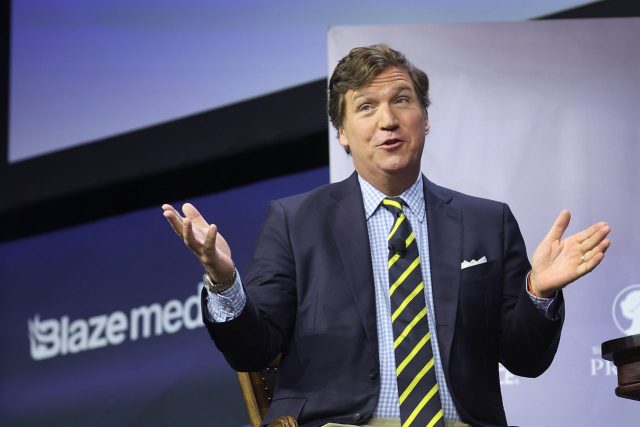
If you wonder how the GOP transformed from free-market champs to MAGA in less than 30 years, “you could do worse than using the arc of Tucker Carlson’s career as your lens,” said Jennifer Burns in The New York Times. “And if you’re looking for insight into the right-wing pundit’s transformations, you’ll definitely want to read Jason Zengerle’s breezy, entertaining, and ultimately disquieting Hated by All the Right People.” The veteran political reporter, currently a New Yorker staff writer, first met his subject when Carlson was a talented Weekly Standard writer and bow-tied rising young star of the center right. While the course that the 56-year-old Carlson’s career has taken since then should be disturbing to anyone who values responsible journalism, his story is “not so much a Greek tragedy as a particularly American one.”
Zengerle’s book, published by a new imprint created by three former Obama White House staffers, is “the first to reckon critically with arguably the most dangerous media personality of the Trump age,” said J. Oliver Conroy in The Guardian. Carlson, in his current incarnation as the host of a popular independent podcast, has moved even further to the right than he had when his 2016–23 Fox News program became cable news’s most watched show. But he remains in regular communication with President Trump and is considered a potential future presidential candidate himself. Zengerle’s “smart, well-written” book tracks Carlson’s career closely, reminding us of the pundit’s flameouts at CNN, PBS, and MSNBC as well as his 2010 bid, with the launch of The Daily Caller, to create a news site he believed might become the Right’s answer to The New York Times. Hated by All the Right People leaves some important questions unanswered, including whether Carlson truly believes some of the tinfoil-hat views he currently espouses. But Zengerle leaves no doubt about how he judges Carlson’s ethics, writing that his subject has “descended into madness.”
Was there “a definitive moment” when yesterday’s Carlson became the one we know today? asked Becca Rothfeld in The Washington Post. Zengerle’s account suggests the shift happened in steps, as TV and then the internet began rewarding extreme positions and Carlson repeatedly chose that path to fame and power. “Once Carlson became a slave to virality, his extremism was all but assured.” Today, the son of a Ronald Reagan appointee chats amiably on his show with Holocaust deniers, slurs Volodymyr Zelensky, and praises Vladimir Putin. It hardly matters what Carlson actually believes, because millions of listeners, including Trump, take cues from him. Thanks to his long pursuit of influence, “he has become disastrously entertaining.”
‘Football’ by Chuck Klosterman
“Football is unlike any book on the sport to come before,” said Zack
Ruskin in the San Francisco Chronicle. Chuck Klosterman’s new nonfiction best seller is “a hybrid of memoir, sports reporting, and cultural critique” that asks why America loves the game above all other pastimes. In 13 previous books, the 53-year-old North Dakota native “has written with equal fervor about the Boston Celtics, hair metal bands, and the practical limitations of time travel,” but he confesses that no subject has loomed larger in his mind than the violent, television-friendly game he has followed since childhood. Each of the 11 essays in this book offer “fresh, fascinating” perspectives, starting with the provocative notion that football’s cultural dominance can’t last forever.
“Klosterman’s thesis for why football so captures the American spirit isn’t completely novel,” said Derek Robertson in The Washington Examiner. “He argues in so many words that it represents the irreducible remainder of danger, bravado, and risk in human existence,” making it a game that invites morbid fascination. His suggestion that it’ll fade in importance rests on the notion that Americans’ relationship to danger will change enough over the next 50 or 100 years that disruptions caused by player strikes or shifts in the game’s financial infrastructure will be enough to sever fans’ deep connection to the spectacle. Horse racing, he notes, was huge when many Americans lived with horses. But a reader needn’t buy his doomsday pitch, because it’s “ultimately secondary to Klosterman’s trenchant, funny ruminations on the sport.”
“One of the most surprising and winning aspects of the book is how wonky it is, how obsessive about actual gameplay,” said Will Leitch in NYMag.com. Klosterman played high school ball and dreamed at the time of stalking the sidelines as an offensive coordinator for a major college team, and his love for the game’s minutiae hasn’t diminished even as his perspective has deepened. Chapter topics include brain injuries, racism, and the best players of all time, and each time, “he digs deep, asking stirring questions,” said Edward Banchs in the Pittsburgh Post-Gazette. So persuasive are his predictions that Football will be “a book worth keeping around.”
A right-wing pundit’s transformations and a closer look at one of America’s favorite sports