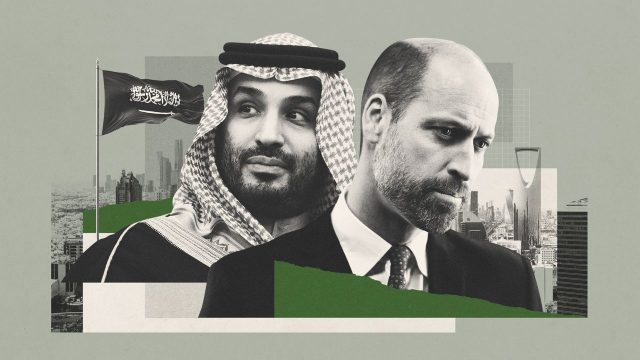
It’s a turbulent time for the monarchy, as fresh revelations in the Epstein files continue to increase scrutiny of the King’s brother. And now Prince William is walking a fine line – with a controversial visit to Saudi Arabia and an audience with Crown Prince Mohammed bin Salman, the man said to have ordered the brutal murder of dissident journalist Jamal Khashoggi.
The Prince of Wales arrived in Riyadh yesterday, on a three-day visit aimed at strengthening relations with a key allied power in the Middle East, despite its infamously poor human rights record. Kensington Palace said the trip was timed to mark 100 years of diplomatic ties between the UK and Saudi Arabia, and would “celebrate growing trade, energy and investment ties”.
What did the commentators say?
The fact that the UK government requested the trip is a sign of confidence that “a visit from the heir to the throne will help burnish ties”, said Megan Specia in The New York Times. William had met the Saudi prince, and de facto ruler of the kingdom, when he visited Britain in 2018, and has seen him fashion himself into a “major geopolitical power player” in the years since Queen Elizabeth II’s death. If William and MBS can “strike up a positive diplomatic rapport, this could lead to a meaningful future relationship between the countries”, royal historian Ed Owens told the paper.
After all, MBS is 40 and William is 43: the millennial princes will in all probability “reign in tandem, on opposite sides of the world, for decades”, said The Telegraph’s royal editor Hannah Furness. If William succeeds in “winning over” the leader of a country where political decision-making rest in the hands of dozen men, it could have “profound” consequences for the British economy. The Gulf state has invested an estimated £15.3 billion in the UK since 2017, and British politicians have been working to increase that.
As a monarchy, Saudi Arabia is “instinctively more comfortable dealing with fellow royalty rather than elected politicians”, royal historian Robert Hardman told Politico’s Sophie Inge. A foreign secretary or ambassador “cannot open the sort of doors and generate the sort of mood music that a senior member of the royal family can”. The royals’ longevity, compared to “here today, gone tomorrow” politicians, enables the formation of valuable long-term relationships, said Eddie Lister, director of the Saudi British Joint Business Council. And, in the Middle East, “relationships are more important in business than anything else”.
But does Realpolitik mean that “the heir to the throne must cosy up to his murderous Saudi counterpart?” said Middle East expert Malise Ruthven in UnHerd. William has carefully “cultivated an image as a thoughtful, socially conscious public figure”. It “does not befit that persona” for him to associate with a regime implicated in “murderous violence, and repression”.
The British embassy described “the human rights picture as nuanced”, and it’s true that William is visiting a Saudi Arabia that “looks very different to the one his grandmother travelled to”, said the BBC’s royal correspondent Daniela Relph. But its criminalisation of same-sex relationships, oppression of dissent, “enormous limitations” on women’s freedom, and the lingering memory of Khashoggi‘s murder in 2018 mean that images of William with MBS “will be hard to stomach for many”.
What next?
This royal visit comes “hot on the heels of Trade Minister Chris Bryant’s tour of the Gulf last week”, said Politico. He reportedly said a trade deal with the Gulf Cooperation Council, which includes Bahrain, Kuwait, Oman, Qatar and the UAE, as well as Saudi Arabia, was “97.5% done”. William “may now be asked” to “work his royal magic” and “nudge it the remaining few percentage points”.
But the British prince should “decline any invitations to inspect MBS’s yacht, Serena”, said Ruthven in UnHerd. An anonymous Saudi activist claims Khashoggi’s fingers are “kept on board as a trophy”.
Government requested royal visit to boost trade and ties with Middle East powerhouse, but critics balk at kingdom’s human rights record