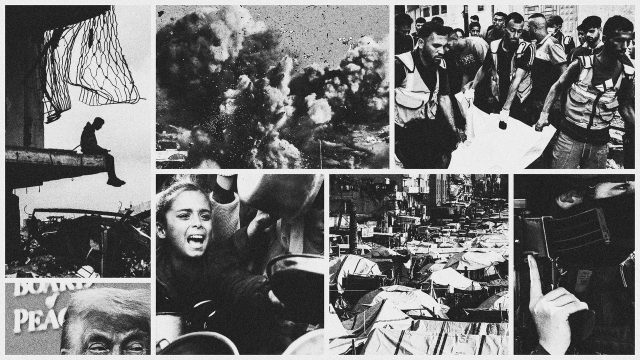
After the return of the final hostage taken during the 7 October attacks, phase two of the 20-point Gaza peace plan is under way. During this period, the plan requires Hamas to demilitarise, relinquishing its weapons, and for Israel to fully withdraw its troops from the region.
The return of the body of police officer Ran Gvili has “turned the page on arguably Israel’s darkest chapter”, said Henry Bodkin in The Telegraph. However, “in doing so, it ushers in an uncertain new era”.
What did the commentators say?
There is no doubt that the “situation changed” when the ceasefire came into effect on 10 October, but the balance of power “remains precarious in the almost entirely destroyed territory”, said Luc Bronner in Le Monde.
Since the ceasefire was introduced, more than 500 Palestinians have been killed – at “an average of just over 4.5 deaths per day” – with 1,400 more wounded, and three Israeli soldiers have been killed. This compares to around 92 deaths per day during the two years of conflict preceding the ceasefire, according to Ministry of Gaza records. What has become clear is that “it is neither full-scale war nor a true ceasefire”, said the outlet.
“Difficult questions remain unaddressed”, said Reuters. Phase two efforts have been “shaken” by Israeli attacks in the region, and Hamas resistance. Both Israel and Hamas have “shown little sign of narrowing their disputes”. Phase two success is contingent on the disarmament of Hamas, “further withdrawal of Israeli forces” and deployment of peacekeepers. “Many Israelis and Palestinians suspect Donald Trump’s plan will never be fully realised and a frozen conflict will continue indefinitely.”
The Gaza reconstruction effort is “better organised than many commentators seem to realise”, said David Ignatius in The Washington Post. Of course, progress towards peace faces “many obstacles”. Why would Hamas, whose existence is “about armed struggle”, want to “neuter itself”?
The jury is also out over whether Qatar and Turkey – two of its biggest supporters and now members of the Board of Peace – will pressure Hamas to sign a deal. Looking forward, Hamas will “want a share” of the projected “$25 billion [£18.2 billion] in investment in new utilities and public services”, which could provide “more than 500,000 jobs”.
Nevertheless, “any sensible person should wish success for the Board of Peace and its courageous Palestinian representatives”. The Board of Peace may appear a “stunt” to many, but there is a “real plan”, “anchored” in UN resolutions. This is different from other Trump-led ventures: it is an “attempt at systematic implementation”. It may be a “long shot”, but it’s the “best chance” to create a Gaza controlled “by its people”, not by Israel or Hamas.
Gaza has to be approached differently, said Nidžara Ahmetašević in Al Jazeera. If current plans go ahead, the region will be “on its way to becoming a semi-protectorate, just like Bosnia”. The peace plan may promise to end attacks, but it “institutionalises endless external control”. The Dayton Accords, which brought the Bosnian War to an end 30 years ago, excluded Bosnian citizens, and the “same logic underpins” the proposed plans in Gaza: “peace negotiated about a people, not with them”. “Peace that merely stops violence without enabling freedom and dignity is not peace.”
What next?
At home, Israeli Prime Minister Benjamin Netanyahu will have to fight to stave off challengers to his position, mainly from some relatives of hostages, said Bodkin in The Telegraph. The “bring them home” movement has been an “uncomfortable voice” in Netanyahu’s ear, and has ignited “intense feelings of solidarity” across the country”.
According to current polling, should Yonatan Shamriz – whose brother was killed in December 2023 – start his own party, he could win six Knesset seats, providing a “significant block” to the current PM.
“Ultimately, the question is whose clock is ticking with a greater sense of urgency,” said Dennis Ross and David Makovsky in Foreign Affairs. Israel has “made clear” that it will resort to violent action if the voluntary disarmament falls through, giving a deadline of six months after the initial ceasefire.
Trump’s role will be key, having to “apply sustained leverage” on all parties, backed up by states that have influence in the region. If this phase fails, the “future looks bleak”. At best, the territory will stay partitioned and, at worst, “Gaza will once again become a war zone”.
Since the ceasefire agreement in October, the situation in Gaza is still ‘precarious’, with the path to peace facing ‘many obstacles’