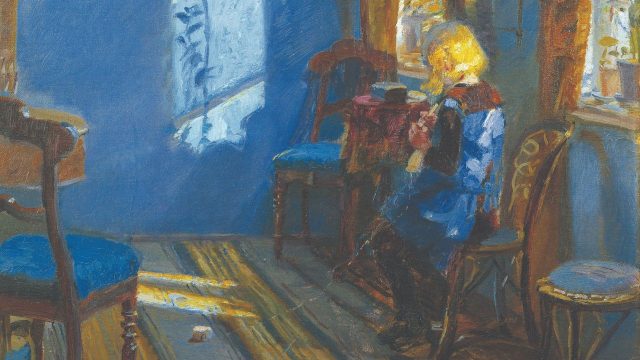
Skagen is “a remote fishing port at the northernmost tip of Denmark”, said Chloë Ashby in The Times. A wild beauty spot where the North and Baltic seas meet, it is today a magnet for Copenhagen’s elites in the summer. But in the late 19th century, it was home to “a thriving community of international artists” attracted by Skagen’s landscape and the qualities of its light. Anna Ancher (1859-1935) was its innkeeper’s daughter, aged just 12 when this bohemian influx to her home village began. Clearly, it sparked something: Ancher went on to make herself one of Denmark’s best-loved painters. The young Anna, keen to learn how to paint, had “unofficial teachers on tap”.
Later, she married an artist, Michael Ancher, and lived in Copenhagen and in Paris, where the efforts of the impressionists inspired her to return to her hometown and paint similar scenes. She painted portraits, seascapes, still lifes and interior scenes, all meticulously recreating the village’s famous light. Bringing together more than 40 paintings, this exhibition gives British audiences previously unacquainted with her work an introduction to Ancher’s bold and singular art.
Entering the exhibition “feels like walking into a pat of butter, or perhaps, more aptly, a ray of sunlight”, said Eliza Goodpasture in The Guardian. The gallery’s “luscious pale yellow walls” set the tone for this exploration of Ancher’s “practice of painting light”. Most of the works on show record “her home or that of other members of the Skagen community”, revisiting the same subjects again and again but refining them every time. Some of “the most moving” paintings here depict her mother: in one, she’s a “shawl-swathed figure” dissolving into abstract tones of red and thence raw canvas. Another sees her leaning over the coffin of her daughter Agnes, “drenched in shadow” while the deceased is “almost completely washed-out in white”.
Ancher avoided grandiosity, said Lucy Waterson in Apollo. Instead, she gave her pictures a “softer, more domestic focus”. The people in her paintings – a working woman in “The Maid in the Kitchen”, or “patient mothers and their squealing children” in “A Vaccination, Study” – are shown performing “mundane tasks, painted without drama or exaggeration”. But it’s the light in her works that really grabs the attention: it “streams in through windowpanes or shines bright through linen curtains”, but is best captured in “pared-back studies” such as “Evening Sun in the Artist’s Studio at Markvej”, depicting a corner of her workspace patterned with light on a wall. Among a handful of landscape studies, meanwhile, is the gorgeous “Moorland” – in which a green plain stretches out below a “candy-coloured sky” – and “Blue Sunset”, capturing a rare moment of stillness on Skagen’s beach. This exhibition wonderfully showcases Ancher’s “virtuosic handling of the shifting Nordic light”.
Dulwich Picture Gallery, London SE21. Until 8 March
Dulwich Picture Gallery show celebrates the Danish artist’s ‘virtuosic handling of the shifting Nordic light’