
Andrea Rodríguez (AP News) wrote about Santería rituals in Cuba as 2026 gets under way. In another article (Los Angeles Times), Rodríguez explained that the yearly predictions, La Letra del Año 2026, announced that Oggún will be the ruling deity (lord of metals and roads), accompanied by Oshún (orisha of love and fresh water). The sign foretells a year of intense conflicts, political instability, and the need to seek unity and dialogue to overcome crises. Here are excerpts.
As tensions rise between the United States and Cuba and the island braces for more economic difficulties, priests and priestesses of the Afro-Cuban religion known as Santería held several ceremonies on Sunday, offering gifts to deities and asking for peace.
Several leading figures in the Santería community prayed for the “spiritual healing” of the Cuban people and an end to the violence and conflicts that, according to their predictions in late December, would characterize this year.
They chanted in ancient Yoruba, brought to the island by enslaved Africans and passed down orally. African and Spanish traditions syncretized, giving rise to Cuba’s strong Afro-Cuban identity.
“We…believe that through sacrifices and prayers we can alleviate the impact of harmful issues,” said Lázaro Cuesta, a renowned priest who organized the ceremony in the courtyard of an old house.
On Jan. 2, Cuban Santería priests known as babalawos predicted the possibility of war and violence that would affect Cuba and the world using traditional divining methods.
A day later, on Jan. 3, the United States struck Venezuela’s capital, Caracas, and arrested then-President Nicolás Maduro. Thirty-two Cuban soldiers from Maduro’s personal security detail died in the operation.
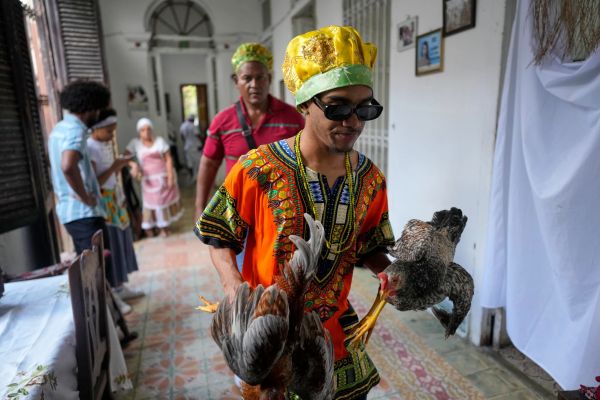
At the foot of a leafy mango tree swaying in the breeze, a hen, a rooster and a dove were sacrificed. Around them, several dozen babalawos raised their voices in prayer, repeatedly asking Eggun, the deity of the ancestors, for permission to invoke his power and presence. [. . .]
Dressed in white, wearing necklaces and headdresses, they made their offering to Azowano, one of the forms Saint Lazarus takes in their religion. They knelt before a large basket and bowls filled with beans, corn, and even two eggs, a generous offer since they are expensive in Cuba. Afterward, several hundred people formed a single file, circled the basket and were finally “cleansed” after being swept with two live chickens while the attendees chanted in Yoruba. [. . .]
For full article, video and photos, see https://apnews.com/article/cuba-santeria-peace-deities-us-venezuela-0919aedc8a60943708057ad3ce4d3970
Andrea Rodríguez (AP News) wrote about Santería rituals in Cuba as 2026 gets under way. In another article (Los Angeles Times), Rodríguez explained that the yearly predictions, La Letra del Año 2026, announced that Oggún will be the ruling deity (lord of metals and roads), accompanied by Oshún (orisha of love and fresh water). The