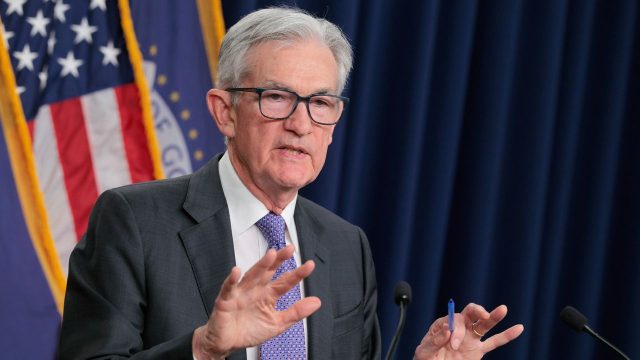
“In the annals of political lawfare there’s dumb, and then there’s the criminal subpoena federal prosecutors delivered to Federal Reserve Chairman Jerome Powell” last week, said The Wall Street Journal in an editorial. The feds accused Powell of lying to Congress about running over budget on the central bank’s $2.5 billion renovation project. But make no mistake: This “dubious” prosecution is really a “pretextual political assault” to force Powell out so that he can be replaced by someone who will do President Trump’s bidding. Powell issued an extraordinarily “defiant statement,” saying the charges were “a consequence of setting interest rates based” on evidence, not “the preferences of the president.” Lawmakers rushed to Powell’s defense, including Sen. Thom Tillis (R-N.C.), who pledged “to block a Trump nominee for Fed chair” until the “legal harassment” ended. But Trump continued to lob insults at Powell. “That jerk will be gone soon,” he said.
The idea to bring charges against Powell seems to have come from Bill Pulte, said Megan Messerly in Politico, who is also responsible for “some of the administration’s most outlandish economic policy messaging.” Pulte, the Federal House Finance Agency Director, visited the White House recently with “wanted” posters bearing Powell’s image. But the inquiry “blindsided” other aides and officials, including Treasury Secretary Scott Bessent, who had “spent months laying the groundwork for a smooth transition” to a new Fed chair “that wouldn’t rattle matters.” Bessent’s frustration is warranted, said Bill Dudley in Bloomberg. Piling pressure on the Fed to lower interest rates “will undercut Trump’s own aims.” There’s little chance Powell will back further rate cuts now because “investors would worry that the Fed’s independence has already been compromised.” It also motivates Powell to stay on as a Fed governor once his term as chair ends in May.
“Let’s pause to note the hilarity of Trump threatening to indict Powell over purportedly mishandling the ‘renovations of historic buildings,’” said Jeffrey Blehar in National Review. “Trump literally just demolished the East Wing of the White House without any sort of review.” But he seems to be taking a page from the Stalinist playbook: “Show me the man, and I will find you the crime.” A criminal investigation of a Fed chair “with the obvious intent” of forcing lower interest rates is unprecedented, said Thomas L. Friedman in The New York Times. “If the Justice Department can be leveraged to destroy the sacrosanct independence of the Federal Reserve,” it signals Trump is “completely unbound, and we are heading for economic trouble and constitutional ruin.”
There are other examples of government officials standing up to Trump, said Nick Catoggio in The Dispatch, but Powell’s act of resistance feels particularly remarkable. Few businesspeople have displayed the courage to push back on Trump’s demagoguery. But Powell “questioned the president’s motives explicitly and did it in a format designed to reach the widest possible audience.” It felt more “like the act of a whistleblower.” I think Powell “understands that he is one of the last few first-world bulwarks in American government resisting Trump’s project to ‘Maduro-fy’ it.” We all owe him for that.
Federal Reserve Chairman Jerome Powell fights back against President Trump’s claims