Many people in the UK are taking advantage of private schemes to reduce their energy bills, buying “zero-bills homes” not only to reduce their energy bills, but remove them entirely.
It comes as the government today launched its £15 billion “Warm Homes plan” in a bid to “upgrade the nation’s homes, help families cut their energy bills, and tackle fuel poverty”.
This will include providing zero-interest loans to homeowners to fund heat pumps, with a “Netflix-style” subscription for solar panel installation under consideration, said The Times.
What are they?
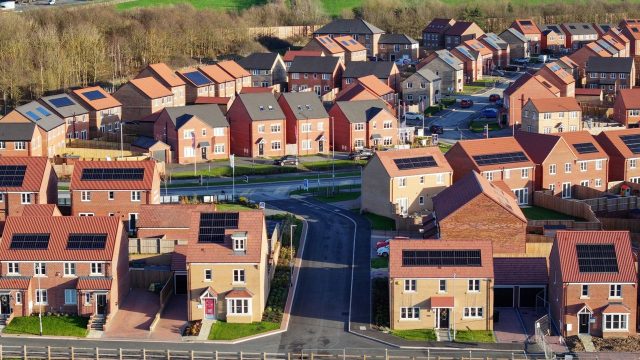
Zero-bills homes are fitted with solar panels, heat pumps and batteries, which generate more electricity than the resident uses. Any excess electricity is then sold back to the national grid, meaning the consumer’s monthly bills come to a grand total of £0. However, the scheme does not currently include electric vehicle charging, and is limited to a fixed time contract.
The main spearhead of the scheme is Octopus Energy, which became the UK’s largest energy supplier in 2024, said The Independent. The company works alongside developers – such as Barratt Redrow, the “country’s largest housebuilder” – to build homes which come fitted with “bill-busting” upgrades like solar panels, heat pumps and battery storage.
Under its tariff arrangements, Octopus “guarantees” that each property will “pay nothing for energy, even if it uses more than it generates”, for a fixed period of between five and 10 years, said This Is Money. The company makes enough revenue via “exporting excess energy” to the grid to make the scheme commercially viable.
Octopus’ reputation is rising in the industry, with the government recently taking a £25 million stake in Kraken – the company’s tech platform that automates and manages energy supply chains – to try to “persuade the business to choose London for a future stock exchange listing”, said the Financial Times. Kraken also manages Octopus Energy’s customer service, and smart grid operations using AI and data, and last month was valued at $8.65 billion (£6.4 billion).
What are the benefits?
“If done well, upgrading homes is an effective way to slash bills and reduce damp”, said Sky News. “Campaigners and industry have broadly welcomed the idea.” Octopus estimates that an average two- to three-bedroom house could save nearly £1,800 per year, based on current Ofgem price cap rates.
Switching would not only make sense financially, but have environmental benefits too, said The i Paper. Zero-bills homes, built from scratch, can contain “cutting-edge” ventilation systems, which bring “fresh air inside while capturing and reusing the heat from stale, outgoing air”.
On a broader scale, as more people shift away from gas, we should see a reduction in the UK’s gas imports, said Sky News. For the government, there could even be a “geopolitical value in weaning the country off gas”, and opting instead for clean power harnessed at home, rather than relying on purchases from abroad.
The switch to a zero-bills home “doesn’t necessarily come cheap, though”, said This is Money. Depending on the size of the houses, and if any of the accessories are pre-installed, the average cost of technology and installation can range from £5,000 to £20,000.
What are the next steps?
Octopus intends to “roll out” 100,000 homes on the zero-bills tariff by 2030, recently investing “£100 million to fund the initiative”, said The Independent. To date, 5,000 properties have been approved, with sizable developments taking place in Northampton and West Sussex.
Domestic installations of solar panels are “booming”, but “solar could also become a victim of its own success,” said David Strahan in The Telegraph. There is a “growing risk” that too much electricity will be exported into the grid in the middle of the day, when demand is low, which could lead to the industry being “penalised, as it has been in Spain, Australia and parts of China”.
However, if electricity tariffs continue to rise, what may appear to be “ostensibly bad news” for many, could make the prospect of zero bills “even more attractive”, said the outlet. Furthermore, if alternative energy sources falter, such as the government’s recent “troubles with the latest auction for offshore wind farms”, cheap solar energy could “become yet more valuable”.
The scheme, introduced by Octopus Energy, uses ‘bill-busting’ and ‘cutting-edge’ technology to remove energy bills altogether