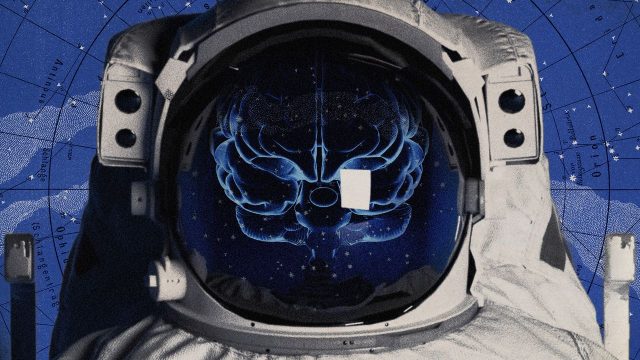
They say travel broadens your mind but, if you’re travelling into space, it could displace your brain.
Results of new study add to a growing body of evidence that astronauts’ brains change position and shape in space. The brain shifts “upward and backward within the skull”, with sensory and motor regions showing the largest shifts, according to a US study published in PNAS this month. These brain shape changes are “considerable”, can lead to disorientation and loss of balance, and can persist after return to Earth for more than six months.
This evidence of brain deformation “could complicate future efforts to explore the cosmos”, said Futurism.
Brain-shifting ‘sensory conflicts’
The researchers examined MRI scans from 26 astronauts who had been in space for varying amounts of time and compared them to scans of 24 Earth-bound volunteers who had been placed on bed rest for up to 60 days with their heads tilted back to simulate a microgravity environment. Both groups experienced changes in brain shape and position but the astronauts’ brains underwent a greater upwards shift.
Most of the astronauts’ brain deformation “recovered over six months post-flight” but “some persisted”, the study concluded. The “health and human performance implications” of these findings require “further study to pave the way for safer human space exploration”.
Those astronauts who went to space for a year “showed the largest changes”, said study co-author Rachael D. Seidler, an expert in spaceflight-induced neuroplasticity at the University of Florida. And those who had stayed in space for six months or longer still had upward movement that was “pretty extensive”.
“It’s in the order of a couple of millimeters,” Siedler told NBC News. That “doesn’t sound like a big number but, when you’re talking about brain movement, it really is”. And “we need to understand” the “sensory conflicts” these changes cause, “and their impacts”, so we can “keep astronauts safe and healthy and protect their longevity”.
Microgravity and Mars
The study findings have “implications for Nasa’s goals to conduct long-duration missions to the Moon and Mars”, said NBC News.
Scientists already knew that spaceflight could affect the brain, but this study is among the first to document how those shifts influence how astronauts function in space and back on Earth. Previous studies have also found that space travel can cause changes in the brain’s white matter, leading to sensorimotor issuesand a condition commonly known as Space Adaptation Syndrome.
Space travel has also been found to accelerate bone density loss and the destruction of blood cells, put pressure on the eyes that can cause vision problems, and lead to deterioration of muscle strength. Cosmic radiation poses a series of risks, such as cognitive impairment and blood-brain barrier damage.
But further research on the long-term effects of space on humans is hamstrung by the small available sample size. Although the number of long-duration human spaceflights has increased significantly over the past 15 years, they are still very rare.
“In short,” said Futurism, “we’re only beginning to understand how microgravity affects our brains”. More research “could prove invaluable” if we’re thinking of venturing “even deeper into space”.
Space shifts the position of the brain in the skull, causing orientation problems that could complicate plans to live on the Moon or Mars