What happened
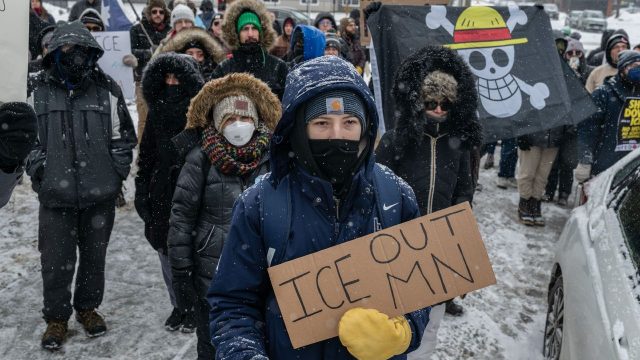
The Trump administration doubled down on its immigration enforcement operation in Minneapolis this week, as growing numbers of demonstrators took to the city’s streets to protest the fatal shooting of a local woman by an ICE officer and the increasingly brutal tactics used by immigration agents. Some 2,000 immigration officers were dispatched to the Twin Cities area last week for a sweeping crackdown tied in part to a welfare fraud scandal involving members of the Somali community in Minnesota. That deployment was met with protests by residents, among them Renee Good, a 37-year-old mother of three who was shot three times in her car by a veteran ICE agent. Cellphone footage of the killing fueled anger in the city, as did videos circulating on social media of armed, masked federal officers threatening to arrest protesters for following them; smashing car windows and dragging people out of vehicles; randomly stopping people on the street and asking where they were born; tear-gassing crowds; and in one case hauling away a young Target employee as he shouts, “I’m a U.S. citizen.” Minnesota sued the Trump administration to stop the surge of immigration agents, saying the deployment amounted to a “federal invasion.”
The White House appeared uninterested in de-escalating tensions. Homeland Security Secretary Kristi Noem said she was sending “hundreds more” federal agents to Minneapolis. Trump adviser Stephen Miller told ICE agents they have “federal immunity” and that “no city official, no state official” can stop them from performing their duties. President Trump posted online that the officers were in Minnesota to remove “murderers” and “drug dealers,” and told the state, “THE DAY OF RECKONING AND RETRIBUTION IS COMING!”
After the Justice Department blocked Minnesota officials from joining the investigation of the Good shooting, and pushed to investigate her wife’s ties to anti-ICE groups, six federal prosecutors in Minnesota resigned. Among them was First Assistant U.S. Attorney Joseph H. Thompson, who had led the investigation and prosecution of fraud schemes in the state. At least six career prosecutors in the Justice Department’s Civil Rights Division also resigned, soon after discovering there would be no civil rights probe of the shooting.
What the columnists said
Thompson and his colleagues were right to resign, said Rochelle Olson in The Minnesota Star Tribune. As career professionals, they knew Trump’s DOJ was not interested in “an evidence-based conclusion” on Good’s shooting, but instead wanted to exonerate the ICE agent, Jonathan Ross. That’s why, within hours of the killing, Noem, Vice President JD Vance, and other administration officials were denouncing Good as a “terrorist” and “deranged leftist.” Those words have turned “Minnesota streets into a powder keg” and raised questions over whether “we remain a nation bound by laws.”
The problem in Minneapolis “isn’t ICE, it’s ICE Watch,” said Dan McLaughlin in National Review. This coalition of activist groups, with which Good and her wife were reportedly involved, tracks the movements of federal immigration agents and tries to hamper their operations. So-called ICE Watchers block traffic—like Good did before she was shot—and shove cameras in officers’ faces to “create headline-grabbing conflict and drama.” This time, that foolish behavior yielded something tragic.
Public opinion is turning against ICE, said Peter Hamby in Puck. According to an Economist/YouGov poll, 69% of Americans have seen footage of the Good shooting and of those a majority said the killing was not justified. Only 30% thought it was justified. ICE is now 14 points underwater in its net favorability rating, down 30 points since Trump’s inauguration. Even Trump-supporting podcasters from the manosphere are repulsed by ICE’s actions. “Are we really gonna be the Gestapo,” Joe Rogan asked this week. “‘Where’s your papers?’ Is that what we’ve come to?”
It seems that way, said Mara Gottfried in the St. Paul, Minn., Pioneer Press. Elizabeth Lugert-Thom, of St. Paul, said officers knocked on her door and “specifically asked me if I knew where the Hmong families” and “the Asian families” lived in the area. City Council Member HwaJeong Kim said she’s heard of numerous instances of people being grabbed from the streets. “If you are Black, if you’re Brown, if you are Asian, Latina, even Indigenous, if you are just not white,” she said, “at this point, you are a target.”
We’re headed toward “a large-scale conflagration,” said Jay Caspian Kang in The New Yorker. As Trump deploys more agents to U.S. cities, more people will take to the streets. Americans, after all, “do not respond well to thousands of federal masked agents running around their neighborhoods.” The administration is trying “to scare ordinary people into giving up” by telling agents they can do what they want—even kill, said Amanda Marcotte in Salon. But it’s not working. Community organizers in Minneapolis have seen a spike in volunteers. “Ordinary people are refusing to comply.”
“The resistance libs were right,” said Michelle Goldberg in The New York
Times. They’ve warned us that the “emotional core” of Trump’s movement “has been textbook fascism”—the sense of victimization, dread of the other, and the taste for violence. Those warnings didn’t become reality in his first term, because he lacked a paramilitary force. Well, now he has ICE, which has killed a U.S. citizen in Minneapolis and is seeking new recruits with an ad that declares, “We’ll Have Our Home Again,” part of the refrain of a white nationalist anthem. Whether we call it fascism doesn’t matter; what counts is that we wake up to this country’s “likely trajectory.”
What next?
While it’s a virtual certainty Jonathan Ross won’t face federal charges for shooting Renee Good, Minnesota prosecutors could try to bring a case against the ICE agent, said Shaila Dewan and Jonah E. Bromwich in The New York Times. But they would face “many obstacles.” The Constitution bars state prosecution of federal officers who were performing an act they were legally “authorized to do” and did “no more than what was necessary and proper.” The state would have to show Ross exceeded those bounds, and “success is rare.” On Capitol Hill, progressive Democrats “are pushing for an all-out fight” to rein in ICE, said Manu Raju and Sarah Ferris in CNN.com. They want the party “to hold firm” against passing a government-funding bill without conditions such as requiring agents to wear ID and show their faces. But they face resistance from moderates “eager to avoid another huge funding showdown,” and party leaders have so far shown no inclination to play hardball.
Federal agents and protesters clash in Minneapolis