
An Amazon river lodge
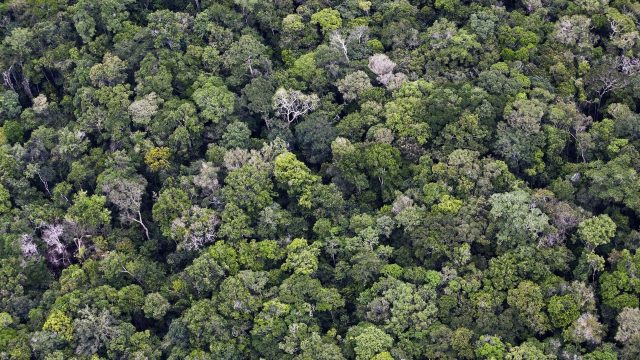
A “vast, pristine” river archipelago in the heart of the Amazon rainforest, Brazil’s Anavilhanas National Park is a place of “otherworldly” beauty, said Idra Novey in Travel + Leisure.
It lies on the Rio Negro, a tributary of the Amazon which, owing to its acidic water, is mercifully free of mosquitoes, so visitors needn’t take malaria pills. On a recent trip, my family and I stayed at the luxurious Anavilhanas Jungle Lodge, where I swam in the river at sunset every day, spotting spider monkeys in the overhanging branches and families of pink river dolphins playing.
We visited a riverside village, and hiked for an hour to a cave complex where we saw a towering angelim pedra tree (the tallest of all tropical species) with exposed roots “as elaborate as a Gilded Age chandelier”. Yet more wondrous were our boat trips through the flooded forest, where the immense old trees were reflected in the river’s black surface as in a “shadowy chamber of mirrors”.
And at night, when our guide scanned the forest with a torch, we saw an extraordinary range of creatures, including sloths, caimans and a boa constrictor.
The writer travelled with the specialist tour operator Dehouche.
Bears and bison amid Romania’s high peaks
The Southern Carpathian Mountains of Romania are home to Europe’s largest unbroken area of forest, pierced by “epic” limestone ridges and roamed by wolves and bears.
Logging companies have chipped away at it since the fall of communism, said Toby Skinner in the Financial Times, but in recent years, philanthropists including the Swiss billionaire Hansjörg Wyss have bought up large tracts to protect them under the auspices of the Foundation Conservation Carpathia. The aim is to create a 200,000-hectare national park, “the Yellowstone of Europe”, and rewilding work is already under way.
On a week-long trip with the European Nature Trust, I stayed in lodgings ranging from the aristocratic Zabola Estate to a “cosy” log cabin in the mountains. On guided hikes, I ventured deep into virgin forest where the beech and fir trees were up to 500 years old, and watched a family of bears at close quarters from a hide.
Most “magical”, however, was a chance sighting in a high mountain meadow of a herd of European bison, a species that was reintroduced here in 2020.
The trip costs from £3,500pp; the European Nature Trust.
Walking in the wilds of northern Japan
The northernmost quarter of Japan’s main island, Tohoku was the region worst hit by the 2011 earthquake and tsunami. Eight years later, a 600-mile hiking path was opened along its east coast, said Adam H. Graham in Condé Nast Traveller, as part of efforts to draw visitors back.
Passing memorials to the roughly 20,000 people who died, the Michinoku Coastal Trail wends through woodland groves, along “immaculate” beaches and “blustery” sea cliffs.
On a trip last year, I hiked four of its most spectacular sections and also ventured further inland, to walk for a day along the Oirase Gorge. Set in the Towada-Hachimantai National Park, this path follows a river through an ancient beech forest that owes its “rich” biodiversity partly to the region’s volcanic soil.
There are “abundant” waterfalls, and a chance of spotting bears, tree frogs and tanuki (raccoon dogs). I saw trees I’d never heard of, from white-bark magnolias to Manchurian elms, and was glad I was there in November, when the forest was “ablaze” with autumn colour.
Inside Japan has an 11-night trip from £4,456, including flights.
Reconnecting with historic nature across the world


