
Alina Cohen (Artnet) describes Jean-Michel Basquiat’s most expensive artworks, explaining that “his top auction result briefly made him the most expensive American artist of all time.” What I find interesting about this article is that Cohen provides interesting commentary on the paintings and the conditions that inspired their subject matter. Here are excerpts; for full description, prices, and photos of the artwork, go to Artnet.
By the time he was 23, Jean-Michel Basquiat had dated Madonna, sold artwork to Debbie Harry, participated in Documenta, and shown at Gagosian. By age 27, he was dead. If the artist’s mythic rise and tragic end are the stuff of legend, his paintings chart an even more epic course. Basquiat’s expressive works synthesize the aesthetics of both graffiti and the Italian Renaissance, metabolizing anatomy, history, and mythology all at once.
The scale of Basquiat’s ambition, the trajectory of his life, and his close relationships with some of the art world’s most powerful figures (Warhol was a close friend) created a powder keg for his market, which exploded about a decade ago. Below, we examine the artist’s top five results, including the most expensive artwork by an American artist ever sold at auction.
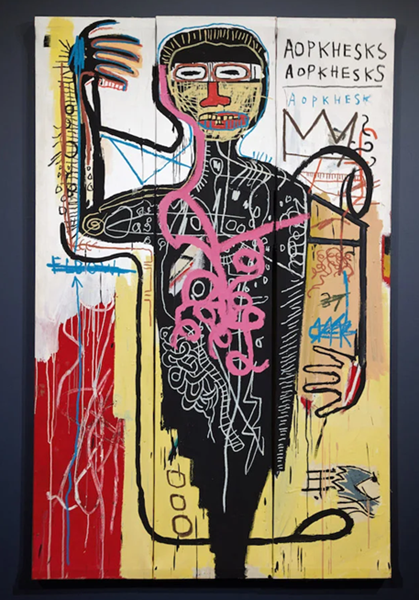
5. Jean-Michel Basquiat, Versus Medici (1982)
[. . .]The title references the powerful Medici family whose Renaissance-era patronage shaped the history of western art. Basquiat visited Italy in 1981, and his three-panel composition evokes Leonardo’s engagements with anatomy. The artist rendered a larger-than-life black body, filled with a jazzy tangle of intestines. To the side is a crown that conveys who’s really king. (It’s him.)
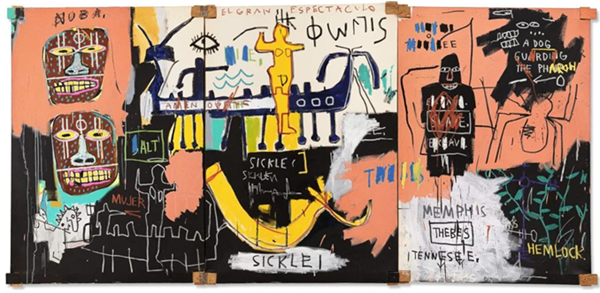
4. Jean-Michel Basquiat, El Gran Espectáculo (The Nile) (1983)
[. . .]Basquiat’s 12-foot-long triptych El Gran Espectáculo (The Nile) epitomizes the epic scale of the artist’s ambitions. Via word and image, Basquiat references Ancient Egypt, slavery, and, according to his alternate title, “The History of Black People” at large. [. . .]
3. Jean-Michel Basquiat, Untitled (1982)
[. . .] 1982 was a watershed year for Basquiat. Annina Nosei Gallery, New York hosted the artist’s debut solo exhibition. He became the youngest artist invited to participate in that year’s prestigious Documenta presentation in Kassel, Germany. Gallery shows with Bruno Bischofberger, Fun Gallery, and Galerie Delta Rotterdam swiftly followed.
Amid these successes, dealer Emilio Mazzoli invited Basquiat to visit Modena, Italy, where the artist produced Untitled (1982) and other monumental, career-defining canvases. This expressive self-portrait likens the artist to a devil, emerging from a fiery backdrop of creativity and rage. [. . .]
2. Jean-Michel Basquiat, In This Case (1983)
[. . .] Basquiat’s top auction lots are two of the artist’s three monumental skull paintings. Eli and Edythe Broad acquired the third, Untitled (1981), the year after it was painted, and it hangs at their eponymous Los Angeles museum. Art historians connect Basquiat’s most prized motif with vanitas paintings—Dutch still lifes that often featured skulls and reminded viewers of their own mortality.
In This Case (1983) blends anatomical specificity, exemplified by an intricately shaped eye and teeth, with mechanized figures and a bright red backdrop that is indistinguishable from the head itself. [. . .]
1. Jean-Michel Basquiat, Untitled (1982)
[. . .] The work’s frenetic energy, its blending of precision and apparent improvisation, and its amalgam of interior and exterior worlds made it exceptional. The new price tag helped it enter the pantheon: Basquiat became the most expensive American artist of all time, until he was supplanted by his friend Warhol, in 2022.
[Shown above: 1) Jean-Michel Basquiat, Versus Medici (1982). Image Courtesy Sotheby’s. 2) Jean-Michel Basquiat, El Gran Espectáculo (The Nile) (1983). Courtesy Christie’s Images Ltd 2023.]
For full article, see https://news.artnet.com/market/top-lots-jean-michel-basquiat-2726806
Alina Cohen (Artnet) describes Jean-Michel Basquiat’s most expensive artworks, explaining that “his top auction result briefly made him the most expensive American artist of all time.” What I find interesting about this article is that Cohen provides interesting commentary on the paintings and the conditions that inspired their subject matter. Here are excerpts; for full