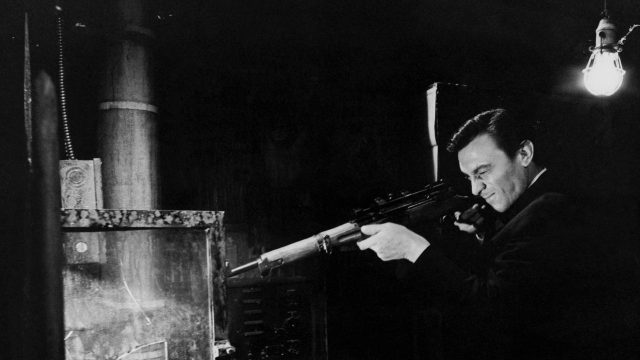
Filmmakers and audiences remain fascinated with glamorous, globe-trotting double agents and their efforts to steal, retrieve or secure information, people or weapons deemed vital to a country’s national security. Some of the best examples deploy some of Hollywood’s most luminous stars, from Robert Redford to Jessica Chastain, to make us contemplate the nature of spycraft and the sometimes morally compromised leaders and causes they serve.
‘The 39 Steps’ (1935)
Alfred Hitchcock, had directed more than a dozen mostly forgotten feature films before hitting it big with a pair of back-to-back suspense thrillers, “The Man Who Knew Too Much” in 1934 and then “The 39 Steps” in 1935. The plot revolves around Hannay (Robert Donat), a Canadian in London unwittingly drawn into an espionage ring when a woman is murdered in his flat.
He flees to Scotland and falls in with Pamela (Madeleine Carroll), seeking to clear his name and unravel the mystery of the titular spy ring dedicated to stealing British military secrets. A “taut thriller,” the film’s “theme of the innocent man trapped in a web of intrigue was one Hitchcock would visit so regularly that the term ‘Hitchcockian hero] became shorthand for such characters,” said Saptarshi Ray at The Guardian. (Prime)
‘The Manchurian Candidate’ (1962)
Perhaps the ultimate cinematic expression of Cold War paranoia, “The Manchurian Candidate” was released, incredibly, during the Cuban Missile Crisis of October 1962, as hundreds of millions of Americans lived in fear of an imminent Soviet nuclear strike. Decorated Korean War veteran Raymond Shaw (Laurence Harvey) was brainwashed in captivity and is now a Sino-Soviet sleeper agent with a plan to overthrow the American government.
Major Bennett Marco (Frank Sinatra) begins to suspect that Shaw is no longer who he says he is. This “jazzy, hip screen translation of Richard Condon’s bestselling novel” works because “from uncertain premise to shattering conclusion, one does not question plausibility: the events being rooted in their own cinematic reality,” said Vincent Camby at Variety. (Prime)
‘From Russia with Love’ (1963)
While the James Bond character has been resurrected in the form of a new actor every decade or so — the latest being Daniel Craig, who died at the end of 2021’s “No Time to Die” — the early Bond films remain iconic. In the franchise’s superb second feature film, Bond (Sean Connery) is dispatched to Istanbul to collect a stolen decoding device from potential Soviet defector Tatiana Romanova (Daniela Bianchi).
A “Cold War thriller in the best sense of the word,” it is an “extremely taut entry” with “perhaps the best story among all Bonds” but “makes no excuses about portraying its title character as the true sexist that he is,” said Gerardo Valero at Roger Ebert. (Prime)
‘Three Days of the Condor’ (1975)
Turner (Robert Redford) is a CIA operative who runs an agency front called the American Literary Historical Society. Its actual purpose, foreshadowing Large Language AI Models, is to feed novels, short stories and articles into a computer looking for evidence of leaked operations or new spycraft ideas from fiction writers.
When Turner’s entire team is murdered, he stumbles on a CIA plot to precipitate American military action in the Middle East and finds himself on the run from an assassin named Joubert (Max von Sydow). Released the same year that the U.S. Senate’s Church Committee began investigating the CIA’s role in political assassinations and coups, in director Sydney Pollack’s tense, glossy thriller, the “action rarely falters, and at its best the film offers an intriguing slice of neo-Hitchcock,” said Time Out. (MGM+)
‘The Lives of Others’ (2006)
Not all espionage crosses borders. In director Florian Henckel von Donnersmarck’s Academy Award-winning drama, East German secret police officer Gerd Wiesler (Ulrich Muhe) is assigned to listen in on the phone calls and private life of prominent playwright, Georg Dreyman (Sebastian Koch), and his girlfriend, Christa-Maria Sieland (Martina Gedeck).
The lonely Wiesler eventually becomes infatuated with the rich lives of his targets in ways that make him doubt what he’s doing and the odious regime he serves — a regime just a few years from being swept away in the collapse of communism. The lead performances “add dignity and pathos” to the story, and the movie’s “portrayal of Stasi-era East Germany is chilling in its detail,” depicting a society where “there are so many spies that there is almost no one left to be spied on,” said Geoffrey Macnab at Sight and Sound. (Prime)
‘Tinker Tailor Soldier Spy’ (2011)
Based on the 1974 novel by John le Carré, himself a former British intelligence agent, “Tinker Tailor Soldier Spy” is about the search for a Soviet mole inside M16, with George Smiley (Gary Oldman) brought out of retirement to lead the inquiry after the first effort to unmask the double-agent goes horrifically awry. Smiley, working with his colleague Peter Guillam (Benedict Cumberbatch) narrows his inquiry to five men, including Bill Haydon (Colin Firth) and Roy Bland (Ciarán Hinds), using clever subterfuge and maneuvering to get the truth.
Swedish director Tomas Alfredson successfully brings the stylishly gloomy sensibility of his acclaimed vampire film “Let the Right One In” to a completely different genre. A movie “set during the grubby nub end of the 1970s,” its filmmakers “bring a sense of the paranoia of surveillance culture” to this “impressive” story of Cold War double crosses, said Wendy Ide at The Times. (Prime)
‘Zero Dark Thirty’ (2012)
Director Kathryn Bigelow’s story of how the United States found and killed 9/11 mastermind Osama bin Laden is the middle entry in what is now seen as a trilogy of 21st-century national security movies that includes 2008’s “The Hurt Locker” and 2025’s “A House of Dynamite.” Jessica Chastain plays a CIA agent named Maya, a fictional composite character who serves as the movie’s protagonist in the decade-long manhunt that culminates in the raid on Bin Laden’s Abbottabad compound in 2011.
“Zero Dark Thirty” depicts both the professionalism of the intelligence officers who carried out the search as well as the moral compromises made along the way, including torture. In a film that “represents a clever balance of emotion and catharsis,” a “decade’s worth of unresolved tension is released in a stirring and relevant motion picture,” said Brian Eggert at Deep Focus Review. (Peacock)
‘Black Bag’ (2025)
George T. Woodhouse (Michael Fassbender) and Kathryn St. Jean (Cate Blanchett) are married intelligence agents with the U.K.’s National Cyber Security Centre in director Stephen Soderbergh’s ingeniously designed thriller. When George is tasked with outing a mole in the organization who may share some kind of new cyber-weapon with the wrong people, he invites the suspects, who happen to be two similarly glamorous NCSC couples, for a dinner party.
There isn’t much action in “Black Bag,” but there is an abundance of wit as George turns his guests against each other searching for clues. The “inevitable dinner-party shenanigans play a bit like James Bond by way of Edward Albee,” said Justin Chang at The New Yorker. (Prime)
Excellence in espionage didn’t begin — or end — with the Cold War