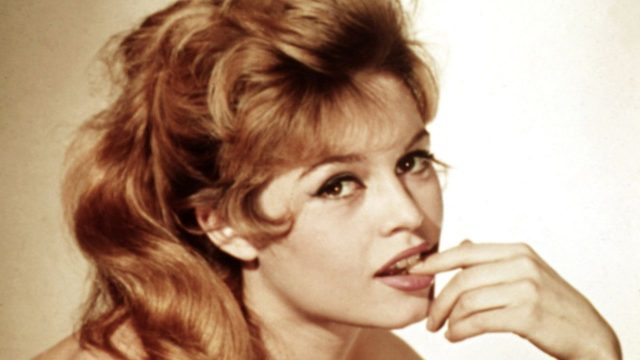
Brigitte Bardot was more than just a screen sex kitten. With her tousled
blond hair and signature pout, the French actress personified her country’s newfound sexual and social liberation through the ’50s and ’60s. And God Created Woman (1956), in which Bardot played a teenager
exulting in her sensuality, shocked censors but became the highest-grossing foreign film of its day and launched a global obsession with French cinema. Simone de Beauvoir proclaimed the actress “the most liberated woman in postwar France,” and Charles de Gaulle chose her as the model of a new sculpture of Marianne, the symbol of the French Republic. But to Bardot—who would retire at 39 and later become known for animal rights activism and anti-Muslim bigotry—her heyday felt like anything but freedom. “My life is like a big prison,” she said in 1960. “A pleasant one, but it’s a prison all the same.”
Born Brigitte Anne-Marie Bardot into a very strict, “proper, and prosperous Catholic family” in bourgeois Paris, she was an aspiring ballerina, winning admission to the Paris Conservatory at 13, said The Washington Post. Two years later she’d been hired as a fashion model and quickly caught the eye of aspiring director Roger Vadim, who “became her Svengali” and, once she turned 18, her husband. (He was 24.) Despite not speaking English, Bardot landed her first lead role as a temptress in a 1955 British comedy called Doctor at Sea. After the breakthrough success of And God Created Woman, in which she sunbathes nude, she was generally cast as a sexpot, said The Hollywood Reporter. But at least two “fiery performances” proved her range: The Truth (1960), a riveting courtroom drama, and Jean-Luc Godard’s Contempt (1963), “now considered to be a New Wave classic.”
Bardot suffered through bouts of suicidal depression and the “constant, wild harassment” of the paparazzi, said The Guardian. She quit acting in 1973, and on the grounds of her Saint-Tropez villa, she amassed dozens of rescue animals as she campaigned for animal welfare. Her repulsion at halal methods of slaughter led her to condemn the “Islamization” of France by “cruel and barbaric invaders,” and she was convicted six times of inciting racial hatred. She eventually married a bigwig in the far-right National Front party. In her final years, Bardot confessed to disliking all
people, not just Muslims. “Humans have hurt me. Deeply,” she wrote in a 2018 memoir. “It is only with animals, with nature, that I found peace.”
The actress retired from cinema at 39, and later become known for animal rights activism and anti-Muslim bigotry