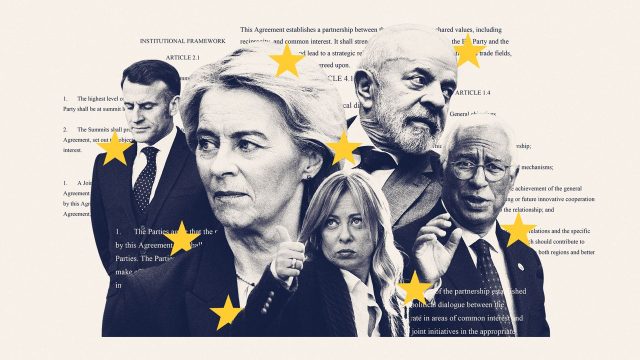
Following nearly a quarter of a century of diplomatic negotiations, European and South American leaders are set to sign a new trade deal.
First broached in 1999, the EU-Mercosur agreement will create the world’s largest free trade area, covering more than 700 million people.
The European Union is the second largest partner of Mercosur – a free trade bloc between Argentina, Brazil, Paraguay and Uruguay – and accounted for almost 17% of Mercosur’s total trade in 2024. Removing tariffs on trade could also save EU exporters more than €4 billion in customs duties each year.
What is in it?
As part of the deal, “Mercosur will remove duties on 91% of EU exports” over 15 years, said RTE. This includes scrapping tariffs, currently 35%, on European cars. The 27% duty on EU wine exports and the 35% on spirits will also be removed.
In return, the EU will “progressively remove duties” for 92% of Mercosur exports over up to 10 years. In addition, the EU will allow 99,000 tonnes more beef from South America, while Mercosur will give the EU a duty-free 30,000-ton quota for cheeses. There will also be protections over recognised brands – such as “Parmigiano Reggiano” – to prevent imitations.
Why bring it in and why now?
Those against the deal – such as European farmers – can “blame” Donald Trump for this “significant” free trade agreement, said the Atlantic Council. Negotiations had stalled after a basic agreement was reached in 2019, with the proposals still facing “serious opposition” from some members of the EU.
However, with the introduction of import- and export-related tariffs from Trump, Europe has been forced to “diversify its trading partners”. Since then, it has brokered an agreement with Indonesia, updated resolutions with Mexico, and has progressed with an EU-India trade deal.
The blossoming relationship between Europe and South America comes at a time when countries in both continents are “looking for more predictability”, said Politico. As Trump “doubles down on tariffing the world”, and with the capture of President Maduro from Venezuela, he is showing a clear interest in that part of the world.
From Brussels’ perspective, this step is a “major geopolitical win”, especially when taking into account China’s “rising share in trade and influence” in Latin America.
Why has it been controversial?
Support within Europe was far from unanimous. France, Poland, Austria, Ireland and Hungary have all expressed their opposition to the agreement. For an EU proposal to be blocked, at least four member states must vote against it, and their combined population must represent more than 35% of the total EU population. To achieve this, the opponents required the support of Italy, who eventually voted in favour of the deal.
For months, European farmers have staged “violent demonstrations” against the deal, said the Financial Times. In recent weeks, tractors have circled the Arc de Triomphe in Paris, milk was poured on the streets of Milan, and since the deal was confirmed, there have been large-scale protests in Ireland, Poland and Belgium.
In the final negotiations, the EU was forced to offer “several concessions” to farmers and “agricultural powerhouses” such as Italy to secure the deal. The European Commission promised an extra €45 billion to farmers in a new seven-year budget from 2028, and agreed safeguards to prevent market disruption from South American imports.
Who are the winners and losers?
Italy’s Prime Minister Giorgia Meloni has added “yet another laurel in Rome’s crown”, said Politico. She “saw which way the political winds were blowing and skilfully extracted last-minute concessions for Italian farmers after threatening to throw her weight behind French opposition to the deal”.
Despite announcing concessions to farmers, European Commission President Ursula von der Leyen has “bent over backwards to accommodate the demands of the sceptics” and build her majority. She has turned a bloc that has become a “lumbering dinosaur” and “consistently outmanoeuvred by the US and China” into a promising trading proposition. “Expect a victory lap next week.”
For von der Leyen and Brazil’s President Luiz Inácio Lula da Silva, the agreement will “signal independence from the world’s two largest economies”, and show that “broad multilateral deals remain possible in a global order upended by Donald Trump”, said the Buenos Aires Times.
Despite potential harm to its manufacturing industry, the agreement will boost Argentina’s agricultural sector, “deepening a dynamic” of the country exporting primary goods, said the Buenos Aires Herald.
France has not come out of it so well, with Emmanuel Macron in particular “effectively sidelined” during negotiations, said Euronews. For a country “mired in political turmoil”, the president has not been able to control its “waning influence” on the continent. The union’s second-largest member has become “paralysed by political fragmentation and partisan infighting”, and has failed to “assemble a blocking minority”.
Will it be worth it?
German Chancellor Friedrich Merz called the EU-Mercosur agreement a “milestone in European trade policy” and a “strong signal of our strategic sovereignty and ability to act”.
But despite being “diplomatically significant”, the Mercosur deal “will provide little boost to Europe’s economies”, said The Times.
It is estimated that EU exports to Mercosur will grow by almost €50 billion by 2040 according to the European Commission. In return Mercosur exports will in turn grow by up to €9 billion. However, this constitutes a “tiny” improvement, raising the EU’s growth by only 0.05%.
Despite opposition from France and Ireland among others, the ‘significant’ agreement with the South American bloc is set to finally go ahead