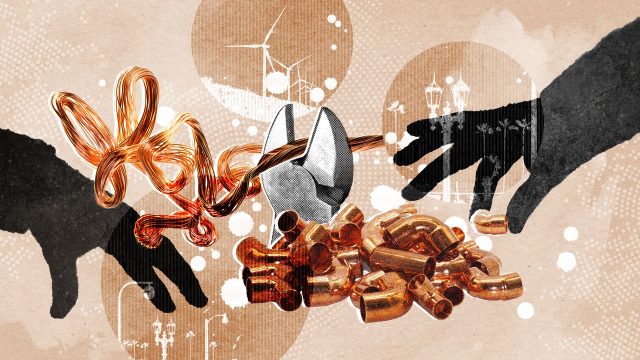
Copper theft may not be the most glamorous crime in the world but it is big business.
It has grown to become a “multi-billion problem worldwide”, said Terry Goldsworthy, associate professor in criminal justice and criminology at Bond University, on The Conversation.
More attractive target
Metal theft is nothing new but it’s “on the rise, largely linked to soaring commodity prices”, said Wired.
This is especially true for copper, “a crucial component in everything from solar panels to electric vehicles and computer chips to plumbing parts”, said The Logic.
Having crashed nearly a decade ago due to factors including a Chinese ban on scrap imports, its price has steadily risen since the pandemic and is now roughly 30% more expensive than it was five years ago. This makes copper a “more attractive target for criminals looking for a quick profit”, said Goldsworthy.
A 2022 systematic review revealed a direct correlation between rising copper prices and an increase in copper theft. And, unlike many other scrap metals, copper “can be recycled again and again, without degrading in the process”.
Huge haul for criminal gangs
A key target in recent years has been copper cabling, even if “the disruption caused is often totally disproportionate to the face value of the stolen material”, said Wired. These are the “conduits that keep people connected, the infrastructure that civilisation depends on” and “as the world electrifies”, this form of theft is getting “ever more serious”.
Take the UK, where the theft of electric vehicle charging cables has exploded in the last two years. “Much like Britain’s shoplifting epidemic, the thefts are widely believed to be linked to organised crime, with the copper from the stolen cables later sold to scrap dealers”, said The Telegraph.
It’s a similar story with the recent spate of copper thefts at England’s onshore windfarms. “From a risk versus reward calculation, stealing copper from a windfarm will be a lot more attractive than dealing drugs, for example. Stealing copper does not come with a class-A penalty,” a source close to the affected windfarm owners told The Guardian.
The profit from each copper cable stolen may be relatively minor but taken together it represents a huge haul for criminal gangs. A 2024 report from the all-party parliamentary group (APPG) on metal, stone and heritage crime found metal theft was costing the UK economy around £480 million a year.
Like playing Whac-a-Mole
Law enforcement agencies often lack the means and resources to act against this growing market for stolen copper. The APPG report showed sentencing guidelines and prosecution rates were not a sufficient disincentive to criminals, with only 229 prosecutions between 2018 and 2022 for scrap metal dealer offences.
“Problems were compounded by the lack of any single body with ownership and oversight of the Scrap Metal Dealers Act 2013,” said Materials Recycling World.
The problem, said The Logic, is that stopping copper theft “is a little like playing Whac-a-Mole”. That is why some forces have turned to predictive policing, using analytics to try to guess where metal thieves will strike next. Todd Foreman, director of law enforcement outreach at the Institute of Scrap Recycling Industries, uses data analysis to help criminologists anticipate future hot spots of metal-related crime.
Rising prices and easy access makes the metal a ‘more attractive target for criminals looking for a quick profit’