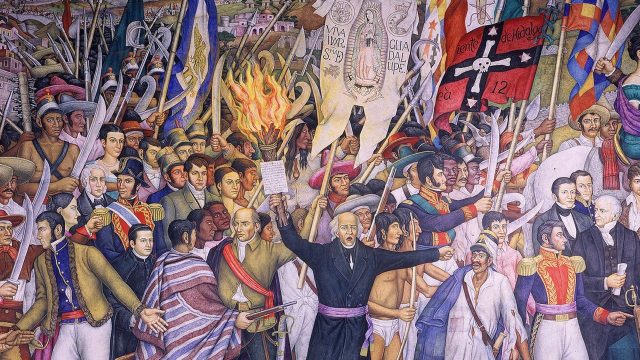
‘Mexico: A 500-Year History’ by Paul Gillingham
“Mexico and Mexicans have had just about enough of being analyzed,” said Camilla Townsend in The Washington Post, and historian Paul Gillingham fully understands that. His “breathtaking” new book “reveals Mexican history in all its kaleidoscopic complexity,” and though his account does nothing to downplay the upheavals the nation has endured, it centers the successes rather than the struggles of the land’s people while emphasizing their remarkable diversity. Fittingly, his account starts not with conquistador Hernán Cortés toppling the Aztec empire in 1521 but with a poor Spaniard, Gonzalo Guerrero, who survived a shipwreck several years earlier, chose to live among the Maya as a Maya, and fathered three children who can fairly be labeled the first Mexicans. Though Gillingham’s account runs 700 pages, he “writes with sparkling verve,” and “every one of those pages is worth reading.”
For 300 years, the nation that Cortés christened New Spain was “the glittering jewel in the Spanish crown,” said Gerard Helferich in The Wall Street Journal. It encompassed most of the land west of the Mississippi in today’s U.S., its corn fed a global population boom, and its silver helped double Europe’s money supply. But the wealth was concentrated among a small elite, and an 1810 uprising sparked a war that led to Mexico’s independence in 1821 and the establishment of a republic. Sixty years of instability followed, amid which Mexico ceded more than half its territory to the U.S. Leaders came and went, including the French-appointed emperor Maximilian I, the reformer Benito Juárez, and the military dictator Porfirio Díaz, before the 1910–20 Mexican Revolution launched a new century characterized by both growth and repression. Gillingham’s “vibrant and thought-provoking account” captures it all.
But while he chronicles each shift in power, “this is not where the author’s heart lies,” said Álvaro Enrigue in The New York Times. Gillingham forever calls attention to the ground-level experiences of the communities that compose Mexico because he judges the country to be the first on Earth where so many different groups—beginning with the land’s Indigenous people, Spanish settlers, and the many enslaved Africans and Asians who arrived during Spain’s rule—came together and created an enduring nation. “At times, as Gillingham makes clear, democracy of the Mexican variety has outshined the American kind,” managing to seat the hemisphere’s first Black president in 1829 and its first Indigenous president in 1858. More importantly, “he understands, as Mexicans do, that it is a miracle that the country exists at all,” especially given how often it has been the subject of tugs of war between other empires.
‘When Caesar Was King: How Sid Caesar Reinvented American Comedy’ by David Margolick
“Sid Caesar did not look like a comic,” said David Denby in The New Yorker. In the early 1950s, when his fame peaked, the TV pioneer “might have passed for a lawyer or a department store manager.” But unlike other funny-men of the era, who told jokes and did shtick, Caesar “could become almost anything, throwing himself into roles with shattering power.” David Margolick’s new book about Caesar and the early days of television captures the performer’s special talent and lasting influence, yet Margolick distinguishes himself as “an ideal cultural historian” because he’s “curious and loving enough to incorporate every telling detail but too wary of nostalgia to slip into ballyhoo.” The Sid Caesar who emerges in this telling is “both funny and tragic”—“a revolutionary talent whose particular success may have been possible only in a brand-new medium.”
Though few people under 70 remember Caesar, “his comedic DNA is everywhere,” said Ann Levin in The Forward. A son of Jewish immigrants and a product of the Catskills comedy circuit, he specialized in sketch comedy, and despite being introverted offstage, “he could bring down the house by impersonating everything from an imperious German general to a fly crawling on a piece of feta cheese.” In 1950, NBC awarded him with his own live 90-minute Saturday-night sketch show. Your Show of Shows spoofed contemporary TV and film, dazzled critics, and drew 25 million viewers a week at its apex. The show’s legendary writers room was populated by future comedy luminaries Mel Brooks, Carl Reiner, and Neil Simon.
“What wasn’t funny was Caesar’s own life,” said Joseph Epstein in The Wall Street Journal. A stormy drinker, he never found a true second act after his shortened sketch show, Caesar’s Hour, was canceled in 1957, having been eclipsed by Lawrence Welk’s anodyne music-variety program. Margolick “brilliantly summarizes Sid Caesar’s fall,” describing him as too sophisticated to perform mainstream comedy and too difficult and stubborn to find an alternate path. A mere 11 years after his death, he is barely known, and yet “the world without him is a less amusing place.”
A chronicle of Mexico’s shifts in power and how Sid Caesar shaped the early days of television