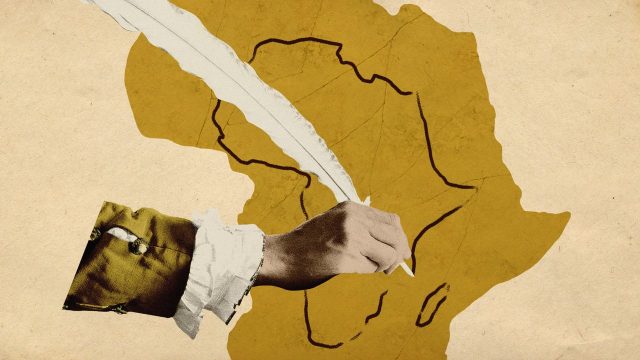
“On classroom walls from Lagos to London”, the standard map of the world depicts an “inflated Britain at the centre” and a dramatically “shrunken Africa”, said The Times.
But this could soon change. The African Union has thrown its weight behind a “Correct the Map” campaign, calling for an end to the use of the standard Mercator map in favour of one that accurately reflects the scale of the world’s second-largest continent.
“It might seem to be just a map,” said Selma Haddadi, of the African Union Commission, “but in reality it is not.”
‘World’s longest misinformation campaign’
Created in 1569 by Flemish geographer Gerardus Mercator, the world map commonly used today “did a good job” of depicting the general shape of countries, said USA Today.
However, when trying to map a spherical planet on to a flat piece of paper, “something’s got to give”. In the case of the Mercator map and its successors, “what gives is the size of places near the poles”, which become distended compared to land masses nearer the Equator.
The result? A map that “disproportionately” enlarges the “rich and powerful regions of the world”, said Al Jazeera. In the Mercator projection, Europe appears to be bigger than South America, when it’s “actually half its size”, while Greenland is “shown to be relatively the same size as Africa” when it could fit inside the continent “14 times over”.
“It’s the world’s longest misinformation and disinformation campaign,” Moky Makura, executive director of Africa No Filter, told Sky News. “It just simply has to stop.”
Haddadi, from the African Union Commission, said the Mercator map creates a “false impression” of Africa as “marginal”, despite its size. These “stereotypes” then trickle down into “media, education and policy”.
Advocacy group Speak Up Africa argues that Mercator impacts “Africans’ identity and pride”, especially children who “encounter it early in school”.
‘Colonial distortion’
Calls for alternative maps have formed part of wider efforts to challenge Western-centred representations in education for decades. After years of “colonial distortion”, hundreds of schools in Boston received a “very different” map that sought to actively “correct the Western world’s distorted view of its own size”, said The Independent in 2017.
Several African nations have begun replacing Mercator maps in schools with alternatives. The current campaign is “actively working” on promoting a curriculum across the continent that uses the so-called Equal Earth map projection, which “tries to reflect countries’ true sizes”, said Reuters.
The Mercator projection is still “widely used” in “schools and tech companies” alike, but there has been progress towards adopting a more accurate map. The World Bank says it is “phasing out” the Mercator map, while the desktop version of Google Maps switched “to a 3D globe view in 2018, though users can still switch back to the Mercator if they prefer” and it remains the default view on the mobile app.
African Union joins calls to ditch ‘colonial distortion’ and portray countries at more accurate size