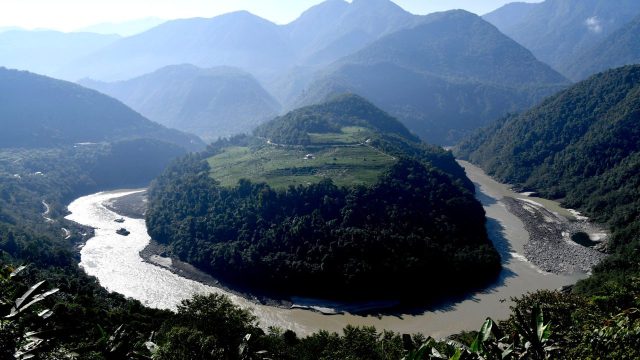
China has begun construction on the world’s largest hydropower dam, a project so massive that Premier Li Qiang called it the “project of the century.” But the dam could also create a big problem for China’s next-door neighbor, India.
The Motuo Hydropower Station on the Yarlung Tsangpo river in Tibet could eventually “generate three times more energy” than current champion Three Gorges dam, said the BBC. But the $167 billion project has “attracted criticism” because of its potential to affect “millions of Indians and Bangladeshis” living downstream. The new dam gives China a “chokehold on India’s economy,” said the Lowy Institute in a 2020 report. That is an “existential threat” to India, said Pema Khandu, chief minister of the state of Arunachal Pradesh. China could use the hydropower station “as a sort of ‘water bomb.'”
The waterway is a “lifeline for millions” in India and Bangladesh, where it provides “irrigation, hydropower and drinking water,” said Reuters. (The river is known as the Brahmaputra in those countries.) That heightens the risk of the dam project as a possible flashpoint: India and China “fought a border war in this region” during the 1960s. Beijing’s “lack of transparency” about the new project has raised new fears that China would “cut off water in another conflict.”
What did the commentators say?
China’s “mega-dam” project could “reshape Asia,” said Riley Callanan at GZERO. There are benefits: The hydropower station is expected to produce 60 gigawatts of electricity, “ten times as much” as the Grand Coulee dam in Washington state. That could “stimulate the Chinese economy.” The danger is that the project will spark a water arms race of sorts, with China and India engaging in “competitive dam-building throughout the Himalayas.” It would not be the first time that water has been weaponized. India suspended a decades-old water-sharing treaty with Pakistan during armed skirmishes in May. The new dam adds “another layer of complexity” to the relationships between regional “neighbors competing for the same resources.”
The dam is “less a beacon of progress” and more a “harbinger of cascading crises,” said Khedroob Thondup at The Sunday Guardian in India. The dangers are more than geopolitical. The dam is located in one of the “most seismically active zones on Earth,” not far from the location of the 1950 Assam-Tibet earthquake that killed an estimated 4,800 people. While “China’s pursuit of renewable energy is commendable,” the world’s climate future should not be “built on fault lines — literal and political.”
What next?
India may start its own dam building, said Bloomberg. Officials are “working with local communities to build support” for a new dam downstream of the Tibet project. China has “already started their dam construction, and we cannot sit idle,” said Ojing Tasing, a minister in the state government. Chinese observers see the new dam as a statement of their country’s ambitions, said the South China Morning Post. The Motuo Hydropower Station is a “strategic pivot that could power both the nation and its markets into a new era,” said Hong Hao, chief investment officer at Lotus Asset Management.
River is a ‘lifeline for millions’ across Asia