
Alicia Grullón (Hyperallergic, 10 June 2025) reviews Nuyorican and Diasporican Visual Art: A Critical Anthology(2025), edited by Arlene Dávila and Yasmin Ramirez. Grullón describes it as “a new book [that] pulses with artistic forms by Puerto Rican artists born of necessity, urgency, collaboration, and activism.” [Also see our previous post New Book: Nuyorican and Diasporican Visual Art.]
As a conceptual artist myself, I instinctively approached Nuyorican and Diasporican Visual Art: A Critical Anthology(2025) with an eagerness to explore the visual storytelling within. I wanted to know: What is represented here? Is this anthology mostly painting and sculpture, or does it delve into photography, community, and performance art — mediums that often go underrepresented in traditional anthologies? The answer was immediate and powerful: This book does not limit itself. It expands. It pulses with artistic forms born of necessity, urgency, collaboration, and activism. Spanning painting, sculpture, photography, performance, graphic design, and artist books, the volume maps Puerto Rican visual expression alongside music, poetry, and street activism. It is, in many ways, a visual archive of liberation.
Edited by Arlene Dávila and Yasmin Ramirez, this impeccably researched and deeply needed anthology sets the record straight — not only by spotlighting Puerto Rican artists living in cities like New York, Chicago, Philadelphia, and Orlando, such as Rafael Ferrer, Candida Alvarez, Luis “Suave” Gonzalez, Ivelisse Jiménez, and Pepón Osorio, but by documenting their central role in shaping groundbreaking 20th-century postmodern and contemporary art in the United States. Nuyorican artists employed strategies that reclaimed a sense of urgency and spontaneous action, utilizing multiple media and interdisciplinary approaches. They dismantled traditional forms and embraced experimentation, merging performance, conceptualism, and political critique. Not only was the work a reaction to institutional norms, but it was also a call to reimagine the role of art in an increasingly fractured world.
These artists have long operated outside the traditional art historical canon, left out not for lack of talent or impact, but because they refuse to conform to narrow definitions of “Latin American Art” or US standards that are deeply rooted in racialized exclusion, including what the editors call the “archival methodologies” of academia, art institutions, and libraries that struggle to comprehend the complexities of diasporic identity. The book doesn’t beg for inclusion into that canon, but rather indicts it by asking why institutions remain so attached to their definitions of contemporary art and why these works are not already foundational to contemporary art history. Its editors and contributors do not seek permission; they assert that the work has always been here to be included. As a result, the book reframes art history itself to account for the multidimensionality of Latinx art, from Puerto Rican to Central American and Dominican diasporas — an especially urgent task in 2025, in a climate of book bannings and the steady erosion of cultural institutions.
A central quote opens the second chapter, drawn from Marta Moreno Vega’s 1993 essay “The Purposeful Underdevelopment of Latino and Other Communities of Color.” She writes: “In the late sixties and seventies our communities duplicated what the cimarrones (runaway enslaved people) did during colonization …. Collectively we defined, articulated and insisted upon our fair share of resources, our right to our own culture and right to self-determination.”
This quote captures the book’s essence: a sustained resistance against erasure. Vega’s words remind us that the fight for visibility is also a fight for cultural and political sovereignty. These artists were never simply producing work in a vacuum. They were creating through and against structures of abandonment and systemic violence, building cultural spaces where none were afforded. Nuyorican and Diasporican Visual Art is an excellent primer, in particular, of those alternative art spaces that emerged in Loisaida (the Lower East Side) from the 1970s to the 1990s, run by artists, neighbors, performers, activists, and organizers. The activation of these spaces emerged, in part, as a response to the radical activism of the 1960s and 1970s, fueled by the civil rights and anti-war movements. [. . .]
For full article, see https://hyperallergic.com/1019108/a-visual-archive-of-diasporican-liberation/
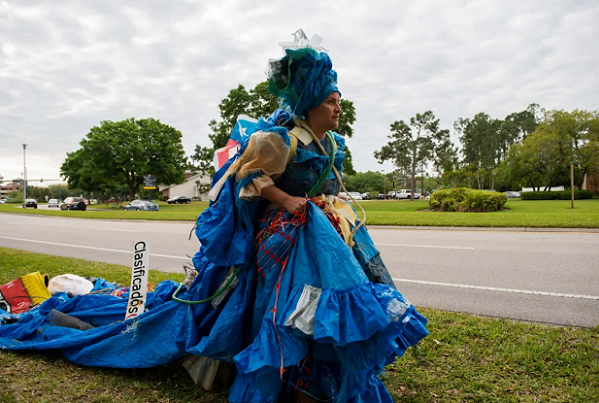
[Shown above, photo by Dominic DiPaolo (courtesy the artist, for Hyperallergic): Wanda Raimundi-Ortiz during her procession, “Exodus/Pilgrimage,” in downtown Orlando (2019).]
Alicia Grullón (Hyperallergic, 10 June 2025) reviews Nuyorican and Diasporican Visual Art: A Critical Anthology(2025), edited by Arlene Dávila and Yasmin Ramirez. Grullón describes it as “a new book [that] pulses with artistic forms by Puerto Rican artists born of necessity, urgency, collaboration, and activism.” [Also see our previous post New Book: Nuyorican and Diasporican