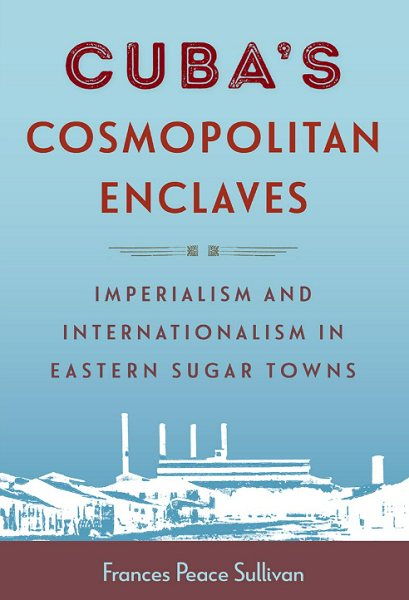

Examining how northeastern Cuba became a hub of international solidarity and transnational movements in the 1920s and 1930s, Frances Peace Sullivan’s Cuba’s Cosmopolitan Enclaves: Imperialism and Internationalism in Eastern Sugar Town (University of Florida Press) will be “on the shelves” on May 27, 2025.
Jorge L. Giovannetti-Torres (author of Black British Migrants in Cuba: Race, Labor, and Empire in the Twentieth-Century Caribbean, 1898-1948) describes it as “An exemplary transnational history distinguished by its simultaneous treatment of multiple and diverse sociological actors in their complex sociopolitical engagements, working-class alliances, and pan-African solidarities. [. . .]”
This book explores how a region in Cuba that was widely known as a site of labor subjugation became a hub of international solidarity in the 1920s and 1930s. In the early twentieth century, United States agricultural companies like the United Fruit Company established sugar export operations in Cuba’s Oriente Province, creating a zone of economic imperialism. These early multinational corporations recruited Afro-Caribbean laborers from surrounding islands, aiming to create closed, self-sufficient plantation complexes.
However, as Frances Peace Sullivan shows in Cuba’s Cosmopolitan Enclaves, the influx of foreign capital led to the development of diverse, vibrant communities in these company towns. Drawing on archival sources in Cuba, the US, Russia, and the UK, Sullivan demonstrates how immigrant workers joined local Cubans in movements for radical transnational solidarity. In the interwar years, northeastern Cuba became a center of Garveyite Pan-Africanism, global communism, and antifascist support for Republican Spain. In 1933, the region attracted the world’s attention when workers seized sugar mills in a revolutionary strike.
Placing northeastern Cuba at the heart of the history of interwar internationalism, Sullivan shows how Oriente emerged as a focal point for visions of resistance. Cuba’s Cosmopolitan Enclaves reveals how workers seized pathways created by imperialist companies and used them to advance their own goals. In this focused study, Sullivan offers a detailed portrait of how ordinary people became leaders in transnational radicalism.
20% off with code 31SAVE with order at upress.ufl.edu
For more information, see https://upf.com/book.asp?id=9781683405115
Examining how northeastern Cuba became a hub of international solidarity and transnational movements in the 1920s and 1930s, Frances Peace Sullivan’s Cuba’s Cosmopolitan Enclaves: Imperialism and Internationalism in Eastern Sugar Town (University of Florida Press) will be “on the shelves” on May 27, 2025. Jorge L. Giovannetti-Torres (author of Black British Migrants in Cuba: Race,