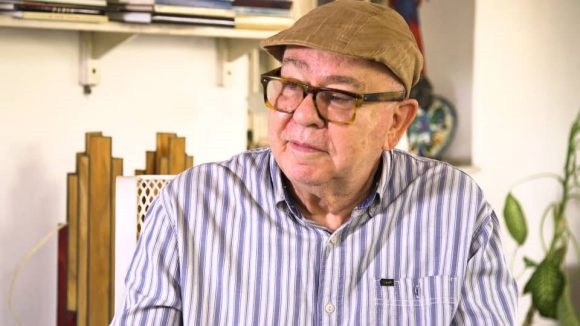

Our warmest congratulations to Cuban writer and ethnologist Miguel Barnet, who recently received the 2023 National Cultural Heritage Award for Lifelong Work, a well-deserved distinction that recognizes his extensive work in the research and the preservation of cultural values. According to the jury, Barnet received the award for his dedication to the rescue and promotion of Cuba’s heritage and the most intrinsic elements of the nation’s culture. [On a personal note, I am truly happy for him. Barnet is an extremely generous scholar who does not hesitate to share his wealth of knowledge and to help others on their own paths of intellectual exploration, as I learned at the beginning of my own journey, a long time ago. I will forever be grateful for his kind and welcoming manner, and to Emilio Jorge Rodríguez, who introduced us.]
In “Miguel Barnet: Premio Patrimonio por la Obra de Toda la Vida” (Cubadebate) Cuban writer, educator, and former Minister of Culture, Abel Prieto Jiménez, writes a personal note of congratulations with emphasis on Barnet’s many achievements:
It was greatly accurate of the jury to choose Miguel Barnet for this transcendent Award.
Beyond the work he has done for our Heritage from the Fernando Ortiz Foundation, from the La Fuente Viva collection, from UNESCO, from the International Slave Route Committee, beyond the support he has given to the Castillo San Severino Museum, the Timbalaye Project, and all the initiatives aimed at safeguarding the material and intangible heritage of the nation, it must be said that all of Miguel’s work, absolutely all of it, has been aimed at saving and promoting the historical and cultural memory of Cuba.
Miguel’s vocation for our [national] memory is not something collateral, it is not an addition to his intellectual work, it is not another attribute, quite the opposite: it is something central, decisive, in his way of seeing life, culture, and the country.
Apart from being a dazzling fictionalized testimony, a kind of great epic and eternal poem, what is Biografía de un cimarrón? It is, of course, as we all know, one of the most acute and brilliant efforts to fix in the memory of this country essential passages and figures of our formation and our growth as a nation.
And aren’t Canción de Rachel, Gallego, La vida real, and all of his work very similar endeavors of what we could call his “ethnographic narrative”?
What about Oficio de ángel, which is a much more personal story, with an autobiographical perspective? Doesn’t it also explore what we Cubans are as a people, our roots, the nutrients of that “living source” that is Cuban national identity?
His essays, obviously, are very important, because they give us a much more structured answer to the questions that come to us from his stories.
It is not possible to decipher the keys to being Cuban without Miguel’s exceptional work. He continued the mission of Fernando Ortiz, his teacher, his tutelary angel, his guardian angel; but, thanks to poetry, thanks to another angel, “el ángel de la jiribilla”, and to Miguel’s constant rejection of all sterilizing positivism, of all rigid academicism, he managed to open new paths, new perspectives, new directions.
At the same time, in an oblique but deeply penetrating way, like a mischievous companion to narrative and essay writing, Miguel’s poetry has been visiting us constantly and telling us about ourselves, about our destiny, about our origins, about that what Fernando Ortiz called Cubanía.
As a great poet, as a thinker, as a chronicler, as a storyteller, Miguel has contributed substantially to the accumulation that defines our culture, our national being, our heritage.
Miguel has received all possible recognition in Cuba and other countries in America and Europe; but I’m sure this specific Award makes him particularly happy, because it underlines one of the most notable features of his condition as a great humanist intellectual.
In this world in which the heritage of humanism is scorned, in which amnesia and frivolity are encouraged, and where the instant, the present, the flash without resonance are all worshipped, we have the privilege of having among us Miguel Barnet, a Creator—with capital letter—one hundred percent Fidelista, anti-imperialist, anti-colonial, exponent of Martí, and holder of all the keys to understanding and loving Cuba.
Congratulations, dear Miguel.
Translated by Ivette Romero. For full article, see http://www.cubadebate.cu/opinion/2024/01/09/miguel-barnet-premio-patrimonio-por-la-obra-de-toda-la-vida/
Our warmest congratulations to Cuban writer and ethnologist Miguel Barnet, who recently received the 2023 National Cultural Heritage Award for Lifelong Work, a well-deserved distinction that recognizes his extensive work in the research and the preservation of cultural values. According to the jury, Barnet received the award for his dedication to the rescue and promotion