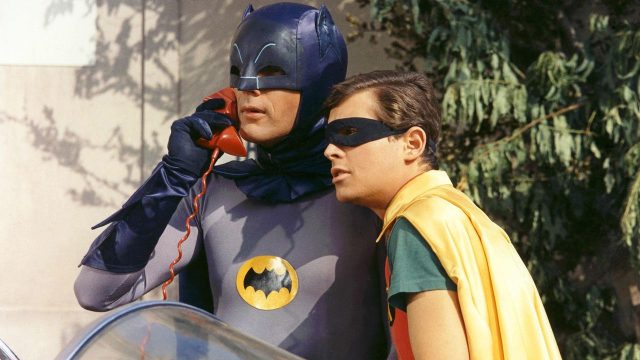
Critics are sometimes contemptuous of the way superhero entertainment has been embraced by adults, who should presumably be making their way through the Booker Prize longlist. But the best of these good-versus-evil narratives, like in these eight series, can connect one generation to the next, introducing kids to the world’s complexity and keeping grown-ups tethered to the wonder of their childhood selves.
‘Batman’ (1966-1968)
The original ‘Batman’ series is both the first live-action television adaptation of the now-iconic DC Comics character as well as a kind of time capsule that reminds viewers of what the genre can be like when it dispenses with tortured origin stories, brooding anti-heroes and gore. Batman (Adam West) and his sidekick, Robin (Burt Ward), spend 120 breezy, campy episodes fighting crime, and both the humor and the tone hold up surprisingly well for a show that debuted 60 years ago. Its villain-of-the-week structure introduces viewers to characters indelibly associated with the juggernaut franchise, including Catwoman (Julie Newmar) and The Joker (Cesar Romero). This Batman is not only the “most fun, it is also the most subversive and truthful Batman we can hope to ever witness,” said Jack Bernhardt at The Guardian. (Prime Video)
‘Smallville’ (2001-2011)
Before Marvel and DC Comics staged their takeover of Hollywood and before “IP” was synonymous with viability, there was the WB’s “Smallville,” a highly successful slice of network television that helped reinvigorate the genre. “Smallville” is both a reimagining of Superman as well as an origin story, beginning with the 1989 meteor crash that brought him to the titular town and led him to be raised by the Kents before fast-forwarding to the present, with Clark (Tom Welling) as a handsome high schooler beginning to realize he has special powers. Sometimes a young adult drama and sometimes a superhero show, it often finds the “most grounded and least ridiculous take on some of the comic’s stranger material,” said Chancellor Agard, Sydney Bucksbaum and Christian Holub at Entertainment Weekly, before it begins to “embrace the canon more and more” over the course of its ten seasons. (Disney+)
‘Jessica Jones’ (2015-2019)
Arriving just ahead of the #MeToo movement that shook the world, “Jessica Jones” was a superbly timed piece of entertainment that helped give depth and seriousness to the superhero genre that was producing one so-so series after another. “Superhero noir” is ultimately the best way to describe this Marvel series from Netflix. Krysten Ritter plays Jessica Jones, a former superhero battling PTSD and working as a private eye. The terrific Scottish actor David Tennant provides the season 1 villainy as a man able to puppeteer others using his voice. Buoyed by a “strong, clear performance” from Ritter, it’s not an anti-hero narrative but rather a “post-hero story, making it fascinating and unique in a marketplace that doesn’t lack for costumed do-gooders of all types,” said Sam Adams at IndieWire. (Disney+)
‘Daredevil’ (2015-2018)
Charlie Cox (“Adults”) is Matt Murdock, a blind lawyer who, in keeping with the work-around-the-clock ethos of the superhero genre, moonlights as the crime-fighting “Man in Black” at night. In season 1, gangster kingpin Wilson Fisk (Vincent D’Onofrio) frames him for a series of bombings, and the two go toe to toe, with Murdock torn between how to bring Fisk to justice. Elden Henson plays Murdock’s legal partner, Foggy Nelson, who begins the series blissfully unaware of his colleague’s true identity. “Dark, brooding and violent,” the series’ “pulpy style and brutality” make it “dressed for success,” said Variety. A follow-up series, “Daredevil: Born Again” was released to critical acclaim in March 2025. (Disney+)
‘Legion’ (2017-2019)
From “Fargo” creator Noah Hawley, the offbeat “Legion,” loosely located in the X-Men universe, remains beloved by critics even if it never quite found a broad audience during its run. David Haller (Dan Stevens in a tour de force performance) has spent much of his life shuffling between one psychiatric institution after another, and has been led to believe he is schizophrenic. But when he falls for a fellow patient named Syd Barrett (Rachel Keller), who inadvertently swaps bodies with him, he comes to understand that he is actually a mutant. At a kind of sanatorium for mutants run by Dr. Melanie Bird (Jean Smart), he learns to harness his powers and face his trauma. A meditation on mental illness, “Legion” is “no ordinary comic-book show: It’s a head trip, and it’s spectacular,” said James Poniewozik at The New York Times. (Disney+)
‘The Boys’ (2019–)
“The Boys” gleefully goes where no other superhero show has gone. A uniformly sensational ensemble cast is one of the show’s great strengths, including Antony Starr as the insecure, virtually undefeatable “Homelander.” The show’s conflict is between the glossy secretly sociopathic superheroes of Vought International’s The Seven, a carefully curated group of “supes,” and a band of renegade truthers, including Billy Butcher (Karl Urban) and the show’s protagonist, Hughie Campbell (Jack Quaid).
Over the course of its five ultraviolent seasons, “The Boys” gradually merges with America’s unhinged politics, offering both a satire and a critique of the country’s drift into autocracy. A series that “takes gleeful aim at the cultural monopoly of the Marvel machine,” it is “outlandish, pessimistic and brutally funny,” said Doreen St. Félix at The New Yorker. (Prime Video)
‘Watchmen’ (2019)
From the first episode viscerally depicting the Tulsa Massacre of 1921, HBO’s “Watchmen” is the rare television show that feels genuinely unique. Building on the 1986 graphic novel series by Alan Moore and Dave Gibbons, it is presciently set in an alternate present in which police officers wear masks to hide their identities. Angela Abar (Regina King) is a detective codenamed Sister Night who is investigating the murder of Tulsa’s police chief and hunting white supremacist vigilantes in the Seventh Kavalry.
The plot defies a quick summary but involves a massive conspiracy, an omnipotent blue god named Dr. Manhattan (Yahya Abdul-Mateen II) and a reclusive genius named Ozymandias (Jeremy Irons). The series “left me dizzy from its audacity, its delight and its occasional lack of taste,” said Emily St. James at Vox, by using superhero tropes and archetypes to “tell stories about the world we live in today and how unjust it is.” (HBO Max)
‘WandaVision’ (2021)
In “WandaVision,” Disney+ takes two characters from the smash Avengers films, Wanda Maximoff (Elizabeth Olsen) and Vision (Paul Bettany), and places them as husband and wife in the sepia-toned suburb of Westview where they try to keep their identities a secret. Kathryn Hahn is perfectly cast as Agnes, a neighbor who begins to suspect not all is as it seems.
Like the Apple TV+ comedy “The Afterparty,” every episode of “WandaVision” is a pinpoint parody of a different beloved sitcom, from “Bewitched” to “The Brady Bunch.” A series that proves “just how elastic the Marvel brand can be,” creator Jac Schaeffer’s limited series manages to get viewers “so caught up in the sheer energy and commitment” of its ensemble in “loving homages” to classic television, said Alan Sepinwall at Rolling Stone. (Disney+)
From gritty reboots to beloved classics, masked heroes have lit up the small screen for decades